Agriculture, Grains
July 08, 2026
DRY BULK QUARTERLY: South American grain demand drives rise in Atlantic Panamax rates

By Sabiha Makda
Editor:
HIGHLIGHTS
Q2 KMAX9 Index average 65% higher YOY
ECSA-Far East shipments surge 134% in Q2 2026
North Atlantic mineral trade adds support
The Atlantic Panamax market defied expectations in the second quarter of 2026, as it showcased its volatility and resilience, tightening, softening and finding support again.
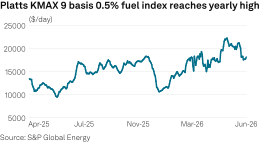
The Platts KMAX9 Index -- a global ton-mile-weighted average of nine Panamax routes – reached a yearly high and averaged $18,933/d in the second quarter, 65% higher than the $11,513/d average in the same period in 2025.
ECSA-to-Far East: Demand hotspot that tightened the market
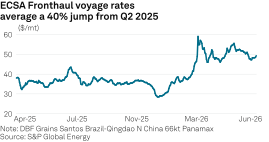
East Coast South America shipments to the Far East became the market's main engine through much of the quarter, as grain flows into Asia kept ships occupied. The result was a sharp year-over-year gain in fronthaul pricing, with the Santos-Qingdao grains fronthaul route for 66,000 metric ton cargoes, assessed by Platts, part of S&P Global Energy, averaging about $50.18/metric ton, 40% higher than the Q2 2025 average of $36/mt.
For owners, it was a welcome stretch of leverage. For charterers, it was a reminder that the Atlantic can tighten quickly when cargo programs gather momentum and available tonnage thins.
"The second quarter [of 2026] was fundamentally driven and not led by the Forward Freight Agreement market. Demand was significantly stronger across both grains and minerals. Some of the larger grain houses were far more willing to put cargo out," said a London-based shipbroker.
"On the other hand, the second quarter of 2025 was sentiment-driven. FFA levels at the time were so cheap and charterers were not willing to pay up, so naturally it led to weaker sentiment."
"Particularly through Q2 of this year, it was more so a case of ECSA being slow to begin with, in terms of levels-wise, but was very busy on the fixing front. As the Pacific started to take off and got really firm, ECSA sat where it was. Recently however, you can now see a major disparity between prompt loading dates and later laycan dates, [with prompter runs holding a premium]," added the London-based shipbroker.
The ECSA-to-Far East corridor was the standout performer and continues to be the lifeline for Panamaxes. Shipments from South America into Far East destinations -- including Japan, Korea, and Taiwan, South China, North China and East China -- gave the market its strongest sense of direction.
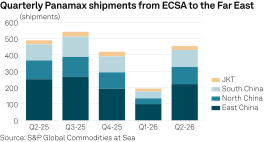
The number of shipments from ECSA to the Far East totaled 454 in Q2 2026, up 134% from 194 shipments in Q1 2026, with China remaining the main buyer throughout the past year, according to S&P Global Commodities at Sea data.
As cargo demand built, the supply of prompt Panamax tonnage became more competitive, particularly for owners positioned near the right loading areas.
"The main trend -- especially during May and early June -- was that the Pacific was doing really good, and so there were limited ballasting vessels heading from the Pacific to ECSA. Most owners were content with staying in the East and so were doing a lot of Australian and Pacific voyages," said a Greece-based shipbroker.
Although geopolitical impacts were limited, hopes for progress in US-Iran talks prompted a modest correction in voyage freight rates by mid-June. Lower bunkering fuel costs in several ports reduced overall voyage expenses.
"At the time, bunkers started correcting and a lot of people held back amid the uncertainty," added the Greece-based shipbroker.
"There are some trades with Panamax and Kamsarmaxes going into the Persian Gulf, but the loss of those volumes of trade was less significant than the percentage of the Panamax fleet that was inaccessible to the west of the Persian Gulf," said a Greece-based analyst.
North Atlantic: A second support beam for Panamax rates
Mineral trade from the North Atlantic to Europe mirrored the same dramatic year-over-year rate increase as the ECSA fronthaul market, helping hold the wider Atlantic structure together.
For Panamax owners, this matters. A market driven only by one long-haul grain lane can become vulnerable when that demand fades. But when mineral cargoes, coal movements and grain flows all offer employment at the same time, the basin becomes more resilient.
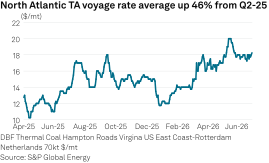
Trans-Atlantic coal rates strengthened toward the end of June, adding another layer of support. The 70,000 mt Hampton Roads-Rotterdam coal trans-Atlantic route, assessed by Platts, averaged about $17.70/mt, 46% higher than the Q2 2025 average of $12.11/mt.
"The North Atlantic market reacted to mostly the supply side of things, and on changes that occurred on the supply of available tonnage," said the Greece-based analyst.
"Ships were redelivering in the Western Mediterranean or the Continent, but because there was substantial demand for cargo liftings out of the North Coast of South America, the market experienced many weeks that was left with little tonnage to cover the incremental requirements of the North Atlantic market."
"Q2 for the North Atlantic was relatively bullish. The cargo flow that we had coming out of mineral houses was surprisingly more active than you would normally see in the first half of the year, and especially in the last month, with charterers willing to buy any available tonnage," said the London-based shipbroker.
Outlook suggests cautious optimism for potential Q4 relief
As the market moves into the second half of 2026, the key question for the Atlantic Panamax market is whether ECSA can sustain enough grain momentum to keep fronthaul rates supported, or whether seasonal shifts will return more ships to the Atlantic list.
Much will depend on the pace of South American export programs, Far East buying appetite, coal demand into Europe, Pacific basin activity, and the continuing pull from North Atlantic trades.
Some market participants remain optimistic, reporting that fundamentals remain bullish.
"Everything points towards a slightly more bullish outlook, due to fundamentals and FFA trading, a lot of the large players are willing to cover their positions," said the London-based shipbroker.
Others note that Q3 can be unpredictable, but Q4 may bring some relief as renewed Chinese demand for US soybeans picks up and Black Sea seasonality is expected to return.
