Crude Oil
July 08, 2026
China's weak demand for Brazilian crude drags down delivered cargo prices
Editor:
HIGHLIGHTS
Delivery price for Tupi hits 6-year low
Brazil output jumps 16.9% to 4.3 mil b/d
Refiners shift to Middle East crude supply
Chinese demand for Brazilian crude has weakened, dragging down delivered cargo prices from the Latin American producer as production continues to rise, trading and refining sources told Platts, part of S&P Global Energy, on July 8.
The Platts-assessed delivered Tupi crude differential slumped to a discount of $2.19/b against Asian Dated Brent, DES Qingdao, at the July 3 Asian close, its lowest level in more than six years since May 4, 2020, when it was assessed at minus $2.42/b. The differential later recovered modestly to a $1.70/b discount July 7.
The weakness marks a stark turnaround from April, when delivered Tupi averaged a record premium of $13.25/b and surged to an all-time high of $18.77/b on April 9 amid supply disruptions linked to the closure of the Strait of Hormuz. The April 9 premium was the highest since the assessment was launched on Oct. 1, 2019, Platts data showed.
Cash differentials for Brazilian crude weakened as Chinese demand waned and Middle Eastern crude flows increased following the reopening of the Strait of Hormuz, trading sources said.
Meanwhile, Brazil produced 4.301 million b/d in May, jumping 16.9% from 3.679 million b/d a year ago, the latest data from Brazil's National Petroleum Agency showed.
Pressure has not been limited to Brazilian crude. An oversupplied Atlantic Basin has dragged down differentials for both West African and Latin American grades as suppliers compete to move volumes eastward, leaving August-loading cargoes on a bearish footing as Chinese buyers retreat, Platts previously reported.
"[There is] very little demand from China, coupled with a bit of demand destruction in Asia, [so the] prompt physical market is just sliding," said one market analyst familiar with Brazilian grades.
Most recently, Unipec was heard to have purchased one VLCC-sized cargo of Tupi crude scheduled for September-arrival from Petrobras at a discount of around $2/b against Dated Brent, DES China, according to the traders.
"Medium [crudes competition] is fierce, [for both] sweet and sour [crudes]," an Asian based trader said.
"It will be difficult for other buyers to offset the decline in Chinese procurement," a Singapore-based supplier of Brazilian crude said. "We will have to wait for China's crude imports to recover to more typical levels. As long as buying volumes remain capped, Chinese refiners are likely to prioritize Middle Eastern barrels."
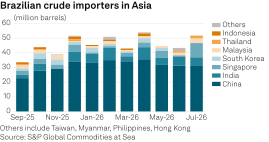
China is the top buyer for Brazilian crude, taking more than 60%-80% of the Latin American cargoes to Asia, according to S&P Global Commodities at Sea.
China's imports reached a record high of 35.6 million barrels (1.19 million b/d) in April and would gradually fall to an estimated 31 million barrels in July, CAS data showed.
Two Singapore-based traders said China usually takes 17 VLCCs of Brazilian crude cargoes per month, but their buying has dropped since June for August-delivery cargo.
Refiners are making procurement plans for September arrivals, which are unlikely to see a jump as they prefer to maintain low runs, according to three sources with state-run refineries.
A London-based analyst projected China's crude imports at 9.5 million b/d in September, below the average 11.06 million b/d in 2025, while the stock build activity was unlikely to resume until Q4.
Amid the limited budget, the three refining sources said that they will take more cargoes from the Middle East while cutting those from Latin America and West Africa, as most of China's refineries were designed to process Middle Eastern crudes.
"We have relied mostly on Brazilian crudes these three months, and the operation and production department has complained that the high nitrogen content leads to facilities' corrosion," said a source with a Guangdong-based refiner.
Brazilian crudes typically carry 2,800-3,300 ppm nitrogen, compared with below 1,000 ppm for many other commonly traded crude grades, according to the refiner.
