Maritime & Shipping, Containers, Dry Freight
July 06, 2026
Cement shipping rates lose steam as scheduling pressure eases into Q3

Editor:
HIGHLIGHTS
Med-Houston cement freight loses momentum
Southeast Europe rates stay capped below $15/mt
Q3 outlook hinges on cargo scheduling urgency
Mediterranean cement freight rates have begun to soften heading into the third quarter of 2026 as cargo scheduling pressure eased, with technical indicators showing reduced buyer urgency across key shipping lanes after a spring rally that lifted rates in some routes but left others capped.
Heading into Q3 2026, the two main Platts West-of-Suez cement freight assessments show a clear split: Med–Houston 40kt strengthened through spring and has now started to soften, while Med–Southeast Europe stayed capped and lacked durable momentum into early July.
With Med–Houston 40kt, the market climbed steadily from January through March and April, moving from the mid/high $20s/mt to the low-to-mid $30s/mt. The momentum signals show that buyers were willing to pay up to cover cargoes during the early part of the move. RSI—Relative Strength Index, a momentum indicator that compares recent gains versus recent losses—remained elevated through much of March and April, reaching the $60s. In simple terms, an elevated RSI suggests price action is being defended, not just chased at the margin.
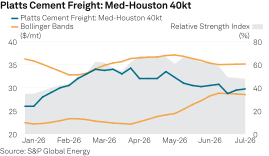
That changed in mid-to-late June. RSI slid from the mid-to-high $50s toward the high $40s, and price also eased off the earlier highs, moving from around $30.75 on June 11 to about $29.75 by July 2.
Bollinger bands—an envelope built from a moving average plus/minus recent volatility—help explain the turn. When price moves away from the upper band and starts working back toward the middle of the range, it usually shows that the earlier urgency has faded. In Med–Houston, the market did not fall sharply, but momentum clearly cooled. For Q3, that points to a market that can stay bid, but is less likely to push higher unless cargo scheduling tightens again.
As for Med–Southeast Europe, this lane stayed much more rangebound. Values spent much of the period around $13.75–$15/mt, with only small step-ups. RSI often stayed below $50 in June and continues to weaken into early July. When RSI remains weak for long stretches, it generally means buyers are not being forced to pay up again and again. They have enough flexibility on timing, routing, or alternatives to avoid locking into a higher-rate environment.
Bollinger behavior supports that reading. Upper-band levels in this series sit well above prevailing prices for much of the period, and the price does not repeatedly reclaim the upper-band area. That is usually what one sees in a market that can be negotiated, not one that is forcing bids.
Fundamentals that matter in Q3: workability, not headlines
The cement freight market's sensitivity to operational factors means that rate direction depends heavily on whether cargoes must move within narrow windows or can be spread across more flexible schedules, with port handling capacity, discharge slots, and producer-buyer coordination all influencing whether freight rates face upward or downward pressure.
In Med–Houston, the spring buildup suggests enough cargoes were being pushed into tighter timing to support firmer rates. The fade into June—RSI easing and price drifting lower—fits a market where that urgency has faded. For Q3, that raises the bar for more upside: the lane needs a new burst of cargo clustering, not just the normal need for cement to move. If producers and buyers can spread demand across more windows, the market can stay supported, but it will likely grind higher rather than break out.
In Med–Southeast Europe, the persistent cap and weak RSI suggest that buyers still have options. That can happen even when there is cement demand, because demand can be met from multiple sources or shifted through different timing and routing. In that environment, freight rates can stay flat to soft: sellers have supply, but they are not able to create urgency for buyers. For Q3 to improve materially in this lane, the market needs a clear trigger—something that reduces substitution and tightens effective loading or discharge capacity.
The Q3 hinge for both lanes is whether cargo programs stay clustered into fewer booking days and fewer effective workable slots, or spread back out once operational friction eases. In practice, watch how quickly shipments get covered at current levels and whether fixtures bunch into tight windows, supporting trend, or stay spread out, which would support mean reversion dynamics.
For Med–Houston, the issue is persistence. The market has improved from the earlier lows, but momentum has cooled. Q3 needs repeat fixtures that hold the improved pricing structure, not one-off tightness. For Med–Southeast Europe, the issue is conversion. Technicals say the lane has not yet seen enough forced demand to move into a higher-rate regime. Without a scheduling or workability trigger, this lane is likely to remain more negotiable than pressured.
