Refined Products, Maritime & Shipping, Fuel Oil, Bunker Fuel
June 30, 2026
INTERVIEW: Gibraltar worried about RED impact on West Med bunker markets

By Max Lin
Editor:
HIGHLIGHTS
RED III shifts bunker trade in Rotterdam
Bunker regulation in Strait may be fragmented
Alternative fuel demand drives transition pace
Gibraltar Port Authority is concerned about the potential impact of the EU's Renewable Energy Directive III on West Mediterranean bunker trades, which could prompt ship operators to refuel at non-European locations while achieving little decarbonization, according to its top official.
Brussels' flagship clean energy legislation has mandated EU-based companies to raise renewable energy supplies to the transport sectors, but each member state could have different definitions on what constitutes low-carbon fuels and define how the rules apply to the international bunker sector during national transposition.
"If the RED III is implemented as written by the European Commission, then the volume will go to the other side of the strait," GPA's chief executive, John Ghio, told Platts in an interview. "Which is beyond ridiculous ... we don't achieve anything because the pollution will not stay on one side."
His remarks came as the bunker hubs around the Strait of Gibraltar could face a more fragmented regulatory landscape. Spain is still evaluating how to transpose the RED III into national law, which would be applied to Algeciras in full and its African enclave of Ceuta, potentially with some exemptions. Morocco's Tanger Med is not subject to the EU jurisdiction.
Gibraltar, a British overseas territory with annual bunker volumes of 4 million metric tons, one of the largest in Europe, will be required to align its regulatory frameworks with the EU's based on a UK-EU deal due to enter provisional application from July 15.
"We have a commitment in our relationship with the EU to have a broad regulatory alignment," Ghio said. "That doesn't mean that all EU legislation will be implemented like-for-like."
Ghio added that Gibraltar's regulation would aim to achieve the RED III's goal of raising low-carbon energy supplies while not exactly following the same mechanism.
Dutch bunker suppliers have imposed a compliance surcharge on their sale prices for conventional, oil-based fuels after the Netherlands began to implement the regulation in January, driving ships to refuel at the nearby Belgian port of Antwerp as Belgium faced delays in transportation.
Rotterdam's total bunker deliveries dropped 25% on the year to 1.81 million mt in the first quarter, according to the Dutch port's local authority, while Port of Antwerp-Bruges reported its bunker sales were up 16% at 2.52 million mt.
"RED III Is fundamentally flawed ... We've seen the delays across Europe in other countries implementing it, and for very valid reasons, because the disruption that RED III is bringing to Rotterdam is crazy," Ghio said.
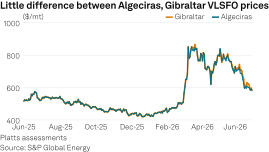
The delivered bunker price for very low sulfur fuel oil in Rotterdam has usually been $20/mt higher than Antwerp so far in 2026, compared with parity last year, according to Platts assessments from S&P Global Energy. The price gap between Gibraltar and Algeciras has traditionally been small, with Gibraltar's price $5/mt higher on June 29.
Energy transition
Most West Mediterranean bunker hubs are geographically close to one another, and bunker suppliers and barges could often operate in more than one port.
Currently, GPA has granted licenses to five active marine fuel providers and 24 bunker barges, of which 12-18 on average would supply from Gibraltar at any given time, according to Ghio.
Some companies have been supplying biobunker fuels from Gibraltar, while three of the barges are designed to refuel ships with LNG. But the CEO said the port authority did not plan to set arbitrary supply targets for alternative fuels.
"Ultimately, it's all driven by demand," Ghio said. "We can put out targets. But unless the receiving vessels are transitioning to the new fuels, they are artificial targets."
The CEO said GPA would prefer to establish a transparent regulatory framework for alternative fuel supplies rather than provide discounts in port fees for ships using such fuels, which he described as "a token measure."
"If you look at what the port fees are compared to what the bunker fuel bill is, we're talking about marginal fees," Ghio said.
A mid-sized ship could be charged several hundreds of US dollars per bunker call in Gibraltar, according to the GPA website. Meanwhile, calculations based on Platts assessments show sustainable fuels could be at least twice as expensive as conventional marine energy, with a price gap of over $700/mt -- and bunker volume could range between 300-1,000 mt per call.
Hormuz
Maritime traffic via the Strait of Hormuz has slightly recovered since Iran and the US reached a 60-day truce in mid-June, but remained far below the level seen before the two went to war, when 20% of global seaborne oil and LNG flows through the waterway.
Ghio said the conflict did not affect bunker volumes in Gibraltar, with a small increase in the number of bunker calls offset by lower bunkering volume per call amid market volatility.
"We haven't seen a negative impact because of our strategic location," the CEO said, adding that more shipments from the US Gulf Coast made up for low volumes from the Persian Gulf.
But if the Hormuz shipping crisis prolongs and worsens, fuel supply issues -- especially those related to residual products -- might eventually emerge, according to Ghio.
"Even in that situation, we are protected by virtue of the critical mass," he added. "I think smaller ports with smaller volumes will have more difficulty accessing products than the big bunker hubs."
