Crude Oil
June 25, 2026
Venezuela's oil production, refining unharmed by June 24 earthquakes
By Eamonn Brennan and Mery Mogollon
Editor:
HIGHLIGHTS
Venezuela oil facilities escape damage
Earthquakes kills 164, prompts emergency
Trump offers US aid to Venezuela
No significant damage has been reported to Venezuela's oil production and refining facilities so far following two earthquakes on June 24, according to sources at state oil company PDVSA. A 7.2 magnitude earthquake was reported as centered about 160 km west of Caracas, followed by a 7.5 magnitude earthquake centered near Moron on the north-central coast.
Venezuelan President Delcy Rodríguez declared a state of emergency. Rodríguez said the Caracas airport was closed due to the earthquakes. On June 25, Jorge Rodríguez, president of the National Assembly, confirmed the deaths of 188 people and a total of 1,520 injured in a statement broadcast by Venezolana de Televisión.
Rodríguez reported that 157 people are missing and that nearly 200 people are trapped under collapsed buildings.
"We are in a desperate race against time to rescue most of them," said Rodríguez.
According to PDVSA sources confirming reports in local media, the Morón Petrochemical Complex -- the second largest in the country -- underwent a preventive safety shutdown following the earthquakes. Local firefighters confirmed a leak in a storage tank, and personnel were ordered not to enter the facilities while safety inspections were underway.
Early June 25, the local fire department reported that the complex had already begun restarting its plants after verifying that there was no major structural damage.
A operator at the El Palito refinery told Platts "everything is normal at the refinery" June 25, but did not provide additional details.
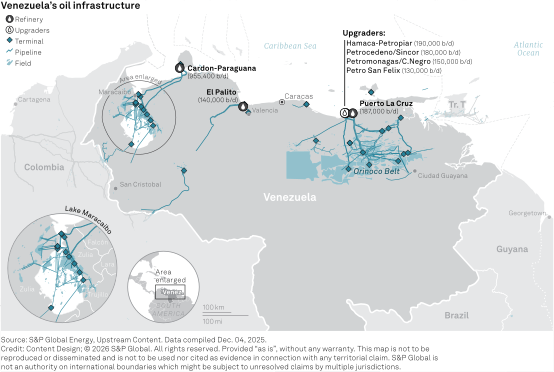
In the Orinoco Belt and the Maracaibo Basin, the main crude oil extraction regions, operations were proceeding normally. Multinational companies with a presence in the country, such as Chevron, issued official statements assuring that their operations remain active and that there have been no infrastructure issues following the earthquakes.
Other key refineries -- including the Paraguana Refining Center and the Puerto La Cruz -- remained operational, according to reports. Work at the Jose terminal, the principal export gateway through which much of Orinoco's upgraded barrels ship, was also unaffected.
Venezuela has roughly 1.3 million b/d of refining capacity. However, those plants were operating well below capacity prior to the earthquakes.
PDVSA sources told Platts, part of S&P Global Energy, that the country's power grid was the biggest concern following a blackout that affected the central region states of Carabobo, Aragua, and Yaracuy.
Production, exports on rise before earthquakes
Six vessels were loaded with crude in Venezuela on June 25, S&P Global Commodities at Sea data showed. Three vessels were loaded at the Jose terminal, and the others at Puerto La Cruz, Puerto Miranda and the Bajo Grande Refinery.
Venezuela's total crude exports have surged in recent months, following the US's Jan. 3 capture of former President Nicolas Maduro, the passage of a new hydrocarbons law, and the relaxation of US sanctions on state-owned producer PDVSA. The US has controlled Venezuela's oil revenues, encouraged US companies to explore development, allowed global commodity trading houses to facilitate exports, and prevented Venezuela from exporting to China, formerly the top buyer of the South American country's crude.
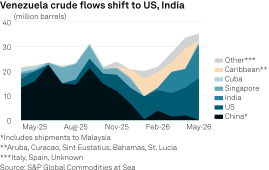
Venezuela's crude exports rose to 35.3 million barrels in May, up from 22.1 million barrels during the same month of 2025, according to CAS data. Exports to the US reached 17.1 million barrels in May, followed by India's 13.5 million barrels.
Venezuela's oil industry produced 3 million b/d in 2008, but output had dropped to around 963,000 b/d by December 2025, just before Maduro was removed from power. The Ministry of Hydrocarbons reported production of around 1.155 million b/d in May. PDVSA has said it aims to reach 1.37 million b/d by the end of 2026.
Venezuela's oil projects require a breakeven price of $64/b, among the highest in South America, but reforms under US oversight could lower costs to $45-50/b within the next few years, according to S&P Global Energy CERA's 2025 Cost of Oil Report. The country's oil reserves are among the largest in the world, with S&P Global CERA analysts estimating fields containing close 364 million barrels of oil equivalent.
US President Donald Trump said the US was ready to aid Venezuela.
"The two major earthquakes that just hit the great people of Venezuela are both massive in scale and have left a devastating number of deaths. The U.S.A. stands ready, willing, and able to help!," Trump said on his Truth Social media platform. "I have instructed all agencies of our government to get ready to move quickly. We will be there for our new and great friends."
US Secretary of State Marco Rubio, in a statement on X, formerly Twitter, said the US State Department was "deploying search and rescue teams, medical resources and humanitarian assistance to Venezuela."
