Crude Oil, Refined Products, LNG, LPG
June 25, 2026
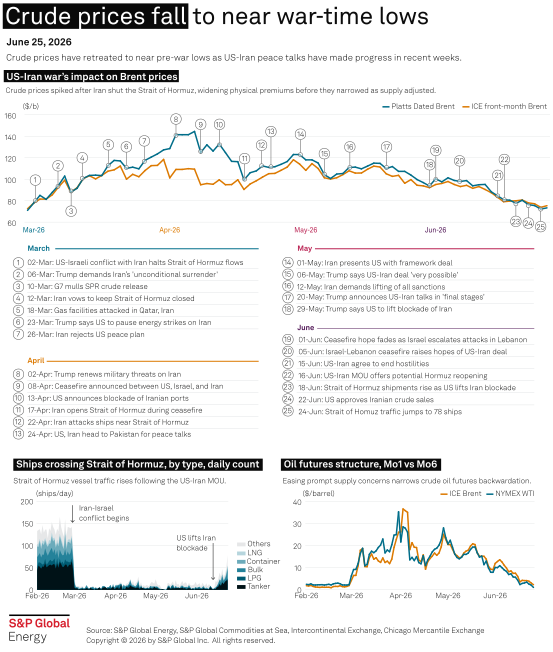
Hormuz traffic rises to near-wartime high of 78 ships; 42% take Oman route
Editor:
HIGHLIGHTS
42% of ships use Oman-managed safe route
Signs show gradual navigation normalization
Iran objects to 'new route' through Hormuz
Traffic through the Strait of Hormuz rose to 78 ships June 24, the highest since the war began in late February, with 42% of these vessels using a route managed by Oman and the International Maritime Organization, S&P Global Commodities at Sea said in a June 25 report.
The safe corridor for transits close to the Omani coast was used by 33 ships, although some ships continued to sail closer to Iran, CAS said in the report. A total of 92 ships were recorded Feb. 28, the first day of the war, according to CAS data. Of the 33 ships that used the Oman route, 25 were exiting the Persian Gulf, CAS said.
"While most outbound vessels had been trapped inside the Gulf since the onset of hostilities, a subset of these movements involved ships that entered more recently and are now exiting, pointing to early signs of normalization and a gradual reestablishment of freedom-of-navigation patterns," CAS said in the report.
However, Iran's Islamic Revolutionary Guard Corps navy objected to the use of a "new route" for passage through Hormuz, without specifying which route it meant, according to a June 25 statement on the army's news website sepahnews.ir.
"Hours ago, without informing or coordinating with the Islamic Republic, a new route has been announced by some authorities for the transit of ships through the Strait of Hormuz. This route is unacceptable and completely perilous," it said. "The only permitted route for passing through the Strait of Hormuz is the same routes announced by the Islamic Republic of Iran. Transit of vessels through those routes is very risky and prohibited. We warn to avoid any transit outside the announced routes."
The IMO said in a June 23 statement that it had received safety guarantees from relevant parties to use the Omani route and a second route administered by Iran to evacuate 11,000 seafarers stranded on ships in the Persian Gulf following the outbreak of the war.
But four tankers made a U-turn after sailing to exit the Strait of Hormuz near or in Omani waters, and one container ship was hit by a projectile on June 25. The IMO suspended the evacuation program on the same day, saying further clarity is needed on the security situation.
The 78 ships June 24 include 22 oil and chemical tankers, 12 product tankers, four LPG ships, and two LNG carriers, according to CAS. Ten crude tankers made the trip, including five VLCCs and three Suezmax ships moving outbound, and two VLCCs crossing inbound into the Persian Gulf, CAS said. Only one of the VLCCs, the Amak, is linked to Iran and has been sanctioned by the US, according to CAS.
The Very Large Gas Carrier Zakher, which entered the Persian Gulf June 22, exited June 24 through the Oman route after loading LPG at Das Island, UAE, and heading for Yantai, China, CAS said.
The VLGC Silvio successfully left the Persian Gulf June 24 after being stranded there since loading LPG at Mesaieed, Qatar, March 2, according to CAS. It was most recently spotted off Fujairah, CAS said. There is only one non-Iran-laden VLGC still in the Persian Gulf—the India-flagged BW Loyalty, after loading at Ras Laffan, Qatar, April 17, according to CAS.
