Refined Products, Crude Oil, Gasoline
June 24, 2026
Trump orders DOJ to look into ‘big oil’ over high US gasoline prices
By Claudia Carpenter and Eamonn Brennan
Editor:
HIGHLIGHTS
Gasoline prices climb 2% over the last week
Trump says gasoline prices need to fall
US President Donald Trump has ordered the Department of Justice to "start looking into" why oil companies are not lowering pump prices despite lower crude feedstock costs.
"Gasoline prices better start going down a lot faster than what I'm seeing," Trump said June 24 on his social media platform, Truth Social. He said crude prices were "dropping like a rock," but that oil companies "are not dropping their price at the pump commensurate." He added that US consumers were being "gouged."
"I have instructed the DOJ to immediately start looking into this," he added.
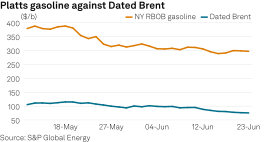
Platts, part of S&P Global Energy, assessed RBOB gasoline by barge in New York at $2.969/gallon June 23, up 2% since June 17, when Iran and the US signed a 60-day ceasefire, while Dated Brent crude was assessed at $75.39/barrel, down 6.1% over the same period.
Regular unleaded gasoline, US West Coast cargo, has climbed about 1% over the same period. The Los Angeles regular RBOB differential to NYMEX August futures fell 2 cents to plus 27 cents/gal June 23, breaking a two-day upswing.
"Our industry shares the goal of delivering relief at the pump and restoring stability to global energy markets," Bethany Williams, a spokesperson for the American Petroleum Institute, said in a statement. "Gasoline prices don't move in lockstep with crude oil, especially during a major global disruption that is still affecting supply, refining, and inventories. Our focus remains on supporting market stability and delivering the energy consumers need."
S&P Global Commodities at Sea data showed about 1.45 million barrels of gasoline were in transit to California aboard six vessels. The Port of San Francisco is set to receive the bulk of the product (591,300 barrels), followed by the Port of Long Beach (452,600 barrels), Port Stockton (229,400 barrels), and Benicia (179,100 barrels).
"Compared with longer-term benchmarks, the relief at the pump remains substantial," Flynn wrote in a client note. "A week ago, regular gasoline was $4.0250; a month ago, it averaged $4.5150; and year-ago prices were much lower at $3.2240. Similar patterns hold across mid-grade, premium, diesel, and E85. While the minor overnight uptick may have drawn the President's attention, the broader multi-week decline continues to deliver meaningful savings for American drivers."
Patrick De Haan, petroleum analyst for GasBuddy.com, wrote that large US convenience store operators had flagged higher-than-usual margins on fuel sales in recent earnings reports.
"Trump [is] looking at some of the largest c-store operators and their quarterly earnings reports, highlighting that some gas stations have been making upwards of 40-60 cents/gal on gasoline as prices have been falling with delayed drops in retail prices," de Haan said in a post on X. "But these aren't owned by 'big oil.'"
"If gas prices had no lag to oil, the national average today could be in the ballpark of $3.50-$3.70/gal," de Haan wrote. "But (the) reality is we're currently at $3.90/gal, as prices are sticky on the way down and stations take their time due to margin lost in (March and April) when prices spiked."
In a client note, ClearView Partners wrote that "lean product inventories—in the US and globally—may be playing a role in the stickiness of pump prices." The US Energy Information Administration reported June 24 that US crude oil inventories fell to 17-month lows, driven by robust export demand and sustained refinery runs, with storage at the crucial Cushing, Oklahoma, hub at historically low levels.
The week ended June 19 marked the ninth consecutive week of draws from Cushing, leaving inventories at the NYMEX delivery hub at just 18.9 million barrels, 31.6% below the five-year average, the EIA said. Inventories were last seen lower in August 2014.
"Inelasticity leads to mismatches between energy production and consumption," ClearView wrote.
