Refined Products, Maritime & Shipping, LNG, Chemicals, Fertilizers, Energy Transition, Fuel Oil, Bunker Fuel, Renewables
June 17, 2026
INTERVIEW: Wärtsilä warns of hurdles for low-carbon bunker use amid IMO delays

By Max Lin
Editor:
HIGHLIGHTS
Shipowners face regulatory uncertainty
More regional GHG rules are emerging
Flexible fuel technologies could help
Shipping companies are facing greater challenges in transitioning to low-carbon fuels amid an uncertain, fragmented regulatory outlook following the International Maritime Organization's failure to adopt a global decarbonization framework, according to the top marine executive of Finnish technology group Wärtsilä.
The UN agency in October 2025 voted to delay the discussions of the adoption of Net-Zero Framework by a year, and a growing number of member states are calling for revisions to seek consensus.
The framework was originally designed to place a cost on greenhouse gas emissions from ship operations from 2028, but the US has strongly opposed the carbo pricing element, arguing that it could lead to inflation.
In an interview with Platts, part of S&P Global Energy, Wärtsilä Marine President Roger Holm said shipping companies could struggle to shift to sustainable fuels financially and incentivize more production without a carbon pricing mechanism.
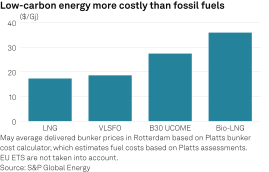
Low-carbon fuels are more expensive due to limited availability. May's average delivered bunker prices for very low sulfur fuel oil were $18.56/gigajoule in Rotterdam, compared with $27.39/Gj for B30 with 30% used cooking oil methyl ester and 70% very low sulfur fuel oil and $35.90/Gj for bio-LNG, according to the Platts bunker cost calculator, which estimates fuel expenses based on Platts assessments from S&P Global Energy.
"If you don't have a cost of carbon, I don't think companies can afford to decarbonize," Holm said. "You need to find a way to bridge this gap slowly."
Regulatory outlook
The IMO delay has led to more uncertainty for shipowners, who do not know when a global regulation would be in place and are increasingly having to deal with regional regulations, according to Holm.
"When you look at the regulations, I think the key here, first of all, is about predictability," the executive said. "[But there is] the uncertainty that the shipowners have to live with because they don't know exactly when will the regulation come into place."
The EU has extended its Emissions Trading System to cover shipping since 2024 and introduced FuelEU Maritime rules on marine energy's GHG intensity since 2025, while the UK has proposed to cover international maritime transportation in its ETS from 2028. UK domestic maritime emissions will be covered from July.
Meanwhile, Djibouti and Gabon have started charging ship operators for their emissions. China -- the world's largest seaborne trading nation -- has also been exploring maritime decarbonization rules.
"I sincerely hope that we will have one global regulation, because now we are on a pathway where we have regional regulations," Holm said. "From a shipowner perspective, that's the worst possible situation because you don't want to have regional regulations."
Flexibility
As a ship's lifespan can usually last for more than 20 years, Holm said shipowners should seek "maximum flexibility" in fuel propulsion technologies while improving energy efficiency amid regulatory challenges.
For example, a shipowner can choose to build a dual-fuel vessel capable of running on LNG and conventional fuels while preparing it for future conversion to be powered by methanol during the newbuild design stage, according to Holm.
This flexibility could help shipowners when one of the alternative fuels becomes more available and cheaper as a compliance option for decarbonization rules.
"If you go for flexibility, it's like you have a rather cheap insurance for changing the fuel during the vessel's lifetime," Holm said.
The executive said shipowners can also save fuel expenses by adopting energy-saving equipment, such as gate rudders or supplementary batteries, which could be financially prudent regardless of the fuel choice.
Wärtsilä is one of the world's largest makers of four-stroke engines, used on cruise ships, offshore supply vessels and other ships in shortsea trades or smaller. The company has planned to expand its engine production capacity by 35% from the 2025 level by the end of the first quarter of 2028 before an additional 30% expansion in Q1 2029.
"That's about our capabilities to even further accelerate development of engines running on green fuel," Holm said. "We have the technology. We have the engines ... [But] we lack the predictability of the regulations and we lack the fuel availability of green fuels."
