Refined Products, Maritime & Shipping, Agriculture, Energy Transition, Fuel Oil, Bunker Fuel, Biofuels, Renewables, Jet Fuel
June 11, 2026
INTERVIEW: Moeve expands B100-capable bunker barge fleet amid rising demand

By Max Lin
Editor:
HIGHLIGHTS
Moeve to have three barges that can supply B100
B100 emerges as cheapest FuelEU compliance option
Hormuz crisis creates challenges to refining system
Moeve is expanding its bunker barge fleet capable of supplying 100% biofuels, according to a bunker executive of the Spanish company, as environmental regulations lead to higher demand for the low-carbon energy.
The fuel supplier's current biobunker business focuses on B30 with 30% used cooking oil methyl ester, but its director for marine fuels and heavy products, Samir Fernandez, said Moeve will have more IMO Type II bunker barges amid increased requirements for B100.
The company took delivery of its first such ship in April and will have another two by the end of August, all three of them to be deployed in the Algeciras Bay, the executive told Platts, part of S&P Global Energy, in an interview.
"I now see an increasing interest in B100 as a method of compliance" for FuelEU Maritime, which would allow ship operators to generate income from compliance surpluses via pooling arrangements, Fernandez said.
With oil prices spiking on the Hormuz shipping crisis, classification society DNV said burning B100 was the cheapest compliance option for non-scrubber ships bunkering in Rotterdam and trading in the International Maritime Organization's Emissions Control Areas in April.
The estimate took into account the EU's Emissions Trading System and FuelEU pooling benefits. The OceanScore Pool-Price Index, which assesses the monetary value of FuelEU surpluses, was Eur171/metric ton of CO2 equivalent as of June 9.
Fernande said Moeve currently physically delivers biobunker fuels and does not have availability for other suppliers, although that could change when more production capacity comes online later this decade.
The company is constructing Spain's largest second-generation biofuels plant in Huelva, which is expected to start operations in 2027 with 500,000 mt/year flexible capacity for hydrotreated vegetable oil and sustainable aviation fuel. It has also taken a final investment decision on a 300-megawatt green hydrogen unit, the largest confirmed hydrogen project in Spain, at the same site and due online in 2029.
Harmonization
In terms of environmental regulations for shipping that could promote more clean fuel usage, Fernandez has called on regulators to align bunker rules at the global and EU levels to create a level playing field.
Currently, the IMO is facing delays in finalizing the Net-Zero Framework. The Netherlands has started to implement the EU's Renewable Energy Directive III from January, resulting in a loss of conventional bunker volumes in Rotterdam as ship operators choose cheaper fuels in Antwerp instead as Belgium is yet to do so. Spain is also in the process of national transposition.
"What we really don't want is to have a fragmented approach in Europe, which leads to different interpretations of the legislative framework and different and more compliance difficulties for a shipowner," Fernandez said.
Separately, the IMO has lower sulfur limits for bunker fuels from 0.5%-0.1% in the Mediterranean Emissions Control Area since May 2025. Its ECA in the Northeast Atlantic will become effective from September 2028.
The ECA regulatory changes will incentivize more production and use of ultra low sulfur fuel oil, which is likely to be the cheapest compliance option for non-scrubber ships, according to Fernandez. It could also prompt ship operators to consider bioblends with ULSFO while 0.5%S fuel oil and 3.5%S fuel are the preferred options now, depending on pricings and onboard equipment, the executive said.
Market volatilities
Moeve, which reported 3.6 million mt of bunker sales in 2025, has been one of the main bunker suppliers in the West Mediterranean with five barges in the Strait of Gibraltar, two in Barcelona and three in the Canary Islands.
Heightened maritime risks in the Red Sea and the Strait of Hormuz have led to lower container ship and product tanker traffic from the Middle East to Europe via the Mediterranean, even as bunker traders reported stronger demand in the Canaries as ships need to top up their tanks when sailing longer routes.
On the supply side, Fernandez said the ongoing Middle Eastern supply issues have not significantly affected crude availability to Moeve, whose refineries with a total capacity of 470,000 barrels/day tend to process Atlantic barrels.
S&P Global Commodities at Sea data shows Spain imported 1.2 million b/d of crude and condensate in 2025, of which less than 5% from Persian Gulf producers. The country has not imported any from the region since February.
"Most of our crude sourcing is from the Atlantic Basin, whether it's Latin America, America or West Africa," Fernandez said. "But from an availability point of view, the significant increase in crude prices impacts everything downstream."
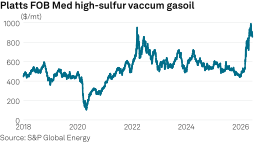
Fernandez said the shipping crisis prompts changes to the company's refining system. For example, high prices of vacuum gasoil have incentivized more production of light gasoline from the feedstock.
"Feedstocks like VGO are extremely tight in the current environment reducing the availability of the component for fuel oil blending," he added.
On a free-on-board Mediterranean basis, 2%-sulfur vacuum gasoil prices jumped from $538.50/mt to $987/mt on May 19 -- the highest since at least 2018 -- before easing to $865/mt on June 10, according to Platts assessments.
Iran has taken control of Hormuz -- which handles 20% of global oil trades in normal times -- since its war with Israel and the US broke out Feb. 28, limiting ship traffic to 90% below the pre-war level.
Many analysts have warned that a prolonged Hormuz blockade could lead to even higher oil prices and lower demand. The International Energy Agency currently forecasts global oil demand to fall by 400,000 b/d in 2026.
"If the conflict lasts longer, that could force inflation and then a lack of movement of goods," Fernandez said.