Crude Oil, Maritime & Shipping, Refined Products, Fertilizers, Chemicals, Energy Transition, Wet Freight, Fuel Oil, Bunker Fuel, Renewables
June 03, 2026
INTERVIEW: Trafigura expands owned VLCC fleet for less exposure to time charters

By Max Lin
Editor:
HIGHLIGHTS
Trading house sees more third-party freight volumes
High charter rates on consolidation, geopolitics
Decarbonization needs to be 'financially viable': shipping head
Trafigura is set to operate more VLCCs under its ownership in bids to meet growing transport demand while reducing exposure to period charter markets, where rates could stay elevated amid consolidation and evolving geopolitics, according to the trading house's top shipping executive.
Andrea Olivi, global head of shipping at Trafigura, told Platts, part of S&P Global Energy, that owning a certain portion of the company's fleet -- which grew to a record size of 500 ships recently -- would allow it to meet internal and external shipping requirements more cost-efficiently.
"Trafigura's shipping volumes are increasing, but we're also noticing an even bigger increase in cargoes and contracts from third-party companies -- who realize that, thanks to our scale, we can offer unique advantages and economies of scale when it comes to freight," Olivi said in a recent interview.
"This applies not only to oil but also dry, gas and, in a not-too-distant future, container freight forwarding."
"We want to ensure that, going forward, we can continue to maintain a scale that allows us to service internal trading activity, alongside a growing number of external counterparties."
The trader, one of the world's largest, reported a crude trade volume of 177.8 million metric tons in its fiscal year 2025 (October 2024-September 2025), up from 156.4 million mt in the prior year.
A significant proportion of Trafigura's fleet transports are third-party cargoes, according to Olivi. The company operates a mix of deep-sea oil tankers, small tankers, LPG/LNG and dry bulk carriers.
With more refineries, oil suppliers and receivers dredging ports worldwide to expand their berths to accommodate VLCCs, the shipping executive said this class of ships would be most capable of optimizing Trafigura's trade operations and reducing unit transport costs and emissions.
"But we need to manage them, and we need to be able to optimize costs," Olivi said. "And the best way for us to ensure that is by owning our own tonnage."
Trafigura refrained from detailing the size of its owned fleet. Information collected by Platts from industry sources -- including S&P Global Maritime Intelligence Risk Suite -- suggests Trafigura might own over two dozens of ships of various types on the waters and order, and that its owned VLCCs in operation could grow from four to more than 10 later this decade if some optional newbuild orders are exercised.
Segment dynamics
Traditionally, Trafigura has been building its fleet by time-chartering vessels from shipowners. But term rates for tankers have been rising as many market participants expect spot earnings to remain high amid consolidation and geopolitics-led disruptions.
Figures from shipbroker Banchero Costa show the one-year charter rate for a VLCC reached $100,000/d in April, up 134.2% year over year.
Brokers have attributed strong term rates to defensive chartering by traders and oil majors, who seek guaranteed vessel supply amid high spot freight rates.
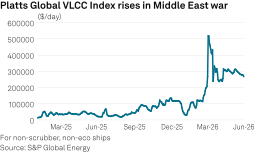
The Platts VLCC index for non-scrubber-fitted, non-eco ships was $267,653/d on June 2, having stayed below $50,000/d for much of 2025 before recent spikes.
In a research note published in May, S&P Global Energy CERA said Sinokor has established a rate level of $50,000-$80,000/d for VLCC trades after taking control of roughly 30% of the non-sanctioned spot fleet.
The South Korean carrier, which had jointly marketed VLCCs with Trafigura, has partnered with Mediterranean Shipping Co. and spent $3 billion acquiring mid-aged ships since 2025 to grow its operated VLCC fleet size to 100 ships based on CERA research.
Many shipping professionals said VLCC consolidation could tighten vessel availability if a large share of the open fleet is controlled by a single owner, potentially driving up spot tanker rates for a sustained period.
Market development
Despite high secondhand prices, Trafigura could achieve healthy investment returns and enjoy strong cash flows for the coming years by owning VLCCs, as market participants expect more demand for non-sanctioned ships amid volatile geopolitics.
In the past few years, mainstream tanker owners have been selling their aged ships to shadow fleet operators that use the shipping capacity to transport sanctioned barrels. But Venezuela has been exporting its oil on non-sanctioned ships following the US ouster of its former president, Nicolas Maduro, in January.
Iran has taken control of the Strait of Hormuz -- which handles 20% of global oil and LNG trades in normal times -- since its war with Israel and the US broke out Feb. 28, limiting ship crossings via the choke point to 90% below the pre-war level. Tehran has been seeking to lift US sanctions on Iran's oil exports during its peace talks with Washington.
Trafigura currently has seven chartered tankers stranded in the Persian Gulf. While the Strait of Hormuz crisis led to tanker rate spikes due to longer shipping distances as Asian importers sought Atlantic barrels, the executive warned a prolonged disruption could create "real problems" as reduced oil supplies could result in higher prices and lower consumption.
Maritime decarbonization
Among other shipping initiatives, Trafigura reduced the greenhouse gas emission intensity of its shipping operations by 25% from 2019 to the full year 2025, ahead of its target year of FY2030. The company is due to take delivery of four ammonia-fueled mid-sized carriers in 2028, while CMB.TECH -- which has ammonia-capable ships coming online -- recently expanded its bunker procurement deal with Trafigura subsidiary TFG Marine to cover its whole fleet.
"We hope that ammonia as a green fuel can develop worldwide," Olivi said. "And then when we see the right demand signals from shipowners, we will want to increase our ammonia bunkering capacity."
But Olivi said Trafigura's plan to decarbonize its bunker mix would be influenced by regulatory developments. The International Maritime Organization's Net-Zero Framework, originally designed to place a GHG cost on ship emissions from 2028, was not adopted last October as scheduled, and some member states are backing an alternative without a pricing mechanism.
"It's important for us to decarbonize, but we have to do it in a way that is financially viable," Olivi said.
