Crude Oil, Maritime & Shipping, Wet Freight
December 16, 2025
INFOGRAPHIC: Sanctions and longer voyages drive surge in oil on water, not storage
By Thomas Washington and Max Lin
HIGHLIGHTS
Transit crude share rises, storage share falls
Sanctions boost long-haul crude shipping from Americas
VLCC freight rate has firmed
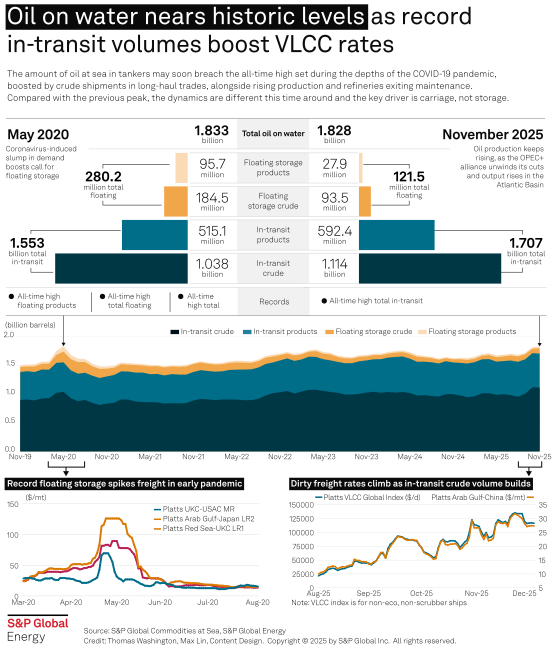
Oil on water has surged to levels last seen during the coronavirus pandemic, but this time, it is not floating storage behind the spike but longer voyages and shifting trade routes.
Total oil water in November was 1.82 billion barrels, of which crude in transit accounted for 61%, crude in storage 5%, products in transit 32% and products in storage 2%, data from S&P Global Commodities at Sea showed.
The last time levels were in that territory was May 2020, at the height of the coronavirus-induced demand slump. Then, total oil on water was 1.83 billion barrels, of which 57% was crude in transit, 10% was crude in storage, 28% was products in storage and 5% was products in transit. In short, between 2020 and 2025 the share of barrels in transit has grown, and the share of barrels in storage has fallen.
"Oil in transit has become kind of a more mainstream measure for investors that focus on shipping. It's now at record highs," Lars H. Barstad, CEO of crude tanker company Frontline said, presenting his company's Q3 interim financial results during an investor call on Nov. 21.
"This happens as export volumes grow, from especially the Americas or around the Atlantic Basin, and we see a positive development in how oil trades," he said.
Demand for tankers is also growing in the Middle East, as OPEC continues to unwind production cuts. OPEC said Nov. 30 that the group of eight OPEC+ producers implementing voluntary crude production cuts will stick to plans to raise December quotas by 137,000 b/d compared to November levels, then pause quota increases through the first quarter of 2026.
This is boosting freight rates. Platts, part of S&P Global Energy, assessed its VLCC non-scrubber, non-eco index at an average of $112,995/day in November. In January, it averaged $29,438/day.
The International Energy Agency sees global oil demand climbing by 790,000 b/d in 2025, and another 770,000 b/d in 2026, it said Nov. 13. In contrast, production is set to rise by 3.1 million b/d in 2025 and 2.5 million b/d in 2026, contributing to what it calls an "increasingly lopsided" market shaped by oversupply, it said.
Storage potential
Floating storage has shown signs of growth. Floating crude storage was 93.54 million barrels in November, almost at August's level of 94.46 million, which was itself the highest since June 2023. However, while the November monthly level was among the highest in the last two years, its share of overall oil on water remained in a well-established range.
Floating crude storage accounted for 5% of oil on water in November and products floating storage for 2%. Crude floating storage has accounted for 3%-6% of the total since November 2022, while products in floating storage have accounted for 1-2% since December 2020.
"Iranian crude represents the largest share of floating storage, with Malaysia acting as the main concentration point," marine data company Signal Ocean said in a note Dec. 5.
Sanctions help to boost transit
Western authorities in October sanctioned Rosneft and Lukoil, Russia's top two oil companies. India has increasingly reduced its intake of Russian feedstock, and this has opened up the ton-mile intensive arbitrage between the Americas and Asia, Frontline said in a statement.
Russian crude exports to India saw the sharpest decline in November, plunging 57% month over month and 50% year over year to 791,000 b/d. Shipments to China fell 25% month over month and 34% year over year to 804,000 b/d, while deliveries to Turkey fell 43% month over month and 53% year over year to 198,000 b/d, CAS data showed.
Stronger, newer sanctions on Russian oil companies and Ukraine upping its attacks on Russian oil infrastructure mean there are many fewer barrels of diesel exported from Russia at present, Derek Solon, chief commercial officer at International Seaway said during his company's Q3 earnings call Nov. 6.
"That void is being filled by the US, by some Latin American [exporters]," he said. "The benefit to us, and a lot of our peers, is also that those are barrels that the compliant fleet can move, not the dark fleet, not the gray fleet, but the combined fleet." This has supported MR rates, Solon added.
Russian product exports floated around the 2 million b/d mark in November. Exports were 2.03 million b/d, representing the third month in a row of modest increases but still below levels from January 2022 to September 2025, CAS data showed.

Editor: