Maritime & Shipping, Refined Products, Wet Freight, Gasoline, Diesel-Gasoil, Jet Fuel
December 12, 2025
Chinese oil firms see higher export quotas as new Five-Year Plan looms: sources
HIGHLIGHTS
For first time, plan promotes peak oil demand by 2030
Domestic surplus prompts reassessment of export strategy
Pollution may no longer be a key consideration
Chinese oil companies increasingly expect the government to raise clean oil product export quotas in 2026, as Beijing has recognized a growing surplus in the domestic market, four sources close to the matter told Platts, part of S&P Global Energy, on Dec. 11-12.
This growing expectation follows the inclusion, for the first time, of an explicit target to promote peaking oil consumption by 2030 in the proposal for China's upcoming 15th Five-Year Plan (2026-2030).
"We have repeatedly communicated to the government about peaking demand and the need to expand access for oil product exports," a senior official at a leading state-run oil company told Platts. "Finally, the message has reached the top decision makers."
Beijing controls China's clean oil product exports by allocating quotas to six state-run oil companies and the top mega independent refinery. The annual quota volume for gasoline, gasoil and jet fuel reached a peak at 59.03 million mt in 2020 and dropped to 37.25 million mt in 2022, until it gradually rose to 41.41 million mt by 2025.
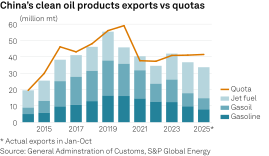
The control aims to prioritize supplies to meet domestic demand, according to industrial sources. In addition to quota control, the government has reduced the value-added tax rebate for clean oil product exports, as it is not a sustainable solution for the government's subsidy outflows.
Demand peak
China's total oil demand is projected to peak in 2027, according to numerous forecasts, including from Sinopec's research institute and S&P Global Energy CERA.
"Considering the demand peak, the total refining capacity of around 940 million metric tons (18.88 million b/d) and refining throughput of 750 million mt -- 800 million mt (15 million-16 million b/d), we have sufficient capacity to supply the world, when demand overseas continues to grow, including in Africa, the Middle East, Latin America and Southeast Asia," a senior Sinopec official said at the International Energy Executive Forum 2025 in Beijing on Dec. 11.
Wang Zhuwei, a director at S&P Global Energy CERA, echoed this sentiment, saying China's peak in liquid demand will limit refinery utilization to relatively low levels if oil product exports remain tightly restricted, which would hurt the refining sector's profitability.
"It is time to reassess the country's oil production and export strategy when the industry drafts the new Five-Year Plan," a Beijing-based industry source said.
Moreover, two sources close to the country's planners said the government has gradually come to understand that pollution and emissions are generated more from the consumption process than from refining and production.
"Pollution may no longer be a key consideration in export policy," one of the two sources said.
Maintain targets, wait for indication
A Beijing-based senior policy researcher said the government would likely prioritize controlling trade exposure risk amid the ongoing trade tensions with the West, rather than the need to improve the refining economy.
"The government has to limit the refining industry's dependency on the international market, avoiding importing more to lift exports," the senior policy researcher said.
Refiners will maintain their clean oil product export targets unchanged from 2025 to plan their annual throughput for 2026, until they receive notification from the government, a senior official with a leading state-run oil company said.
The official said on the sidelines of the IEEF 2025 in Beijing that indications of the allocation trend will likely emerge in February or March, when China holds its key national political event.
But the first batch of 2026 export quota allocations -- expected by the end of December -- may not signal any major policy shift from 2025.
Zheng Baoshan, vice president of the China National Petroleum Chemical Planning Institute, said on the sidelines of the IEEF 2025 that there has been little change to the country's oil product export policy, and export quotas are unlikely to be significantly raised in the short term.
