Maritime & Shipping, Refined Products, Agriculture, Energy Transition, LNG, Fertilizers, Chemicals, Wet Freight, LPG, Fuel Oil, Biofuel, Renewables
November 24, 2025
INTERVIEW: Rotterdam expands green bunker capacity, worried over IMO delay

By Max Lin
HIGHLIGHTS
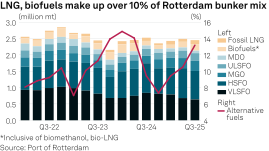
Alternative fuels reach 13.2% of Rotterdam bunker sales in Q3
IMO Net-Zero Framework delay hampers industry transition
Dutch port adds LNG, biofuel storage and shorepower networks
The Dutch port of Rotterdam is pushing ahead with infrastructure expansion for sustainable marine energy, but global decarbonization rules would be required for an industry-wide low-carbon bunker transition, the port's Chief Operating Officer Berte Simons, told Platts, part of S&P Global Energy.
LNG and biofuel bunker sales at Rotterdam, the world's second-largest marine refueling hub, have been on an upward trend in recent years, with the port authority kickstarting its pursuit of climate neutrality by 2050.
The port reported 2.45 million metric tons of marine fuel sales during July-September, of which alternatives to conventional, oil-based fuels accounted for 13.2%, the highest among major bunker ports. Deliveries of biofuels, composed mainly of biodiesel-fuel oil blends, reached 201,319 mt, and fossil LNG amounted to 121,614 mt.
"For the next few years, we will have LNG there together with new green fuels for quite some time," Simons said in a recent interview. "We have set out to increase the volume of biofuels and to come up with bunkering facilities for new fuels, to work on imports and exports and bunkering strategies for hydrogen, ammonia and methanol."
The continued efforts to decarbonize Rotterdam's bunker mix came despite International Maritime Organization member states voting in mid-October to postpone the Net-Zero Framework by a year, Platts reported earlier.
The proposed regulation, backed by the Netherlands and nearly all other EU states, was designed to promote the uptake of low-carbon fuels by placing a cost on maritime greenhouse gas emissions from 2028.
"The postponement of the adoption of the IMO's Net-Zero Framework is a major setback," Simons said. "The absence of a global level playing field, long term perspective and limited demand for sustainable transportation make it difficult to scale and remain competitive."
Brussels has extended its Emissions Trading System to cover shipping from 2024, while introducing FuelEU Maritime rules on marine energy's greenhouse gas intensity in January, pushing up total refueling expenses for ships in EU-related trades.
October's average delivered bunker costs for B30 with 30% used cooking oil methyl ester in Rotterdam were $841.70/mt for ships sailing to a non-EU port, according to the Platts bunker cost calculator. Costs for B24 were $728.46/mt in Singapore, the world's largest bunker port, for ships on voyages to an EU port.
Developments at Rotterdam
Rotterdam, the top European port by cargo throughput, is undergoing several expansion projects for LNG and biofuel tanks.
At the Gate terminal, a new LNG storage tank of 180,000 cu m and additional regasification capacity of 4 bank cubic meters per year is due to be operational by the second half of 2026.
Bunker supplier Peninsula will add eight tanks with a total capacity of 80,000 cu m to its biofuel storage and blending facilities in Chane Terminal next January, bringing its total capacity to 110,000 cu m.
Rotterdam currently handles 2 million mt/year of methanol and 400,000 mt/year of ammonia, predominantly made from fossil fuels, but those would lay the foundation for the transition to sustainable methanol and ammonia bunkering, according to Simons.
The port has been piloting methanol bunkering projects. In April, Trammo completed a ship-to-ship transfer of 800 cu m of ammonia at OCI's terminal in preparation for future ammonia bunkering. In October, OCI signed a memorandum of understanding with Victrol for ammonia bunkering in Rotterdam, Platts reported earlier.
"We are also preparing for bunkering of liquid hydrogen for short-sea shipping," Simons said. "We are focused on having the infrastructure for new bunker fuels."
However, the executive stressed that the marine energy transition would depend on the supply-demand fundamentals for green fuels, whose prices are higher than conventional fuels due to limited production.
"Real growth in the uptake of sustainable fuels depends on clear, consistent, and global regulation," Simons said. "The Net-Zero Framework provides a crucial step forward -- so we hope next year the NZF will be adopted."
Shoreside power
Simons said Rotterdam has 10 berths for ocean-going ships installed with shoreside power charging network and 100 cabinets for inland shipping, with plans for further expansion.
Based on EU regulations, container and passenger ships must be connected to charging facilities by 2030 at the main EU ports listed in the trans-European transport network, including Rotterdam. The ports, in turn, are required to develop the infrastructure to meet 90% of ship operators' demand.
While inland ships can be fully electrified due to limited space for on-board battery systems, large, ocean-going ships could be designed or retrofitted to run on power at berth and turn off their auxiliary engines during "cold-ironing," leading to lower marine fuel use and CO2 emissions as well as less air pollution.
"At the moment we have only a few OPS installations operational for cruise, ferries, offshore and smaller vessels. We are, however, fully on track to realize installations at the container terminals that will bring us to compliance," Simons said, adding that the port's estimated planned capacity in 2030 will be well over 150 MW.
Rotterdam has established a joint venture with Eneco, Rotterdam Shore Power, to execute shoreside power projects in coordination with government-owned grid operators for terminals. Terminal operators can also develop their own charging systems.
Ships could pay a fee per kilowatt-hour based on wholesale pricings -- a model more relevant to inland shipping -- or shipping companies could sign electricity supply deals with terminal firms, according to Simons.
