Refined Products, NGLs, LPG
November 21, 2025
Brazil's LPG sector faces regulatory overhaul challenges amid calls for lower consumer prices

HIGHLIGHTS
ANP aims to open LPG market, spark competition
Distributors fear missing returns on investments
Proposals include partial cylinder filling, new uses
Distributors ask for changes at start of value chain
The Brazilian LPG sector is at a crossroads as regulators prepare to shake-up the market in hopes of sparking renewed competition, to drive prices down for consumers, while established distribution companies fear lower prices and new entrants may impact long-term investments.
Regulation review
Brazil's National Oil, Gas and Biofuels Agency, or ANP, has been debating its rules on opening up the LPG market since 2018 in order to ensure the country's supply and drive costs down. The matter later found its way into the watchdog's review agenda, which led to the publication of a regulatory impact report in July 2025.
Although a definitive document is still in development, among the proposals are the possibilities of not only multiple companies filling the same LPG cylinder but also doing so with competitor-branded ones, as long as they commit to tracking it. It also mentions lifting restrictions on industrial LPG use in the country.
In 2024, total sales amounted to 7.57 million mt, according to ANP data and the country imported 3.14 million mt. In terms of output, most of Brazil's production comes from state-owned Petrobras, with additional volumes coming from private refiners such as Acelen in the Northeast.
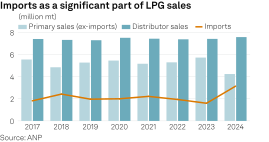
Petrobras also handles most of the imports in Brazil. Petrobras supplies 89% of local volumes, according to data from the ANP, the LPG distributor association Sindigas and Petrobras, while only about 52% of total LPG sales come from its own production.
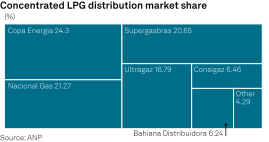
On top of that, four companies (Copa Energia, Nacional Gas, Supergasbras and Ultragaz) hold together an 83% share of distribution, making it a highly concentrated market.
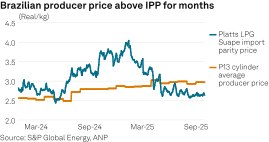
The lack of competition, combined with local prices remaining above the import parity level for extended periods and wide profit margins of sellers, has fueled the conversation for regulatory reform.
Terminal investments at risk
The four distributors have come together to build two LPG import terminals in the Northeast, in an attempt to reduce their dependence on Petrobras and improve the region's infrastructure, according to Sindigas president, Sérgio Bandeira de Mello.
"Suape is a port that receives less than a full vessel per month, and it is done via a tanker stationed off the coast," he explained in an interview with Platts, part of S&P Global Energy. "And most of the Northeast and the Center-West have high production deficits and no real tank storage capacity, which these new terminals could help solve."
One of the terminals, in Suape, will need investments of up to Real 1.2 billion ($225 million) and is being spearheaded by Copa Energia, logistics company Oiltanking and Edson Queiroz, the parent group for Nacional Gas. Supergasbras and Ultragaz's parent company, Ultrapar, are moving another project of similar costs ahead at the Pecem port, 840 km from Suape.
Sources close to the companies say these investments pose a risk at the moment. "The deficit is there, and this will help with regional tankage, but they risk just leasing the infrastructure back to Petrobras," one of the sources commented.
Domestic prices still relatively high
Propane prices have been stagnant to lower in international markets, while Brazil's cylinder prices have inched higher, lending support to higher profitability for Brazilian distributors.
Platts assessed the LPG import parity price in Brazil's northeastern Suape port at $451.43/mt Nov. 21, up from the recent low of $414.62/mt on Oct. 20, but a significant year-to-date plunge from $620.47/mt on Dec. 31, 2024.
"There's an overall pressure on the ANP to bring prices down," Sindigas president Sergio Bandeira de Mello commented. "But we believe mini-scale solutions cannot bring relevant competitiveness shifts."
On the other hand, distributors complain that domestic prices have been consistently above the import parity for at least the past six months. Petrobras also began holding tenders to sell additional LPG volumes in the market, at a premium to already high prices.
During Liquid Gas Week, held from Oct. 12 to 16 in Rio de Janeiro, top companies in the industry presented their concerns about the tenders, stating that they created artificial scarcity, which would pave the way for even higher prices.
Sindigas believes that their returns on capital expenditures in past years, which brought their cylinder park to upward of 130 million 13 kg cylinders, or P13, the most widely used type in Brazil, might also fall short with the changes. They argued that investments were necessary for producing the new cylinders, known as "botijão," as well as for implementing higher safety standards for production and subsequent fillings.
Social responsibility
LPGs are a touchy subject in Brazil because the vast majority of their use is residential, or around 76% according to the 2025 Brazilian Energy Balance published by the government's Energy Research Co. EPE. LPG is widely known in the country as "kitchen gas" and because of that it carries a social and political aspect as the country has 19.5 million people below the poverty line.
Although less lumber is being used for energy in Brazilian households, it still accounts for a significant market share, especially due to its low prices. The EPE, for example, estimated that 20.7% of residential energy consumption came from LPGs in 2024, compared with 22.9% from lumber.
That led the current federal administration to launch a program called "Gas do Povo" to refill LPG cylinders for low-income families, which is due to go into effect Nov. 24.
"We believe this proposed change in regulation can jeopardize Gas do Povo," Mello stated. "And on top of being important for those families, it is a big program affecting 7-8% of Brazilian LPG demand."
Sindigas estimates that with upwards of 15 million households getting the benefit, the country will need 5-10 million new cylinders. This would call for investments of up to Real 2.5 billion.
Companies at Liquid Gas Week also commented that fractioned cylinder filling, a noted piece of the reform, and using third-party brands could lead to safety issues. Sindigas pointed out that Paraguay did something similar, and now almost 80% of their park is outdated.
Sources with ties to regulators counter that if the rule change is approved, companies would have the obligation to track and ensure the safety of cylinders.
Untapped uses
Another topic that the regulation change aims to address is the expansion of the market for broader LPG usage. Currently, ANP prohibits LPGs from being used to fuel trucks, other vehicles or power generators.
Now that LPG supply is expected to increase in the country with Petrobras' Energias Boaventura complex, the agency can safely allow consumption to grow without risking a national supply shortage.
"We can work to open up to more industrial uses with the market being more mature now. There is more production coming and there are no expectations of a spike in demand," a source close to the agency told Platts.
Sindigas welcomes this change, and its official outlook is that full-year 2028 LPG consumption could grow by 3.7% from 2024 from new uses in engines, boilers, pools etc. Power generators could also start using LPGs and pave the way for natural gas while the pipeline infrastructure is being built.
EPE's outlook — published in 2022 — is that LPG production will have grown 79% in a decade by 2031, with output from natural gas processing units hitting 26,800 cu m/d, from 7,800 cu m/d in 2021, and refineries, petrochemical and others staying around 20,000 cu m/d.
Official outlook
Petrobras did not respond to Platts' requests for comments.
ANP said that a spokesperson could not give an interview due to the matter still being discussed. However, an official statement said that there are still no definitive proposals under the regulatory impact report, and they will come only after consultation with the public.
Sindigas says that proposals to shake-up the sector at the beginning of the value chain, either at production or imports, would be much more effective to drive higher competition and help bring prices down.

Editor: