Refined Products, Diesel-Gasoil
November 20, 2025
European distillates market ‘caught off guard’ by ICE sanctions guidance
By Kelly Norways, Jan Kedzior, and David Neef
HIGHLIGHTS
ICE issues guidance on settlement of LSGO contract
Exchange not accepting products of segregated Russian crude
Guidance creates caution over Indian, Turkish imports
A stricter-than-expected interpretation of EU oil sanctions by the Intercontinental Exchange has supported European distillate cracks to two-year highs after the exchange signaled a cautious approach toward foreign refiners still importing Russian crude in its physical settlement process.
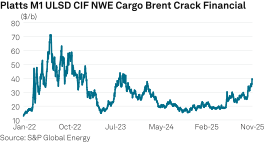
After the exchange's announcement, the December ICE LSGO gasoil crack leapt 11% to $37/b at the market close on Nov. 18, the highest spread since September 2023. In European morning trading hours on Nov. 19, the flat price breached $800/mt, up $22.5/mt from the previous close, before easing back to settle at $768.25/mt.
New guidelines from the commodities exchange on its ICE Low Sulfur Gasoil Futures contract, which is Europe's main distillates benchmark and physically deliverable, has provided one of the most comprehensive outlines to date on planned enforcement of the EU's upcoming import ban, which takes effect Jan. 21, 2026.
The EU sanctions are intended to suspend flows of Russian crude currently refined abroad and re-entering Europe as fuel, however, uncertainty over enforcement had mitigated the market response. In October, the European Commission published FAQs on the new regulations, but left operators to establish proper contractual clauses and due diligence.
ICE, one of the leading commodities exchanges, published its planned enforcement guidelines on Nov. 18, following a month-long consultation with the market. It is just one interpretation of the legislation, but is widely expected to set the standard in the European market.
The text adopted a narrow view of acceptable exemptions to the import ban on fuels made from Russian crude, stating that ICE would only accept delivery into its ICE LSGO futures settlement process from refiners of Russian crude in cases where deliveries were demonstrably suspended for the previous 60 days.
Critically, ICE will not accept material from refineries that simultaneously process both Russian and non-Russian crude in separate systems, it stated, ruling out a potential compliance method outlined by the European Council. The EC had stated that operators may continue importing from facilities capable of segregating their Russian oil refining processes, provided that "enhanced due diligence" is applied.
However, pending further EU guidance on what such due diligence should entail, or established market practices accepted by regulators, the exchange said it would not accept crude segregation as a sole compliance method. In cases where more than one refinery relies on a single crude discharge port, they shall also be treated as one installation, it said.
Sellers into the ICE contract will be required to obtain and verify attestations from refineries to confirm that no Russian oil was discharged, leveraging systems such as independent vessel tracking services. Relevant documentation must then be provided to the exchange upon request, it said. Gasoil originating in specified EU partner countries or net crude oil exporters will continue to be accepted, in line with EC guidance.
Market response
The guidelines have demonstrated a hardening stance toward refined product imports from countries like India and Turkey, both major Russian oil buyers that have emerged as prominent distillate suppliers to Europe in recent years.
When the 2026 EU import ban was first announced, the market response was tempered by suspicions over lax enforcement. Tolerance for "mass-balancing", now expressly ruled out by the EU, or tolerance for segregated Russian processing, were both expected to potentially soften the impact of new restrictions.
Within the day of the ICE circular, the spread between the front-month and second-month contracts had widened by $13.75/mt to reflect a $43/mt premium for the prompt supply at 16:30 London time Nov. 18, reflecting steep intermonth backwardation that eases around mid-2026.
Two European distillates traders, who preferred not to be named due to commercial sensitivities, said that the pricing structures reflect a market now ruling out imports from prominent suppliers in India, which have continued to import large volumes of Russian oil. "Some people were caught off guard," one trader said, adding that they would need to wait until the end of February or early March at the earliest to import cargoes from suppliers currently importing Russian crude.
Reliance, owner India's largest refinery, has vowed to observe EU sanctions, without sharing details on its compliance plan. Turkey's largest refiner, Tupras, has also shared its intent to comply with EU law, and has stressed its flexibility to pivot between suppliers in future.
"Some people may still try to get lucky and import Indian product based on EU, not ICE, rules," one of the European trader said, while the second noted that some market participants are already adapting by floating tougher clauses on origin countries in their distillate tenders.
"We're seeing the combined effects of US sanctions and the closure of the refining loophole basically sending distillates through the roof," said Ben Hoff, head of Commodity Research at Societe Generale. In a research note published Nov. 17, before the ICE guidance, JP Morgan analysts said sanctions could still leave 150,000-200,000 b/d of diesel at risk of being stranded globally, equating to roughly 2% of global supply.
As a result, the investment bank sees diesel crack spreads averaging over $27/b through Q4 2025-Q1 2026, and expects Northwest European margins to average over $17/b.
S&P Global Energy CERA see global diesel cracks averaging over $21/b in Q4-Q1, up from around $16/b the previous year.

Editor: