Crude Oil, Refined Products
November 18, 2025
INFOGRAPHIC: US aircraft deployment ramps up risks on Venezuela's oil sector

By Kate Winston
HIGHLIGHTS
Could start 'shot clock' for strikes: analyst
Potential naval blockade could impact oil exports
Cartel designation could be used to justify strikes
The arrival of the largest US aircraft carrier and its strike group in the Caribbean may have started a countdown for the US to act in Venezuela in the relatively near future, which could threaten the supply of heavy crude exports, according to analysts.
"A 'shot clock' is now ticking," Ryan Berg, the director of the Americas Program at the Center for Strategic and International Studies, said. "My instinct is that we are likely to see some strikes on land in Venezuela before the end of the year."
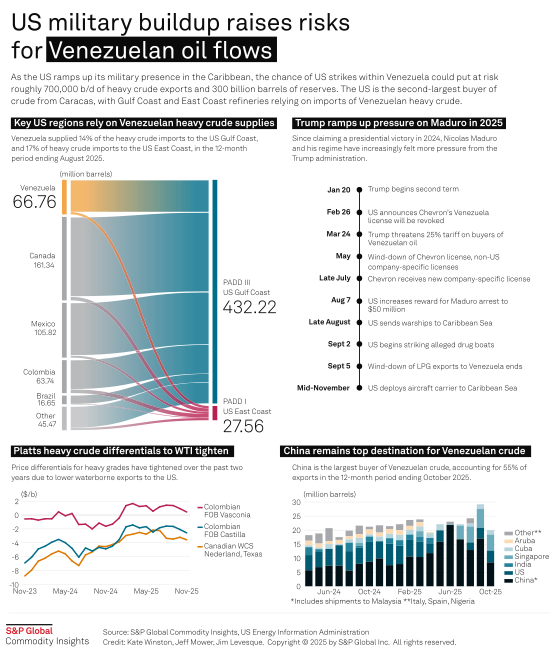
Venezuela exports roughly 700,000 b/d of heavy crude, some of which is exported to US Gulf Coast refiners. While the global market is currently well-supplied, the bulk of that surplus is light and medium sweet crudes.
The US imported 2.5 million b/d of waterborne crude in October, according to S&P Global Commodities at Sea data. Of that, roughly 800,000 b/d was heavy crude, down from a recent peak of 1.3 million b/d in April, CAS data shows.
A steady supply of Canadian heavy crude delivered by pipeline to the USGC is helping to make up for that decline. But heavy crude price differentials have narrowed in recent months, reflecting the tightness.
For instance, Colombian Vasconia crude has averaged at a $2.55/b discount to WTI so far in November, down from a $4.87/b discount in November 2024, Platts data shows.
Blockade would cause storage to hit capacity
US strikes focused on drug and military targets would not have a direct impact on oil production, Nick Blanco, an analyst with S&P Global Energy, said.
But strikes could have an impact on Venezuela's oil industry if they are followed by or tied with a naval blockade and/or a removal of Chevron's license, Blanco said.
"A naval blockade would have a massive impact on Venezuela's oil market," Blanco said. "What will happen is crude storage will reach capacity almost immediately (crude storage is already quite high due to export difficulties), causing production to dive sharply shortly after."
This may be an unlikely scenario, given that Chevron has a license to operate in Venezuela for the purpose of sending crude to the US, Blanco said. But there are not enough US troops in the region for a ground invasion of Venezuela, so the Chevron license removal and blockade are the most likely escalations if efforts to remove Maduro fail, he said.
The US State Department intends to designate Cartel de los Soles as a Foreign Terrorist Organization, effective Nov. 24, 2025. The cartel is based in Venezuela and is headed by Venezuelan president Nicolas Maduro and other high-ranking individuals in the Maduro regime, the State Department said in a Nov. 16 statement.
"The United States will continue using all available tools to protect our national security interests and deny funding and resources to narco-terrorist," the State Department said.
Trump misdirection?
US President Donald Trump told reporters on Nov. 16 the designation allows the US to target Maduro's assets or infrastructure inside Venezuela.
"It allows us to do that, but we haven't said we are going to do that," Trump said. "We may be having some discussions with Maduro, and we'll see how that turns out."
The fact that the State Department signaled its intent to designate the cartel rather than just designating it suggests they might be trying to increase leverage, Rachel Ziemba, a senior adviser with Horizon Engage, said.
While Trump claims he is open to talks with Venezuela, he has employed misdirection in the past and could do so again with Venezuela, according to a Nov. 17 note from ClearView Energy Partners.
For instance, Trump in 2017 hosted a dinner with Chinese President Xi Jinping after green-lighting strikes on Syria, the note said. And before the strikes against Iran, Trump sent one set of B-2 bombers to the Pacific in an apparent effort to pull attention away from the other bombers, the note said.
The FTO designation may provide coverage for the military to strike vessels involved with the cartel without requiring a Declaration of War from Congress, Ellen Wald, president of Transversal Consulting, said.
On that point, Berg said the Justice Department has issued a memo justifying strikes on drug boats near Venezuela, and it could do something similar for land-based strikes.
"That, combined with the FTO designation, is probably what Trump would need to strike inside Venezuela," Berg said.
The Venezuelan people are expecting the US to take action, and they feel hopeful about the idea of a regime change, Iria Puyosa, a fellow at the Atlantic Council, said during a Nov. 13 event.
"Having a population that looks at the perspective of war, or aerial attacks as something hopeful, it tells you the magnitude of the suffering people are undertaking at the moment," Puyosa said.

Editor: