Refined Products, Agriculture, Energy Transition, Gasoline, Biofuel, Renewables
November 13, 2025
INTERVIEW: Crop-based fuel exclusion threatens SAF targets, ePURE warns
By Thomas Washington and Suzanna Hayek
HIGHLIGHTS
Trade pressures loom with Mercosur ethanol imports
Industry identifies growth in higher ethanol blends
European ethanol prices supported for time being
Strict EU policies on sustainable aviation fuel feedstocks may hinder decarbonization targets, while both facing trade pressures and pursuing growth in higher ethanol blends, according to an official from European renewable ethanol group ePURE.
The European Commission's DG ENER decision to, for the moment, exclude crop-based fuels from aviation decarbonization quotas under the ReFuelEU Aviation regulation is problematic, David Carpintero, director general of ePURE, an industry body for European renewable ethanol, told Platts Nov. 13.
The approach makes compliance after 2030 nearly impossible for airlines while jeopardizing climate goals, he said.
"With the current version of ReFuel, you are making the life of airlines very dependent on some limited feedstocks," Carpintero said, referring to the EU's restrictive stance on crop-based feedstocks for SAF production. He argued that focusing on feedstock type rather than reducing greenhouse gas emissions misses the point of effective climate policy.
The comments highlight growing industry frustration with EU biofuel policy that prioritizes advanced biofuels made from waste and residues over conventional crop-based alternatives.
More than half of liquid biofuels currently in use are based on bioethanol produced from food crops, but this can be produced from a range of feedstocks, the International Energy Agency said Nov. 12.
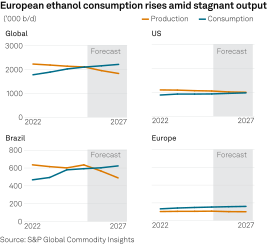
Fuel ethanol demand is projected to grow to over 2.2 million b/d in 2027, with growth driven mostly by the US and Brazil, from around 2.15 million b/d in 2025, analysts at S&P Global Energy said. European consumption will rise 5% from 153,799 b/d in 2025 to 161,174 b/d, while production will dip 2% from 106,255 b/d in 2025 to 103,670 b/d, Energy data showed.
Trade liberalization
Regulatory uncertainty comes as the European ethanol sector faces additional pressure from trade liberalization. The pending trade agreement between EU and the South American trade bloc Mercosur could boost low-duty ethanol imports, with Carpintero warning of "a very negative impact on European ethanol producers" from the cumulative effect of these multiple free trade agreements, Carpintero said.
Brazilian energy company Raizen sees potential for its waste-based ethanol — currently overwhelmingly earmarked for European road users — to grow its share in other transport applications as it ramps up capacity of the second-generation fuel over the next few years, a company official told Platts in October 2024.
Platts, part of Energy, assessed ethanol barges on an FOB basis in Rotterdam that had cleared EU customs at $826.15/cu m Nov. 12, slightly below its five-year average of $843.46/mt.
European ethanol prices surged to $987.86 in October, the highest level since April 2023, driven by several factors. Chief among these were the Dutch decision to no longer allow undenatured ethanol imports to count against the 2026 RED III targets, the lower corn crop in Southeast Europe, the slow pace of imports, and the downturn in deliveries from the UK plants to Amsterdam-Rotterdam-Antwerp. None of them are transient and therefore prices will remain well-supported in the months ahead, analysts at Energy said. Prices will remain volatile until the market has found a new equilibrium, they said.
Market opportunities
The renewable ethanol industry is identifying new growth opportunities in higher ethanol blends for gasoline. Technical specifications for E20 fuel – containing 20% ethanol versus the current E10 standard – are nearing completion and could create substantial new demand.
"There is a significant fleet of cars in Europe that will benefit from E20," Carpintero said, describing the development as "a big step to continue the decarbonization of road transport."
The higher blend could also open maritime applications, with marine engine developers testing ethanol-powered systems.
Bioethanol plays an important role in decarbonizing road transport, but growth opportunities are limited because of the widespread electrification of vehicles, the IEA said Nov. 12.
Ethanol as a marine fuel can ride on the increasing popularity of methanol in the shipping industry, Mikael Wideskog, Wartsila's director for sustainable fuels and decarbonization, told Platts in March 2023.
This growth potential could align well with the International Maritime Organization's net-zero frameworks, and it could be further fueled by global regulatory convergence, Carpintero said.
Bioethanol does not currently meet the requirements for consideration as a sustainable fuel by the FuelEU Maritime regulation if produced from a food crop, and, as a result, its future use depends to a considerable extent on whether it can be produced affordably using waste material, the IEA said.
Despite technical challenges, including the appearance of elastomers in fuel, the expansion into E20 and maritime applications represents the industry's strategy to offset regulatory and trade pressures while maintaining its role in European decarbonization efforts.

Editor: