Refined Products, Crude Oil, Diesel-Gasoil
October 21, 2026
Dangote buys 25% stake in Kenya's state-owned pipeline company

Editor:
HIGHLIGHTS
Nigerian refiner acquires stake in Kenyan oil products network
Pipeline transports 250,000 b/d from Mombasa
Second UAE cargo inbound for Lekki, Middle East crude in focus for Lamu
Africa's largest refiner, the Dangote Group, has purchased a 25% stake in Kenya's state-owned pipeline company as it eyes new distribution channels for the East African market, its founder Aliko Dangote announced on Oct. 21.
In an appearance at the FT Africa Summit in London, the Nigerian industrialist announced that he had secured the interest in the Kenya Pipeline Company with the approval of the country's President, William Ruto, on Oct. 20, allowing his business to use its network to distribute its oil products.
Dangote cited the investment as part of the company's strategy toward acquiring new storage and distribution assets, as the company plots its entry to East Africa with a second refinery development. His business currently operates a 700,000 b/d refinery in Lekki, Nigeria, and is advancing plans to launch a second site in Lamu, Kenya by 2030.
KPC, which offered 65% of its shares in an initial public offering in January, operates the region's most sophisticated and low-cost fuel distribution system, with a system spanning 1,300 km. The network has the capacity to transport roughly 250,000 b/d of oil products from the port of Mombasa to cities in the country's northeast, where some fuel is subsequently loaded onto trucks to travel further inland.
The acquisition will see Dangote sit alongside the Kenyan government, with its 35% stake in the pipeline business, as well as Uganda's national oil company, UNOC, which sought to acquire a 20% interest as part of the public offering. Opening the business to new investors was intended to help Kenya unlock new spending for its infrastructure, which has struggled to keep pace with growing inland demand.
The existing pipeline network has been expanded twice in recent years, and was due for another upgrade under previous KPC plans. Additionally, UNOC has expressed interest in reviving long-delayed plans to extend the KPC network over the Kenya-Uganda border, which has previously been set by regulatory and financial hurdles.
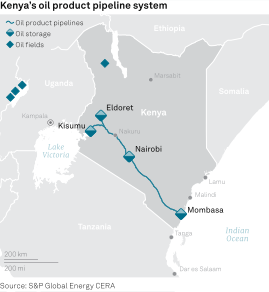
Kenya and Uganda are both discussing stakes in Dangote's Lamu project, which the company has said could potentially process future crude supplies from both countries. Speaking at the FT Summit, however, Dangote noted that limits to the potential oil output from both countries, neither of which are current producers, will mean the refinery needs to take a broader approach to its feedstock sourcing, naming the Middle East as a potential future supplier.
In Nigeria, the company designed its Lekki facility to process the light sweet crude native to the country, but has increasingly sought to tilt its supply towards some heavier grades. Despite disruption from the Middle East conflict, the company took delivery of its first cargo of UAE crude in August, when it received 1.9 milion barrels of the country's Das Blend grade, while another 1 million barrels of Upper Zakum crude is inbound in October, according to S&P Global Commodities at Sea.
Infrastructure sprint
Dangote referenced the Kenyan pipeline deal as part of a wider set of infrastructure investments being advanced by the group, which has targeted $50 billion of new spending as part of its Vision 2030 strategy. Alongside its Kenyan refinery project in Lamu, the company is also working on new pipeline links between Djibouti and Ethiopia, as well as Namibia, Zimbabwe and Zambia.
To support its access to African markets and beyond, the company is additionally building tank farms in Djibouti, Cameroon, and Namibia, among others, the group founder said, without providing further timelines on the company's myriad construction projects.
The East African expansion comes as part of a push to tap unserved inland markets that are growing fast due to population growth and economic development, Dangote said in London.
"When you look at the eastern part of Africa, they need more refining than the western part, because they are into a lot of mining, and it is difficult for them to get diesel. The only thing that isn't a mature market is aviation, for which there's now a lot of market out of Africa," he said.
Uganda currently consumes roughly 45,000 b/d of refined products, although the volume could reach 65,000 b/d by 2035, according to estimates from S&P Global Energy CERA analysts. Kenya consumes roughly 110,000 b/d, with consumption set to grow by more than a third in the next decade.
