Refined Products, Electric Power, Crude Oil, Natural Gas, Diesel-Gasoil
October 06, 2026
European markets rattled by near miss on US diesel export ban

Editor:
HIGHLIGHTS
G7 announcement committed to avoiding bans
Governments discuss reopening refineries, new subsidies
EU to launch new strategic dialogue on refining
The threat of a US diesel export ban is forcing Europe to consider its fuel dependencies in a fundamentally new light, officials and market stakeholders have warned, heralding a unprecedented era of energy insecurity for the world's largest importers.
After weeks of insecurity over the possibility of a US ban, Europe appeared to avoid the risk of a potential embargo on Oct. 2, when the G7 announced its members had jointly committed to preserving the free trade of energy and accelerating stock releases.
Nevertheless, earlier comments from US President Donald Trump suggesting potential restrictions have triggered new concern from Europe over the stability of its most important energy partnerships, said Václav Bartuška, the Czech Republic's UK ambassador, at London's Energy Intelligence Forum Oct. 6.
"The possibility of an embargo on diesel exports is something that if somebody said it two years ago, they would be taken to hospital," Bartuška said, warning that the bloc "will most likely not be able to import it [diesel] from anywhere if things get really bad".
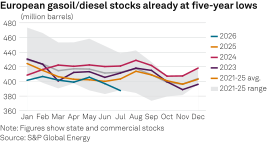
The EU imported half its diesel from the US in August, according to representatives for the commission. According to the Czech ambassador, the UK currently has some of the lowest reserves in Europe, with just 23 days' worth of supply still stored in its inventories
Despite finding an apparent resolution through the G7, however, the threat of a recent trade rupture has triggered new urgency around energy resilience talks, according to Bartuška, who said that governments are now having to consider whether to reopen shuttered refineries or offer steeper fuel subsidies.
"We should trust no one because no one is going to help us. That is actually a very, very new thing for Europeans," he said.
Czech pipeline pivot
Since the outbreak of the Russia-Ukraine war, the Czech Republic has already made a significant shift in its energy sourcing strategy, opting to fully suspend its imports of Russian crude in 2025 after expanding its alternative Transalpine (TAL) pipeline link.
Since fully pivoting to the expanded pipeline, the country has had to put growing focus on physical protection for its infrastructure, Bartuška said, reflecting amplified risks of drone and missile attacks. Its legacy Druzhba pipeline link, which still sends crude oil to Slovakia and Hungary, has been repeatedly interrupted by drones, including between January and April this year.
Also speaking on the panel, Lord Adair Turner, chair of London-based think tank Energy Transitions Commission, agreed that diesel was the "short term stress point" for Europe in an "unpredictable" US policy environment, where bans remain a possibility.
"This would have a very big impact in Europe. I think we would have to go to some quite extreme measures how to manage supply," he said.
His remarks come as diesel prices have continued to hover around record highs, pushing refining up the agenda for major economies. The EU's energy and defense commissioners are due to chair a new strategic dialogue on refining, the bloc announced Oct. 6, while Italy has also called an emergency meeting of its refiners.
European refining strategy
In a live address from Brussels, European Commission President Ursula von der Leyen underscored the regional energy threat, as the US-Iran war and Russian supply shutdowns have continued to send global prices soaring.
"As long as Europe depends on oil and gas, our prosperity remains exposed to the events that are beyond our control. When we import fossil fuels, we import the shocks and crises that come with them," she said.
FuelsEurope, a regional lobby group, had previously responded to the G7's announced stock release by calling for Brussels to establish a new permanent strategic dialogue on refining, which it said should tackle issues with competitiveness and investment.
According to its analysis, Europe has seen the closure of 35 refineries since 2009, reducing its capacity by a fifth, contributing to a growing deficit for the products that fuel its transport, industry, and defense sectors.
"Europe cannot strengthen its resilience, preserve its energy autonomy or secure the fuels and products its economy depends on without a competitive and resilient refining sector," said Liana Gouta, the group's Director General.
"It's not only about the necessity to address the current geopolitical crisis. It's also about addressing the future," she said.
