Crude Oil, Refined Products, Diesel-Gasoil
October 02, 2026
G7 orders 100 million barrel oil stock release, rejects energy export bans

Editor:
HIGHLIGHTS
Deadline set for last tranche of IEA commitment
Members to frontload 'substantial' diesel supplies
Members commit to avoid energy export restrictions
The G7 has set a four-month deadline for its member states to release the last 100 million barrels of oil stocks they committed to in March after collectively pledging to refrain from energy export restrictions within the organization.
In a statement Oct. 2, the seven industrial countries called on the International Energy Agency to "monitor the immediate and full implementation of the March 2026 commitments." Adjusting for stocks already released to the market, the group pledged to oversee the release of 100 million barrels of oil by February next year.
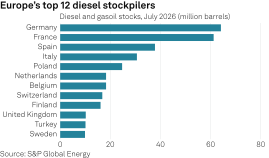
The decision included a commitment for the G7 and partner countries to frontload a "substantial diesel release" in the next 20 days, with members to discuss the possibility of additional releases in coordination with the IEA. The group will also seek to coordinate refinery maintenance schedules to avoid simultaneous shutdowns and increase utilization rates, it said, advocating for engagement with non G7-countries that hold additional capacity.
The statement followed an announcement from US President Donald Trump on Truth Social declaring that Europe has agreed to immediately begin releasing a "massive amount" of its "heavily stocked diesel," after reports of White House requests for leading EU countries to release extra reserves, or potentially face US export bans.
ICE Low Sulfur Gasoil futures -- a metric for European distillates values -- plummeted on the initial statement from Trump, but have since corrected following the G7 statement. Values fell 8% from the previous close to $1,331/mt, before rebounding to $1,364/mt by 1600 GMT.
The IEA, which counts all the G7 nations among its 32 member states, committed to releasing a historic 400 million barrels of oil to the market in March, but had so far only recorded 300 million barrels of deliveries, according to data published in August. Of the supplies released to the market, 110 million barrels came from the Americas, compared with 112 million barrels from Asia-Oceania and 68 million barrels from Europe, the IEA reported in August.
After weeks of US discussions of a potential diesel export ban, the G7 additionally stressed its commitment to "refrain from export restrictions on energy and energy products" between member states, and said it would call on oil producers to avoid imposing bans.
"We welcome the decision of G7 countries not to impose any export bans on allies and the continued solidarity between partners," said European Commission President Ursula von Der Leyen in a statement on the social media platform X. "We support an IEA coordinated release of fuel stocks," she said. A full export ban could have deprived Europe of the source of half its recent diesel imports, according to EU figures, potentially pushing up prices already hovering at record highs.
The G7 recommended that a follow-up report should be delivered within 20 days of its statement, including recommendations for future responses and stock replenishment plans.
US lobby
According to Politico, US Energy Secretary Chris Wright had requested that European countries release 120 million barrels of oil over a three-month period, with France, which holds the G7 presidency, reported to have suggested a new 100 million barrel stock release, split between crude and oil products.
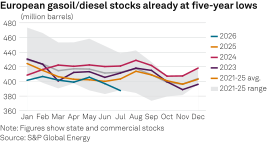
The IEA has said the 400 million barrels of oil it committed to release in March represents just 20% of the stocks its members have at their disposal, although deliveries have slowed to a trickle in recent months. In the EU, diesel stockpiles have slumped to five-year lows, although backwardated market structures have encouraged sales to come mostly from commercial stocks. Meanwhile, the US Strategic Petroleum Reserve, already at 44-year lows, has neared its operational floor.
EU officials have maintained that diesel supplies remain stable in the region, but have warned of a "tough winter" ahead as prices continue to surge. After an informal EU ministers' meeting on Sept. 29, the bloc's energy commissioner, Dan Jørgensen, said officials were concerned with "finding a balance" on stock releases to preserve energy security for even more challenging conditions.
"A staggered release could tide Europe through winter, when heating demand typically pressures stocks," said Eleanor Budds, an oil research and analysis director at S&P Global Energy CERA, who warned that dampening effects for prices could still prove short-lived. "It is a sticking plaster that does not resolve the underlying problem of global tightness, with no clear visibility on when Middle Eastern and Russian volumes will return to the market," said Eleanor Budds, an oil research and analysis director at S&P Global Energy CERA.