Agriculture, Energy Transition, Refined Products, Biofuels, Vegetable Oils, Renewables, Jet Fuel, Gasoline, Diesel-Gasoil
September 25, 2026
INTERVIEW: Repsol's Cabra sees EU rules holding back SAF investment beyond 2030

Editor:
HIGHLIGHTS
Europe's 6% SAF mandate for 2030 achievable
Voluntary market accounts for up to 50% of Repsol SAF sales
Refinery co-production key to competitive SAF economics
Europe's sustainable aviation fuel market is on track to meet its 2030 blending targets, but fragmented regulation across feedstocks, processing technologies and end markets risks choking off the investment needed to hit more ambitious post-2030 goals, a senior Repsol executive said Sept. 24.
The EU's ReFuelEU Aviation regulation has provided a workable framework so far, with the 2025 SAF blending obligation of 2% already exceeded at 2.8%. Luis Cabra, deputy CEO at Repsol and president of FuelsEurope, the European refining industry association, told Platts, part of S&P Global Energy. The 6% target for 2030 was "at hand," but cautioned that the regulatory architecture governing renewable fuels needs reform to unlock the scale of capital spending required for the decade that follows, he said.
"I believe that the positive is that we will be well served until 2030," Cabra said. "But if we look at the regulation, I see some barriers that need to be eliminated in order to confront successfully the 2035 indicative objectives," he said.
Regulatory barriers
There are three interlocking areas where European rules are impeding investment, Cabra said. These are feedstock eligibility, technology neutrality and market access for renewable fuels in road transport.
On feedstocks, the Renewable Energy Directive imposed unnecessary restrictions on the range of inputs that refiners could use, he said, citing caps on used cooking oil as an example of rules designed to prevent fraud that instead constrained supply. "Let's try to control fraud, but do not unnecessarily restrict," he said.
On technology, there are questions about the European Commission's emphasis on synthetic fuels at the expense of more commercially mature biofuel pathways, Cabra said. The cost of producing synthetic SAF, or eSAF, is currently five to ten times that of conventional jet fuel, making it unbankable at scale before 2030, he said. "Technology is not mature enough for synthetic fuels; technology is now quite mature for biofuels, and the cost is a factor of 2 or so," Cabra said.
Platts, part of S&P Global Energy, assessed SAF, produced via the hydroprocessed esters and fatty acids pathway, on a CIF basis in Northwest Europe, at $2,955.25/metric ton Sept. 24, 84% costlier than $1,607.75/mt for jet fuel cargoes on an equivalent basis. The spread between them is slightly below where it was when the Middle East war started on Feb. 28, since when it has caused tighter jet fuel markets.
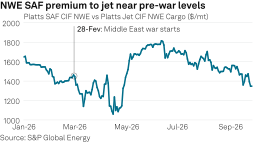
Analysts at S&P Global Energy Horizons forecast the levelized cost of eSAF at $7,500/mt in 2026, falling to $6,200/mt in 2030.
The third barrier is the effective exclusion of renewable fuels from road transport markets under EU vehicle emissions policy. Because refineries co-produce a range of fuels from the same feedstocks and processing units, restricting the market for renewable diesel and gasoline directly undermines the investment case for SAF production from the same facilities, Cabra said. "If I cannot co-produce gasoil for road or gasoline for road, I will have less investment cases for SAF," he said.
European policymakers should treat renewable fuels as a single integrated value chain — covering feedstocks, processing and applications — rather than regulating each element in isolation through separate directives covering aviation, shipping, road transport and energy, he said.
A leaked European Commission impact assessment report for the Renewable Energy Directive IV suggests a shift from rigid transport mandates toward domestic production, feedstock flexibility and resilience, analysts at S&P Global Energy Horizons said Sept. 21. For biofuels markets, the shift is from imposing ambitious renewable fuels targets, the analysts said.
Compliance and voluntary markets
Repsol's own sales illustrate the current health of the voluntary SAF market, with between 25% and 50% of the company's SAF volumes sold outside mandatory blending obligations, depending on the season, Cabra said. He attributed this partly to airlines using free allowances from the EU Emissions Trading System to offset up to 50% or more of the SAF price premium, depending on the airport. At some island airports, such as those in the Balearic Islands, allowances could cover the full cost gap, he said.
Airport infrastructure access is also a constraint on market development, with supply arrangements at some airports affecting pricing and competition, Cabra said. This is something that airports can develop and book-and-claim mechanisms — which allow SAF producers to sell volumes at the most logistically efficient location and transfer the environmental credit to buyers elsewhere — could also help address this, but require a clearer regulatory framework to function at scale, he said.
On the role of conventional refining in SAF production, integrated refinery sites offered a structural cost advantage over greenfield SAF plants, given shared infrastructure for tankage, utilities and distribution, Cabra said. Repsol has increased jet fuel output at its Spanish refineries by 25% to 35% during recent periods of European supply tightness, and a healthy refining base is a prerequisite for competitive SAF supply, he said.
"If we keep oil refining healthy, we will progress quite a lot and much better on renewable fuels supply," he said.
