Crude Oil, NGLs
September 04, 2026
INTERVIEW: Nigerian oil regulator eyes faster licensing cycles to hike output

Editor:
HIGHLIGHTS
NUPRC CEO plans yearly or twice-yearly bid rounds
Each process to add 300,000-600,000 b/d
Plans to allow trade of local crude supply obligations
Nigeria hopes to resuscitate its oil output by keeping up its pace of at least one bid round a year, according to the chief executive of its upstream regulator, Oritsemeyiwa Eyesan, who hopes new entrants and "drill-or-drop" policies will spur fresh productivity in the sector.
Appointed in last year's surprise reshuffle of Nigeria's two oil regulators, Eyesan is the second executive to helm the Nigerian Upstream Petroleum Regulatory Commission, and has the task of growing the country's oil output to 3 million b/d by 2030.
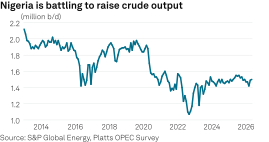
Punchy production targets have eluded previous administrations, with maturing assets, vandalism and underinvestment eroding Nigeria's output in the past decade. The OPEC member has recently pumped roughly 1.5 million barrels/day of crude, but output has not exceeded 2 million b/d for the past 12 years, according to the OPEC+ Survey from Platts, part of S&P Global Energy.
Eyesan aims to encourage new activity by making more assets available to the market and encouraging churn on abandoned concessions. She began her role midway through Nigeria's 2025 bid round — its second in two years — and intends to establish an even faster schedule of regular licensing processes.
"These will be annual, if possible, even twice-annual events. At a minimum, we'll be going to the market on an annual basis," Eyesan said, promising a six- or seven-month turnaround time on future iterations.
The process has already sped up significantly since the introduction of Nigeria's landmark Petroleum Industry Act of 2021, before which the country could go 5-10 years without a licensing round. Its subsequent auctions have steadily grown in scope — with the 2022/23 mini bid round involving seven oil blocks, while 19 were offered in 2024 and 50 in 2025.
The latest round, which spanned the Niger Delta region, as well as the Benin, Anambra and Chad Basins, saw 37 of the 50 licenses awarded in July. The concessions are expected to boost Nigeria's oil production by 300,000 b/d of additional output in the first three years, and the target will be 300,000-600,000 b/d from successive bid rounds, Eyesan said.
Officials are preparing to kick off the next round of auctioning by early October at the latest, with new acreage including the 13 unlicensed blocks returning to the pool from the last round. New assets will span the country's deepwater, shallow water and possibly frontier onshore basins, Eyesan said, without providing further detail.
It is the first licensing round that Eyesan will oversee from start to finish, and despite solid participation in the last process, she promised a stricter focus on only bringing "viable assets" to market.
"I knew we were going to have a problem with some of the blocks," the commission chief said, acknowledging the regulator "took a gamble" on some licenses added to the last pool prematurely.
New operators
After the exodus of international energy companies like Shell, ExxonMobil, TotalEnergies and Eni away from Nigeria's onshore basins, the NUPRC has made it a priority to foster a wave of new operators to drive inland growth.
"For this round, we were very mindful that the target audience was not overtly going to be the major players in the industry," Eyesan said, citing newer entrants like Renaissance and First E&P as recent local success stories.
New "drill-or-drop" provisions are designed to prevent the passive ownership that has dragged on the sector. In the 2025 bid round, shallow-water licenses were awarded for three years only, with an option to extend, while deepwater and frontier concessions were granted for five years.
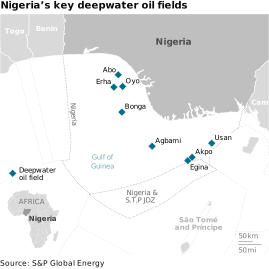
At the same time, the country has largely focused its international investment pitch on its deepwater oil fields, where Shell, Eni and ExxonMobil all have major expansion projects. In the latest bid round, it was the sole deepwater asset, PPL 2010, that attracted the attention of the energy majors, with Chevron snagging the offshore Niger Delta license.
By 2030, the NUPRC hopes to drive $30 billion-$50 billion of new investment to 22 deepwater projects, aided by a package of new tax incentives and investors looking differently at their portfolios in the wake of the US-Iran war. "I think it's enhanced the way the investors analyze and look at their presence in West Africa," Eyesan said of the conflict.
Downstream mandates
The vision for Nigeria's oil sector has evolved as the country has developed into a refining powerhouse. Since the launch of its Dangote refinery in 2024, the country now has a major domestic market for its crude, and officials have sought to prioritize securing its access to feedstock.
At its current capacity of 700,000 b/d, Dangote has recently relied on Nigerian crude for 77% of its feedstock, according to S&P Global Commodities at Sea data. However, the company has previously criticized a lack of crude availability and terminal unreliability — challenges that will be compounded when it completes a project to double the refinery in size.
Eyesan supports ambitions from the Nigerian Midstream and Downstream Petroleum Regulatory Authority to divert all the country's crude to the local refining sector by 2030, and emphasizes the benefits of integrated growth. Nigerian officials have previously cited a growing refining sector to justify aims for a higher OPEC quota, which has been fixed at 1.5 million b/d since 2024.
Nigeria's Domestic Crude Supply Obligation already sets fixed volumes producers have to deliver locally, but in practice, companies are free to capitalize on better offers from foreign buyers. To modernize the system, the NUPRC aims to introduce a compliance trading platform, allowing those overfulfilling their obligations to swap certificates with export-oriented producers, Eyesan said.
Despite the national push, however, Dangote should reserve the right to operate based on pure economics, Eyesan said, acknowledging the refiner's efforts to diversify its crude intake. "I would not begrudge Dangote if [it's] not picking up domestic crude," she said. "It might not be prudent to procure those grades as opposed to cheaper alternatives."
Post-expansion, Dangote will be capable of processing almost all of Nigeria's current crude output, without accounting for government refining projects and newbuilds. Nonetheless, Eyesan remains bullish on the country's ability to recover a long-term crude surplus. "I think Nigeria has a potential very easily to get to 4 million barrels in another 8-10 years," she said.
