Refined Products, Crude Oil, Gasoline
August 11, 2026
Nigerian regulator blames cheap refinery builds for holding back regional trade hub

Editor:
HIGHLIGHTS
NMDPRA CEO blasts 'infrastructure for infrastructure's sake'
Nigeria calls for investment in pipelines, ports and roads
Dangote refinery 'not enough,' oil minister says
The new head of Nigeria's downstream oil regulator has criticized low-value refining and storage projects for delaying the development of a bona fide trading hub in West Africa, holding back essential product standardization and efficient logistics corridors.
Addressing the West Africa Refined Fuel Market Conference in Abuja, Rabiu Umar, CEO of the Nigerian Midstream and Downstream Petroleum Regulatory Authority (NMDPRA), said that fragmented regional infrastructure had been counterproductive to efficient trade and price transparency in the West African market.
"The objective is not infrastructure for infrastructure's sake, the objective is infrastructure that reduces the cost of moving energy and increasing energy security," Umar said.
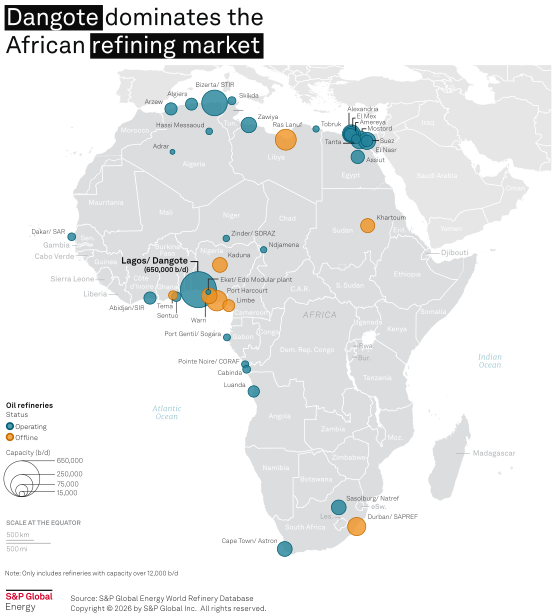
African countries have typically struggled to develop their own refining capacity due to a lack of funding that has produced a smattering of smaller, low-cost projects that have been prone to outages and often poorly maintained.
For Nigeria, that changed in 2024, when the Dangote Group, a private conglomerate, launched a 650,000 b/d state-of-the-art refinery and transformed the country into a net fuel exporter. By 2028, the company aims to double the refinery's capacity, making it the largest in the world.
Umar, a former Dangote executive, urged regional actors to use markets like Europe's Amsterdam-Rotterdam-Antwerp hub as a blueprint for downstream development, with traders and investors building around the best facilities.
"Not every country needs to replicate every asset that we have," he said. "There is absolutely no point".
In many cases, it is still cheaper to import supplies from Europe than to move them between African countries, Umar said, calling excessive red tape and tariffs "expensive bottlenecks".
Instead, investment would be better directed to pipelines, storage, road and rail logistics, as well as expanding and modernizing existing refining assets, Umar said.
In contrast to commercial-scale facilities like Dangote, modular refineries can run into financial difficulties even after short-term setbacks, with most only storing around five days of crude, he said.
Other refineries
The executive's comments come despite a continued push within Nigeria to develop additional refining capacity outside of Dangote.
The NMDPRA has issued 46 prospective refiners with licenses to construct new sites, said Francis Ogaree, an Executive Director at the organization.
The modular Azikel Refinery in Bayelsa, Southern Nigeria, should be online by Q1 2027, but sourcing enough crude to get the project running will prove another hurdle, he said.
Additionally, the Nigerian National Petroleum Corp still aims to return its four state-owned refineries to operation, after more than a year with all the sites offline.
"The time has come for us to follow the results we have seen from the Dangote refinery," said Nigeria's oil minister, Heineken Lokpobiri, also at the event, who said the existing plant was "not enough" and urged further investment.
By 2030, the NMDPRA aims to route all of its upstream oil production to its domestic refining market, it said Aug. 10, setting ambitious growth targets for both sectors. The country pumped 1.74 million barrels/day of oil in June, and wants to hit 3 million b/d by 2030.
Despite Nigeria's bid to emerge as a regional refining hub, other countries have still pushed ahead with projects of their own. In Ghana, the country's 62-year-old Tema oil refinery launched its refurbished crude distillation unit in August, while Angola, Congo and Senegal are all advancing new projects.
"What has constrained us is fragmentation of our markets," said Olu Verheijen, special advisor to Nigerian President Bola Tinubu, who also criticized the siloed approach. "Refining capacity alone does not breed energy security," she said.
Platts, part of S&P Global Energy, assessed the price of gasoline on a FOB West Africa basis at $1127.5/mt on Aug. 10, down from a May record of $1,215/mt but still 150% higher than February levels.
