Refined Products, Diesel-Gasoil
July 23, 2026
Brazil scrambles for diesel as Russian ban, Middle East shocks bite
Editor:
HIGHLIGHTS
Brazil loses key Russian diesel supply
Diesel crack spreads surge 40% since July
India cargoes help fill Russian supply gap
Brazil's diesel market faces tighter availability and rising replacement costs as global diesel crack spreads rise to record highs and the country struggles to source barrels elsewhere.
A Russian diesel export ban, prompted by the country's efforts in securing fuel supply amid refinery attacks and maintenance downtime, and the renewed Middle East conflict have curtailed Atlantic Basin supply. Russia has historically supplied nearly half of Brazil's roughly 1.4 million cubic meters per month of diesel imports, so losing those discounted barrels increases Brazil's exposure to price volatility through 2026.
"The supply scenario is complicated because Europe will compete with Brazil for US production, and we do not have a relevant supply alternative to cover Russia entirely," said João Lopes, an S&P Global Energy CERA refined products analyst. "It depends on how long the Russian ban will last, but even if it returns now, it has already taken long enough to have effects."
Financial diesel crack spreads have surged roughly 40% globally since early July. CERA forecasts they will remain elevated into 2027.
Higher local refinery yields and importers' purchasing power should prevent near-term domestic shortages, but replacement costs have surged as Europe competes with Brazil for US barrels and refineries shift yields toward jet fuel. A favorable arbitrage has temporarily opened up the possibility of cargoes from the East of Suez, but higher international prices are expected to pressure domestic markets from August and September onward.
Russia's absence and global inventory stress
Reduced Russian availability is forcing Brazilian importers to reassess sourcing. With more than one-third of Russia's refining capacity offline because of drone strikes as the country heads into its maintenance season, markets are pricing in export shut-ins for the rest of the year.
Increased US diesel production has not offset Russian losses or broader inventory pressure. European gasoil and US distillate stocks are near historic lows, and refineries are running near full capacity, heightening exposure to unplanned outages and weather risks.
"US and European refineries are shifting production a bit more toward jet fuel, so the trend is for slightly lower diesel output in a scenario still marked by war," Lopes said, referring to the mix of US and European refining production.
The US Gulf Coast diesel spread advantage has narrowed. USGC ultra-low sulfur diesel cracks settled at a record $82.80/barrel July 17, keeping replacement costs elevated and intensifying Brazil's competition for barrels.
Alternative supply
A favorable arbitrage window has supported Indian trade flows to Brazil. East of Suez cargoes are pricing at a 15- to 20-cent/gallon discount to NYMEX September ULSD futures delivered in Santos, making them more competitive than USGC alternatives heard at a 10-cent discount.
Traders said that while India-based Nayara Energy Ltd is sanctioned by the EU and the UK, it is not restricted by the US Office of Foreign Assets Control, potentially allowing Brazilian entities to take those cargoes. Lopes said India lacks the excess production to fully replace Russian volumes, but favorable economics have drawn Indian cargoes to help fill part of the gap.
According to data confirmed by Brazilian trading market sources, four India-origin vessels are arriving in August carrying Nayara and Reliance Industries Ltd products: Sea Maverick (LR1, 46,195 mt) and Blue Talu (LR1, 73,919 mt) from Nayara; and Garrincha (LR2, 114,442 mt) and Aitolos (LR2, 115,521 mt) from Reliance.
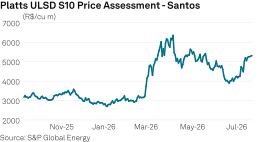
Platts, part of S&P Global Energy, assessed ULSD DAP Brazil at a discount to September ULSD contracts, but rising futures on the NYMEX and increased risk are supporting higher outright prices. Platts assessed DAP Santos from the most competitive origin, currently the US, at $3.9661/gal on July 22, up 89.20 cents/gal from the end of June and at a 10-cent discount to September futures.
Refinery output and inelastic demand
Brazil's domestic diesel demand remains resilient, underpinned by the agricultural cycle.
"Our view is minimal growth to stability," Lopes said of domestic consumption. "In the second half of the year, we will have a complication with the elections, which already slightly reduces demand, but the corn harvest will flow and there is preparation for the soybean crop. There is also domestic grain movement, and our demand is quite inelastic. We do not see a drop even in 2027."
To buffer international volatility, local refinery output increased, with diesel rising to 46% of Brazil's refined product slate in April and May, up from historical levels of 42%-43%.
The June S&P Global Latin America fuels and refining short-term outlook estimates Brazil's 2026 refining throughput at 1.99 million b/d, up 3.2% from 2025, and diesel imports at 280,000 b/d, down 4%, as higher domestic production and weaker demand growth reduce import needs. This higher yield and the importers' greater bargaining power reduce the risk of physical stockouts.
"The scenario is one of higher prices; shortages are not a concern for Brazil, but other parts of Latin America, like the Caribbean, may suffer more with supply," Lopes said.
July import volumes should remain strong because of previously booked cargoes, but inflows may soften from September. Market participants expect a gradual pass-through to domestic prices as distributors assess replacement costs and inventories. Domestic prices may return to levels seen at the start of the Middle East conflict, supported by tighter global supply, reduced Russian availability, logistical risks and steady agricultural demand.
