Maritime & Shipping, Crude Oil, Wet Freight
July 22, 2026
FACTBOX: ICE Brent holds above $90/b on Hormuz, Bab al-Mandab shipping risks
By Claudia Carpenter and Kelly Norways
Editor:
HIGHLIGHTS
Brent crude tops $90/b on Hormuz attacks
Ship traffic drops amid strait tensions
IEA releases 290 million barrels from reserves
Oil prices jumped July 22, with front-month ICE Brent holding above $90/barrel following renewed ship attacks in the Strait of Hormuz and the threat of them spreading to the Bab al-Mandab Strait and the Red Sea.
Over July 11-21, there have been at least seven attacks on merchant ships in and around the Strait of Hormuz, the majority of which have targeted tankers, according to S&P Global Commodities at Sea.
Iran-backed Houthi threats against Saudi shipping in the Red Sea, now a vital outlet for its crude, have prompted some tankers to steer away from the Bab al-Mandab Strait or consider longer, safer routes.
US forces struck Iran for the 11th consecutive night, US Central Command said July 21, while Kuwait faced a fourth day of attacks on its power grid and water distillation systems.
Prices
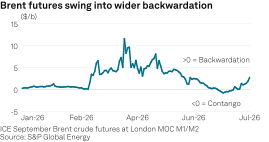
- Front-month ICE Brent crude futures rose 4.8% to $95.42/b in European morning trading on July 22. The contract settled at $91/b July 21, its highest since June 10. Structure has become increasingly backwardated — a sign of prompt market tightness -- with the Mo1/Mo2 timespread widening to a backwardation of $2.80/b at the 16:30 end of the Platts Market on Close assessment process in London.
- The Brent-Dubai spread increased to $12.05/b on July 22 at the London close, a one-month high. The indicator peaked at $18.49/b March 31, contrasting with a prewar average of 77 cents/b in 2025.
- Cash differentials for Middle East crude markers firmed further to cross the $6/b premium mark during the Singapore MOC July 22.
- Prompt-dated NYMEX WTI crude, the US futures price, climbed 4.7%to $88.33/b in mid-morning trading July 22.
- The physical Dated Brent benchmark was assessed by Platts at $94.165/b July 22, up almost 2% on the day to the highest since June 11 but still down from an Iran war peak of over $144/b in early April.
- The ultra low sulfur diesel crack basis CIF Northwest Europe jumped to $75.08/b on July 22, rising 9% week over week and nearing its April 2 record of $76.97/b.
- European natural gas prices rose July 22, with the August benchmark Dutch TTF contract trading up about 4.3% day over day at Eur62.21/megawatt-hour ($71/MWh) as of 1014 GMT, according to Intercontinental Exchange data.
- The August ICE low sulfur gasoil futures contract, used as the basis for middle distillate prices, reached $1,232/mt in European morning trading hours, up 2.2% from the previous close.
- Goldman Sachs analysts said in a July 20 note that a Brent crude price of more than $120/b is possible by the fourth quarter of 2026 if shipping disruptions through the Strait of Hormuz continue, with the potential for further disruptions to crude flows through the Red Sea.
Infrastructure
- The Kuwaiti tanker Kaifan was attacked by Iran on July 21 while crossing the Strait of Hormuz, marking the eighth attack on a merchant ship since July 11.
- Two oil tankers owned by Greece's Dynacom were hit by projectiles off Oman on July 20, including one that had safely transited in and out of the Gulf in recent weeks.
- Kuwait said its power generation and water distillation systems were attacked by Iran on July 21, taking plants out of service as a precautionary measure.
- Yemen's Iran-backed Houthi militia vowed to impose a naval blockade on Saudi Arabia July 20 after blaming it for attacks on Sanaa international airport.
- The International Energy Agency has released 290 million barrels of the 400 million it had committed to destock, it said July 22, without sharing plans for more releases. Its member states have another 1 billion barrels in reserves, it said, noting it was 'monitoring the situation' amid recent escalations in the Gulf.
- Inventories in the US Strategic Petroleum Reserve are at their lowest since 1983, with some 316.5 million barrels of crude remaining, according to the last Energy Information Administration report. New data is expected later July 22.
- Oil product stockpiles at Fujairah dropped for the first time in five weeks as of July 20 as fewer ships traversed the Strait of Hormuz. The total fell to a three-week low of 8.492 million barrels after nearly doubling in the previous four weeks, according to Fujairah Oil Industry Zone data published July 22.
Flows
- Traffic through the Strait of Hormuz dropped to 10 ships on July 22 from 16 ships the day before, while transits through the Bab al-Mandab Strait tumbled to 29 ships from 41 ships over the same period, according to a CAS report July 22.
- Goldman Sachs analysts estimate that the recent escalation has cut Persian Gulf flows to less than 45% of prewar levels, with exports dominated by crude.
- Flows of crude from the Gulf and through the Red Sea hit 13 million b/d in June, according to CAS data, up from 7.08 million b/d in May. That compares with over 18 million b/d in January prior to the conflict.
- Countries in the region have also explored alternative routes, such as pipelines to Yanbu on the Red Sea and the port of Fujairah for Saudi Arabia and the UAE, respectively.
- Products markets have been kept additionally tight by Ukrainian drone attacks that have impacted around 60% of Russian refining capacity, and triggered export shut-ins for diesel, gasoline and jet fuel.
