Refined Products, Crude Oil, Naphtha, LPG
July 10, 2026
New Middle Eastern tensions threaten to erase expected oil supply glut: IEA

Editor:
HIGHLIGHTS
Oil surplus to return in Q4, peak mid-2027: IEA
Global demand to return to growth by October
UAE oil supply hits record 4.1 million b/d
Renewed hostilities in the Middle East could lead to an overhaul in projections of the global oil market returning to a surplus, or even seeing a supply glut, by 2027, the International Energy Agency said July 10.
The Paris-based IEA maintains its expectation that global oil supply will exceed demand by the fourth quarter of 2026, but warned that a breakdown in the fragile US-Iran peace process could turn the forecast on its head and see shipping come to a standstill again in July.
In its new monthly market report, the agency said new attacks in the Persian Gulf over July 7-8 "clouds the outlook" for oil and "could upend the forecast that sees the market flipping to a surplus next year." Its latest view still assumes a gradual recovery in transits through the Strait of Hormuz through the second half of 2026.
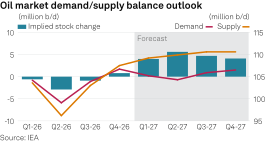
For now, the agency has stuck to its outlook that the market will return to a surplus by the last quarter of 2026, although it downgraded the expected overhang by 400,000 b/d. Over the full year, the market is set to swing from a 900,000 b/d deficit in 2026 to 4.6 million b/d in oversupply in 2027, with excess supply peaking at 5.6 million b/d in Q2.
The new outlook puts world oil supply on track to decline by 3.7 million b/d in 2026 to 102.6 million b/d. Demand is set to drop 1 million b/d to 103.5 million b/d, in what would be the first annual contraction since the Covid-19 pandemic, before returning to 2 million b/d growth next year.
A volatile geopolitical environment has left the market's recovery in limbo, but demand has so far held up better than expected in the face of higher prices, the IEA said. Consumption slipped below 100,000 b/d in May, but rebounded as prices eased, and could still return to year-over-year growth by October, the report said.
Brent crude oil futures jumped 5% on July 8 when US President Donald Trump declared a ceasefire with Iran was over, and have since hovered around $76/b-$78/b. A sustained reduction in Gulf oil flows could push prices to $90/b or higher, said Jim Burkhard, head of oil research at S&P Global Energy CERA, warning that buying patterns, particularly in China, could dictate the scale of the spike.
To date, demand destruction has been most acute in the LPG and naphtha markets, which drove almost half the 4.8 million b/d annual decline in Q2, the IEA said. Nevertheless, observed delivery data came in slightly higher than expectations on the quarter, and the US, responsible for 8.5% of global oil demand, actually increased consumption year over year.
The demand shock has been by far the most severe in China, but consumption is set to shift back to growth by October, the IEA said. It now sees annual Chinese consumption losses widening from 1.6 million b/d in May to 2 million b/d in June, before gradually recovering. In 2027, the agency sees Chinese consumption averaging 120,000 b/d higher than 2025 levels.
Supply rebound
Oil supply has also shown signs of recovery from the depths of the Middle East crisis, though the future trajectory remains highly uncertain.
US naval escorts and sanctions relief for Iran supported a rebound in shipping activity through the Strait of Hormuz, taking traffic to more than 70% of prewar levels by late June, the IEA reported.
As a result, global oil supply jumped by 4.1 million b/d month over month in June, led by a 2.5 million b/d gain from OPEC+, the IEA said. The UAE, in particular, added 1.6 million b/d, producing a record 4.1 million b/d in June. Seaborne loadings from the Persian Gulf rose by 53% in June, while pipelines are estimated to have handled 7.9 million b/d, up 1 million b/d from May.
However, Persian Gulf supplies remained 11.4 million b/d below prewar levels, the IEA said. Downstream, returning Middle East refinery runs boosted global processing rates by 1.5 million b/d in June, although levels remain 6 million b/d below last year's equivalent.
On average in 2026, OPEC+ production is set to fall by 4.6 million b/d, before growing 5.3 million b/d again in 2027. In contrast, non-OPEC+ producers are on track to add 910,000 b/d of new supply this year, rising another 2.2 million b/d in 2027, the report said.
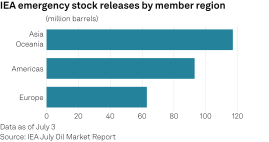
Plugging this year's supply deficit has so far relied on heavy stock draws, many of them from IEA member countries. On a global scale, onshore oil stocks are down by 349 million barrels, or 2.9 million b/d, over the four-month war. As of 3 July, the IEA's 32 member countries had released around 276 million barrels of the 400 million announced in March. However, the pace of stock draws has slowed, with no fixed release date for over 100 million barrels of oil committed to the collective action, the report said.
The IEA's Executive Director, Fatih Birol, previously warned the world could near the "red zone" for oil stocks by July or August, but stressed the IEA remains capable of coordinating further draws.