Agriculture, Energy Transition, Biofuels, Renewables
July 03, 2026
Australian beef tallow prices hit record high on US demand shift
Editor:
HIGHLIGHTS
US shifts from Brazil to Australia amid high tariffs
Asian demand from Singapore, Korea stays firm
Australian beef tallow prices rose to a record high since the assessment was launched on Jan. 7, 2026, driven by uncertainty around proposed tariffs on Brazilian products that could reach 37.5%, market sources told Platts July 3.
The landed cost of Brazilian tallow into the US has become less competitive than that of Australian material due to higher tariff exposure, market participants said.
A global 10% tariff on all products is due to expire July 24, while the proposed 37.5% tariff on Brazilian products, including tallow, is pending formal resolution on July 15. By comparison, Australia would face a 12.5% tariff under the proposed measures.
The uncertainty has made it difficult for Brazilian exporters to conclude business, with some questioning whether US-bound shipments would remain profitable if the proposed tariff is implemented.
"This will remove Brazil's competitiveness in the US market," a Brazilian supplier said. "They will only buy from Brazil if they really need volume."
Platts assessed beef tallow FOB East Coast Australia at $1,320/mt on July 1, up 39.2% since Jan. 7. Australian tallow price is currently at a premium of $40/mt to Brazilian tallow, which was assessed at $1,280/mt FOB Santos Waterborne July 2.
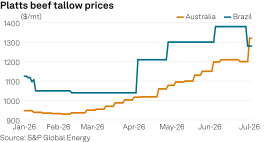
"Brazilian exporters may be discounting to attract buyers because their traditional flow to the US has been disrupted by tariffs/policy uncertainty. In 2025, the US was taking almost all Brazilian tallow exports, but tariffs made those sales harder," an Australian source said.
A US-based trader said buyers were unlikely to shift back to Brazilian tallow in the near term, despite lower prices, due to the lack of clarity around tariffs.
"I heard Brazil is very limited, and people are not really buying Brazil, so prices are going down with the government issue still unclear," the trader said.
Brazilian exporters seek diversification
According to Brazil's Secretariat of Foreign Trade (Secex), the US accounted for 96.8% of Brazilian tallow exports in 2025, totalling 389,571 mt. Most shipments moved before September, when a 40% surtax on Brazilian products took effect, which remained in place until February 2026.
As market participants had expected, the tariff made Brazilian tallow less competitive into the US, prompting many exporters to step back from the market.
The latest data in the S&P Global Energy Advanced Feedstock Analyst report also reflects the trend. Brazilian tallow exports to the US reached around 46,000 mt from Jan-April 2026, down 58.5% year over year. Meanwhile, Australian tallow exports to the US stood at around 90,000 mt over the same period, up 1.1% year over year.
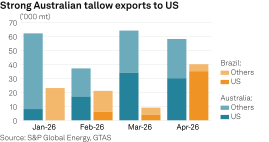
However, trading sources said Europe has not been willing to pay prices comparable with the US market, as Brazilian tallow is not considered an advanced feedstock under RED III rules.
"I will not buy tallow at a higher price than UCO, since both fall under the same category under RED III," a Singapore-based trader said.
Asian demand rises
Alongside stronger US demand, buying interest from key Asian markets, particularly Singapore and South Korea, has supported firm Australian tallow prices, market sources said.
"The primary driver of the global tallow market continues to be the strong demand from the Renewable Diesel (RD) and Sustainable Aviation Fuel (SAF) industries. These sectors are continuing to absorb significant volumes of feedstock, particularly across North and South America, providing solid support to international tallow prices," the Australian source said.
Australian tallow continues to attract strong buying interest from key Asian markets, particularly Singapore and South Korea. This sustained regional demand, combined with healthy global consumption, is helping maintain firm pricing for Australian-origin tallow despite recent geopolitical volatility, the source said.
Participants in both Singapore and the US prefer high-quality, low-FFA Australian tallow because of its consistent quality, processing performance, and sustainability credentials. Singapore has become an increasingly active competitor for Australian supply, with demand linked to large-scale renewable fuel refineries producing SAF and renewable diesel for global markets, particularly Asia and Europe.
The US-based trader said Singaporean buyers were making competitive bids for Australian material. "For Australia, there is more premium because of the lower FFA," the source said. "Buyers are still buying at that level, and they are still competing with Singapore, which is also buying from Australia."
Looking ahead, the market expects Australian tallow prices to remain firm in the near term, supported by steady demand from the US and Asia, unless there is a significant shift in geopolitical conditions or feedstock availability.
