Refined Products, Crude Oil
July 02, 2026 · Updated July 03, 2026
Refinery attacks boost June Russian crude exports, dampen products

Editor:
HIGHLIGHTS
Russian crude exports rise 9% on year
China, Singapore take more Russian crude
Product exports decrease 15% on month
Continued attacks on Russian refining infrastructure and resultant domestic shortages reined in Russian refined product exports in June, but left more crude available for international deliveries, according to cargo-tracking data.
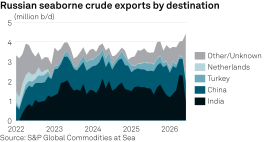
Seaborne exports of Russian crude were 4.414 million barrels/day in June, up 9% on the month and up 28% on the year, data from S&P Global Commodities at Sea showed July 2.
Preliminary data shows Russia exported 939,300 b/d to India in June, down 59% on the month and down 42% on the year. The figure could be revised upwards later. CAS data also shows Russia exported 458,000 b/d to Egypt, a top transshipment hub for Russian oil before the barrels reach Asia, compared with 190,000 b/d in May.
Separately, Russian crude exports to China were 965,600 b/d in June, up 12% on the month and up 6% on the year.
The US waiver for oil on water, extended several times by the US Treasury Department since the start of the war in the Middle East, expired on June 17. However, Indian authorities said in May that the US license had little impact on its refiners' purchase choices.
Russian crude shipments to Singapore surged to 796,800 b/d, up 581% on the month and up 1,090% on the year.
Russian Urals crude has been losing value against international benchmarks. Platts, part of S&P Global Energy, assessed the discount of Urals on a FOB basis at Primorsk to Dated Brent at an average of $25.17/b through June, compared to $21/b in May and against a five-year average of $19.78/b.
Platts assessed the discount at $27.93/b on July 1.
Refinery attacks
Seaborne exports of Russian refined products in June averaged 1.611 million b/d in June, down 15% on the month and down 31% on the year, CAS data showed.
Exports to Egypt, often for transshipments, were 389,394 b/d in June, up 25% on the month and up 340% on the year.
Russian exports to Turkey, another key buyer, averaged 311,169 b/d in June, down 19% on the month and down 36% on the year.
Refinery outages after drone strikes, coupled with seasonally high demand for both gasoline and diesel, are increasingly aggravating a fuel crisis in Russia, with regional authorities introducing limits on fueling cars and market sources reporting shortages.
On June 28, President Vladimir Putin chaired a meeting to discuss the domestic fuel market, during which he called for minimizing the consequences of attacks on infrastructure and ensuring stable fuel supply. Russia's biggest refineries are operating at maximum capacity, and small and medium-sized facilities are also being used, Putin said at the meeting. He added that repairs are being expedited and that planned maintenance has been deferred. He said July output of the main types of fuel should exceed June.
In a separate interview, Putin admitted that attacks on energy infrastructure "are creating problems, that's obvious," adding that repairs should be completed quickly, the sites should be reliably protected and that imports should be arranged. He also said that the shortages were not critical.
Russian authorities have not yet decided on a diesel export ban, Deputy Prime Minister Alexander Novak told journalists June 29, Interfax reported.
