Refined Products, Agriculture, Energy Transition, Jet Fuel, Biofuels, Renewables
June 26, 2026
Record RVO prices reshape refinery economics, boost US jet fuel output to all-time-highs
By Aaron Tucker and Ana Hernandez
Editor:
HIGHLIGHTS
Record RVO prices hit 37.62 cents/gallon
US jet fuel output reaches 2.203M b/d high
D4 RIN credits surge 131%, reach $2.44/gal
The US fuel market is being reshaped by record-high renewable fuel compliance costs, with refiners increasingly leaning into jet fuel production as a way to limit exposure to road-fuel blending obligations.
Under the Renewable Fuel Standard, obligated parties such as gasoline and diesel producers and importers are required to blend renewable fuels into the transportation fuel supply. The Environmental Protection Agency sets annual blending mandates that require parties to either blend renewable fuels or purchase compliance credits known as Renewable Identification Numbers (RINs).
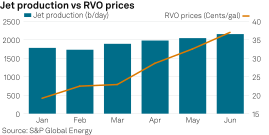
Jet fuel, which is not subject to EPA renewable fuel requirements, often sees increased production as refiners pivot away from the higher compliance burden of road fuels, such as diesel. As RIN prices have rallied over the course of 2026, jet fuel production has risen alongside.
Jet fuel output hits repeated highs
Platts assessed the current-year RVO at 37.6198 cents/gallon on June 26, setting a new all-time high and surpassing the previous record established just days earlier on June 24.
At the same time, US jet fuel production has reached new all-time highs 18 times this year, with the latest Energy Information Administration data from June 24 showing a new record at 2.203 million b/d.
The latest production figure is 7.6% above the five-year average and 4% above the same time last year, or 452,000 b/d and 239,000 b/d, respectively.
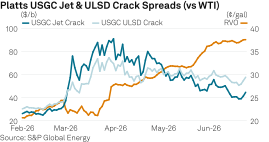
In the latest S&P Global Energy Refining Margin report from June 26, the USGC jet crack was measured at $46.48/b, higher than the previous 5-day average of $41.80/b but below the ULSD crack of $62.65/b. The higher ULSD crack reflects a return to historical norms, as ULSD typically runs a premium to jet.
Market sources have said the return to a normal spread between the ULSD and jet crack has been aided by the increase in the RVO.
"The ULSD crack at a $15/b premium is actually losing 75 points against jet due to the RVO," remarked one US jet trader on June 23. The ULSD-jet crack spread of about $16/b is almost equal to the RVO of $15.7/b, according to the latest Platts pricing data.
Rising RIN prices pushes RVO higher
The record-high RVO reflects broad strength across RIN prices, with D4 biomass-based diesel credits leading the rally.
Since the beginning of the year, US D4 RIN credits have soared by 131%, with prices reaching new records nearly every week since early May. Platts, last assessed D4 RINs at $2.44/gal on June 26, a new all-time high.
The surge can largely be attributed to the biofuel blending mandates for 2026 and 2027, finalized in late March. These targets represent the highest volumes ever established in the 20-year history of the RFS program, with 2026 mandates up 20.06% to 26.81 billion gallons and 2027 mandates rising 21% to 27.02 billion gallons compared to 2025.
Market anticipation ahead of the announcement led to a sharp contango, and prices continued to escalate as the finalized volumes exceeded earlier proposals. Following the announcement, RIN prices continued to climb as the volumes were even higher than expected and what was proposed earlier in June.
To meet these targets, the EPA estimated that biodiesel and renewable diesel production would need to increase by more than 60%.
In 2025, production of renewable diesel and biodiesel declined amid ongoing policy uncertainty surrounding final biofuel volume mandates and the 45Z tax credit. EIA data shows that RD production averaged 6.338 million barrels in 2024 but declined by 8% to 5.791 million barrels in 2025. Meanwhile, biodiesel output dropped 30%, from 3.316 million barrels in 2024 to 2.282 million barrels in 2025.
Sentiment surrounding the higher biofuel mandates has generally been positive within the biofuel industry. However, obligated parties subject to Renewable Volume Obligations—such as gasoline and diesel producers and importers—have raised concerns about the feasibility of compliance. As one refined products trader noted, "I'm worried about there simply not being enough D4s to meet the RVO when we roll into 2027."
BO-HO spread rises
The CBOT soybean oil versus NYMEX ULSD spread, commonly referred to as the BO-HO, climbed to a nearly three-year high on June 16, reaching $2.2146/gal.
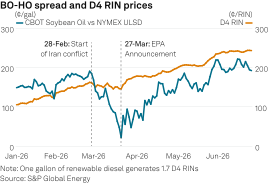
With US diesel prices easing from their recent highs following the onset of the Iran conflict, biodiesel blending economics have weakened, which could reduce production and lead to a drop in D4 RIN generation, helping sustain high prices.
