


Crude Oil
June 17, 2026
World oil market to return to surplus by year-end after Iran war shock: IEA

Editor:
HIGHLIGHTS
World oil demand to fall by 1.1 million b/d this year
Supply to return to 8 million b/d growth in 2027
Market set to swing to surplus as early as Q4
The global oil sector could return to surplus by the final quarter of 2026 as easing hostilities in the Middle East allow lost supplies to hit the market, the International Energy Agency said June 17.
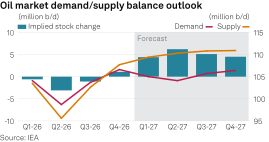
A new report from the Paris-based energy forecaster sees oil demand averaging 103.3 million barrels/day in 2026, down 1.1 million b/d from 2025 but still exceeding 102.4 million b/d in expected supply. However, the market may have seen the worst of the deficit in the second quarter, and could return to a 5 million b/d surplus in 2027.
The IEA quickly labeled the disruption from the Middle East war as the largest supply shock in history and has coordinated unprecedented stock releases to manage the crisis. Increasingly, soaring prices have also put pressure on consumers, and oil demand contracted in the second quarter for the first time since the coronavirus pandemic, it said.
However, an interim peace agreement between the US and Iran represents "an encouraging step forward," the report said, and improves the prospects of returning to a more sustainable trade environment in the coming months.
Shipments through the Strait of Hormuz fell from around 20 million b/d prewar to lows of 9.6 million b/d in May, but have already rebounded to around 12 million b/d due to a rise in ship-to-ship transfers in the Gulf of Oman, the IEA estimates.
Assuming improving conditions through the second half of the year, the agency now sees global oil supplies surging by around 8 million b/d to 110 million b/d by 2027. The shift could produce a "significant overhang," it said, but not before stocks reach historic lows.
"This may provide a welcome respite to the market and an opportunity to replenish depleted inventories, or to build new strategic reserves, as countries review their energy strategies and policies in response to the crisis," the report said.
Demand destruction
Despite collective efforts, markets have been unable to avoid demand destruction that accelerated in April and May, the IEA said, cutting its full-year projection by 700,000 b/d.
Its latest view, reflecting a 1.1 million b/d contraction in annual demand, contrasts with the 850,000 b/d of growth expected before the war and the 1 million b/d still forecast by OPEC.
According to the IEA, demand in the first quarter fell by 5 million b/d quarter on quarter, led by losses in Asia and the Middle East. Japan has cut its crude imports by around 40% since the beginning of the war, while China is expected to consume 360,000 b/d less oil in 2026, marking its first significant annual decline since the 1980s.
In contrast to the beginning of the conflict, when stresses were most visible across petrochemicals feedstocks and jet fuel markets, declines have increasingly shown up across all major fuels. Global gasoil consumption in April and May was down almost 4% year over year, while naphtha dropped 13%. Gasoline fell by 2%, with losses offset by government subsidies prominent across Asia.
Apparent Chinese run cuts, a key question mark for analysts, were likely driven by weaker refining margins, and are unlikely to linger at May lows, the IEA said. Considering actual demand losses, the agency expects a 600,000 b/d month-on-month rebound in Chinese consumption through the second half of the year, starting in June.
Returning Gulf supplies should help ease prices and encourage a rapid rebound in demand, which is expected to grow by 2 million b/d in 2027, the IEA said. LPG, ethane and jet fuel could receive a boost from pent-up demand during the conflict, while motor fuels remain at risk of "economic scarring" and transition headwinds potentially accelerated by the crisis, the report said.
Growth will mostly come from outside OECD countries, which are expected to consume 210,000 b/d less oil in 2027 than in 2025. "The OECD's long-running structural decline tends to be concentrated around global shocks, with plateaus in between," the report said.
Supply adjustment
World oil production totaled 94.5 million b/d in May, down almost 14 million b/d from prewar levels due to ongoing shut-ins and lower usage of bypass pipelines, the IEA said. On a year-over-year basis, it sees 2026 supplies falling by 3.9 million b/d.
Nevertheless, output is expected to increase dramatically next year, led by extra supply from the Americas and returning Gulf capacity. US oil production hit a record high of 22 million b/d in May, and is set to grow by another 300,000 b/d in 2027. Latin America is also on track to increase its output by 900,000 b/d this year, according to the report.
In sum, non-OPEC+ production in 2026 is expected to climb by 820,000 b/d to 60.3 million b/d. The UAE, which the IEA began including in its non-OPEC+ balances this month, is subsequently expected to be one of the largest contributors, with production in 2027 expected to rise by 730,000 b/d to 5.2 million b/d.
Pending a return in traffic through the Strait of Hormuz, Saudi Arabia is poised to boost production by 4.6 million b/d between the second and fourth quarters, close to the 4.8 million b/d expected from all other OPEC+ countries in the Gulf. Projected Russian oil output was cut by 180,000 b/d for 2026 due to the impact of Ukrainian attacks, and held steady for next year.
With the terms of a final US-Iran peace agreement yet to be negotiated, the IEA warned its outlook relies on "critical but contentious details" and remains exposed to downside risks. The organization has yet to announce a new publication date for its long-term oil report, which it was due to release June 17 but deferred last month.
