Crude Oil
June 16, 2026
Oil benchmarks test new floors on promise of US-Iran deal
By Kelly Norways and Natasha Tan
Editor:
HIGHLIGHTS
Brent crude futures below $80/b for first time since March
Crude backwardation narrows to early March levels
Jet fuel, gasoil and LPG close near prewar lows
International oil benchmarks have lost almost all their gains linked to the conflict in the Middle East amid growing optimism for a preliminary peace deal expected to be signed by the US and Iran on June 19.
After almost two months of sell-offs in anticipation of a deal, markets have been in freefall since the US and Iran confirmed a breakthrough agreement on June 14, raising expectations for a rapid rebound in Middle Eastern shipping traffic.
On June 16, ICE Brent crude futures settled below $80/b for the first time since the first week of the conflict, closing at $78.96/b. Prices have continued to trade roughly $8/b above prewar levels, and some $30/b below the heights reached in mid-May. Dated Brent crashed to $80/b on June 17, its lowest since March 2, and $9/b above where it was assessed before the first US-Israeli attacks.
"Markets appear to be pricing in a relatively high probability of a full Hormuz flow normalization," HSBC analysts, including Kim Fustier and Ildar Khaziev, said in a June 16 note.
James Hosie, an equity analyst at UK investment bank Shore Capital, said a return to preconflict shipping traffic could take months, but said the news could be seen as "removing the threat" of a continued stalemate that could spur further price spikes.
With prices declining, market structures have flattened, shedding hefty premiums for prompt supply. For ICE Brent futures, M1/M2 backwardation -- or the premium for the August contract over September -- has narrowed to 38 cents/b, the weakest spread since the war began, and has shrunk by around three quarters in the last week.
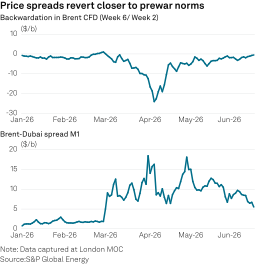
The Brent Contract-for-Difference, which measures the difference between physical barrels and forward-dated supply, has almost returned to its structure in February, with backwardation quickly evaporating. On June 17, settlements for the penultimate week of June were priced just 51 cents above levels four weeks ahead, contrasting to an equivalent time spread of $24/b in early April.
Meanwhile, the Brent/Dubai spread, which reflects the difference between the Atlantic Basin benchmark and its Middle Eastern equivalent, has dropped to $5.58/b, down from over $18/b and its lowest since March.
Future risk premium
Despite the drastic price swings, analysts say prices could go even lower.
"People still need to price in a structural resumption of flows. But if you go with that scenario, I think oil prices could reach $70/b," said Aldo Spanjer, head of commodity strategy at Paris-based bank BNP Paribas.
Morgan Stanley and Goldman Sachs have both already cut their fourth-quarter Brent crude price forecasts by $10/b or more. Investor positioning for energy stocks implies that speculators are also pricing in $70/b Brent, Joshua Stone, head of European energy at UBS, said, adding that further downside risks are possible.
Markets will continue to factor in a risk premium to account for the threat of another flare-up in attacks, but comfort levels could be improved by evidence of recent market resiliency after more than 100 days of the war, according to a note from Goldman Sachs.
The speed of future supply injections will depend on the willingness of ships to re-enter the Strait of Hormuz once some 600 tankers currently stuck in the Gulf are able to clear out. In a best-case scenario, returning tankers could take 45 days to arrive from locations mostly on the US Gulf Coast, Spanjer said, but timelines could be longer, subject to mine-clearing timelines and workable insurance costs.
Refining challenge
Oil products will prove more challenging to return to the market than crude or LNG, Spanjer said, depending on refinery repairs in countries including Bahrain, Kuwait and Saudi Arabia.
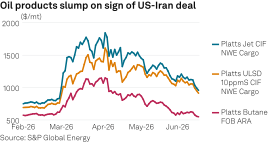
Nevertheless, fuel prices have retreated significantly. CIF Northwest European jet fuel cargoes fell to $957/metric ton on June 16, the lowest level since the war began, and down 14% week over week, but remains $135/mt higher than prewar levels as of June 17. ICE Low Sulfur Gasoil futures have shed 13% in the past week to return to March 2 lows.
Very low sulfur fuel oil -- the main fuel used in the shipping sector -- has dropped by more than $60/b in Europe, while some LPG prices have returned to January levels.
Several analysts have urged caution before prices spring back to February levels. For instance, Morgan Stanley researchers Martijn Rats, Charlotte Firkins and Amy Gower described a "counterintuitive weakening" in Asian naphtha cracks, which are currently hovering near one-year lows, despite around a third of seaborne supply remaining mostly offline.
According to Spanjer, the market may have narrowly avoided steeper demand destruction and refinery run cuts, which could have further depressed prices. Stable consumption, coupled with a spurt of new stockpiling, could easily push crude prices back to $80/b by year-end after an initial sell-off, he said.
"Every importer in the world will build higher stocks postwar, because this is the third once-in-a-lifetime crisis in six years," he said. "I do not think that is priced in."
