Maritime & Shipping, Crude Oil, Wet Freight
June 16, 2026
Hormuz insurance costs deter clean tankers more than crude carriers: brokerage
Editor:
HIGHLIGHTS
War-risk premiums too high for smaller ships
Insurers await sustained peace to cut premiums
Middle East product exports fall to 1 mil b/d
High insurance costs present a greater deterrent to oil products tankers contemplating transit of the Strait of Hormuz than to crude carriers, amid a relatively smaller wartime boost to product freight rates, according to analysts at ship brokerage BRS.
Since the outbreak of the war, additional war-risk premiums have stood at about 10% of hull value, BRS said in a research note June 15. European tanker sources put the figure closer to 7%-9% for clean tankers and 5%-5.75% for crude tankers.
"This cost is easily absorbed by still-stratospheric crude tanker freight rates, but there is evidence to suggest that smaller product tankers receiving lower rates have been discouraged from crossing Hormuz as insurance premiums are not so easily absorbed," BRS said.
Platts, part of S&P Global Energy, assessed the rate to carry a 65,000-metric-ton cargo of refined products from the Persian Gulf to the UK-Continent at $78.46/metric ton June 16, 52% above the five-year average. Similarly, Platts assessed the rate to carry a 90,000 mt cargo of refined products on the same run at $72.78/mt June 16, 41% above the five-year average.
By contrast, Platts assessed the rate to carry a 270,000 mt cargo of crude from the Persian Gulf to China at $74.48/mt June 16, 326% above its five-year average, and the rate to carry a 140,000 mt cargo of crude from the Persian Gulf to the UK-Continent at $105.14/mt June 16, 307% above its five-year average.
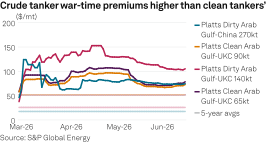
Even before the US and Iran announced they were to sign a peace deal, there were some exports from the region.
In 2025, 4.1 million barrels/day of clean refined products were exported from the Persian Gulf, according to data from S&P Global Commodities at Sea. In May 2026, it was 1 million b/d, a 76% decrease.
As for crude, 17.5 million b/d were exported in 2025 and 3.8 million b/d in May 2026, a 78% reduction.
Thus, the decrease in volumes across both sectors was broadly equivalent.
After three consecutive days with ship transits remaining below 10, activity rebounded to 16 ships on June 15, according to data from CAS.
Fragile ceasefire
"With the opening of the Strait upon the signing of the Deal on Friday, for purposes of mine removal, oil will flow on both ends again for the Region, and the World," Trump said June 14 in a post on his social media platform Truth Social.
Iranian President Masoud Pezeshkian described the agreed memorandum of understanding as an "important step" toward a final agreement. This signals diplomatic progress but also underscores that a durable resolution "has yet to be reached," CAS analysts said June 16.
Even with the impending agreement, some insurers remained hesitant.
"For the marine community, crucially absent from the agreement (as disclosed to date), are the practical details surrounding the Strait of Hormuz reopening, particularly Iran's guarantee to respect freedom of movement within the Strait and the region as a whole," Marcus Baker, global head of Marine, Cargo & Logistics at Marsh, said June 15 in a statement.
While some marine insurers recognize that conditions in the Persian Gulf region have improved over the weekend, the overall market response in the short term will hinge on further de-escalation of hostilities or perceived breaches of the agreement, Baker said.
"In the longer term, following a final agreement, there will need to be a sustained period of no further attempted or successful attacks on commercial shipping before there is an adequate environment to implement a market-wide, significant and meaningful concession in insurance costs," Baker said.
