Agriculture, Energy Transition, Refined Products, Biofuels, Renewables, Jet Fuel
June 15, 2026
Global SAF market needs long-term contracts to unlock investment: experts
By Thomas Washington and Mia Pei
Editor:
HIGHLIGHTS
SAF industry requires 10-15 years contracts
Asia-Pacific feedstock advantage critical for EU compliance
China's SAF capacity to grow over 14 mil mt by 2028: Veridian
Europe's sustainable aviation fuel industry faces a structural supply deficit that cannot be resolved without significant production capacity from the Asia-Pacific and binding long-term contracts that unlock investment in large-scale facilities, according to industry experts.
The challenge stems from a fundamental mismatch between Europe's binding SAF blending mandates under the RefuelEU Aviation regulation and the fragmented, pilot-stage nature of global supply chains. While Europe requires 2% SAF blending in 2025, rising to 70% by 2050, current production capacity remains insufficient to meet these targets without imports from regions with stronger feedstock advantages, particularly Asia-Pacific countries including India, Malaysia, Thailand and Australia.
"What the SAF market needs now is not more pilots, but more long-term contracts that allow capital to flow into production assets," Will Symons, sustainability leader at Deloitte Asia-Pacific, told Platts, part of S&P Global Energy, June 12.
The core obstacle is a classic investment deadlock: producers require guaranteed demand over 10 to 15 years before committing capital to new facilities, while airlines hesitate to sign large offtake agreements without confidence in future supply availability and pricing, Symons said. This chicken-and-egg dilemma has stalled numerous projects at the final investment decision stage, despite growing regulatory pressure on airlines to secure compliant fuel, he said.
Breaking this impasse requires mechanisms beyond voluntary initiatives, Symons said. Early-stage projects might benefit from government underwriting or production credits, while the next phase of market maturity will demand multiyear offtake agreements, aggregated demand pools, corporate co-investment models and risk-sharing mechanisms across airlines, he said.
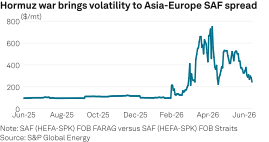
SAF in Europe has seen its premium over product in Asia grow since the war in the Middle East started at the end of February, but it has been volatile during that period. Platts assessed SAF on a FOB basis at Flushing-Amsterdam-Rotterdam-Antwerp-Ghent at $2,830/metric ton June 12, a $245 premium over SAF on a FOB basis at Singapore.
The premium has averaged $417/mt since the start of the conflict; it averaged $129/mt from the launch of Singapore assessment in October 2024 until that point, Platts data showed.
Feedstock constraints
The supply challenge is particularly acute because most current SAF production relies on the Hydroprocessed Esters and Fatty Acids pathway, using waste oils and fats, including used cooking oil and animal fats. Industry stakeholders increasingly recognize these feedstocks alone cannot support long-term aviation fuel demand growth.
Competition for limited feedstocks is intensifying in the Asia-Pacific, where countries are simultaneously pursuing ambitious national SAF targets. Japan's experience illustrates the scale of the challenge: even aggressive collection programs for used cooking oil are unlikely to meet national SAF ambitions without imports and alternative feedstock pathways, Symons said.
This reality makes cross-border supply chains increasingly important. The market must diversify feedstock pathways beyond HEFA to include agricultural residues, municipal solid waste, alcohol-to-jet technologies, and synthetic e-SAF, Symons said.
China's expansion
China's SAF industry is entering a rapid expansion phase, with operational capacity projected to grow from 2.3 million metric tons in 2026 to over 14 million mt by 2028, according to Shanghai-based consultancy Veridian Advisory. Over 70 projects are in the market, with growth driven by export demand, especially Europe's blending mandates, domestic decarbonization targets, and biofuel producers converting operations to SAF.
"The rapid increase (in SAF production capacity) is mainly driven by several leading Chinese biofuel players that are actively converting or expanding toward SAF production," Veridian Advisory's partner Karen Chensaid, noting Junheng Bioenergy, Jiaao and Tianzhou New Energy.
Chen said the projected output capacity includes partial HVO capacity of the projects with flexible renewable fuel configurations, and the actual output by 2028 could end up lower than the announced nameplate capacity, given delays in technology scale-up and offtake agreements.
S&P Global Horizons' estimates show that the renewable diesel and SAF capacity in China, based on publicly announced projects, stands at 7.69 million mt in 2028, more than doubling from 2025's 3.07 million mt, mainly through the HEFA-SPK pathway.
However, many Chinese projects targeting European markets face exposure to international policy and trade risks, particularly around meeting EU sustainability criteria. China's experience with ISCC/EU certification remains limited, and sustainability systems need improvement, according to Veridian Advisory's analysis.
Policy stability critical
Inconsistent policy frameworks can significantly slow investment, with investors requiring confidence that incentives will remain in place and mandates will be supported by production incentives, Symons said. The most successful SAF markets are likely to be those providing investors with a decade-long horizon for planning and capital deployment, rather than relying on short-term policy interventions.
"The question is no longer whether demand for SAF exists. Rather, it is whether the policy environment and supply chain can provide the confidence necessary to unlock long-term capital commitments," Symons said.
For Asia-Pacific airlines, promoting regional production of alternative fuels and diversifying supply chains has become strategically important, particularly in countries without sovereign oil and gas reserves. The real strategic asset in SAF will not just be the refinery but securing the end-to-end value chain, underpinned by government policy support, Symons said.
