Crude Oil
June 11, 2026
The great oil reserves draw: how low can stocks go?

Editor:
HIGHLIGHTS
440 million barrels drawn from reserves
US SPR faces challenges at 33% capacity
Declining political will to deplete scarce reserves
The global oil market is nearing its capacity to drain emergency reserves as governments stretch their tolerance level to deplete stockpiles, according to analysts and industry experts.
The world had a comfortable buffer of oil supply before the US launched its first airstrikes on Iran on Feb. 28, with inventories at about five-year highs of 8.2 billion barrels and buoyed by a year of aggressive Chinese stockpiling, according to the International Energy Agency.
However, stocks have plummeted since the conflict in the Middle East suspended most oil trade through the Persian Gulf, leaving the world's largest reserves close to all-time lows and forcing governments to consider when to turn off the taps.
In the three months since February, about 440 million barrels of crude and refined products were drawn from commercial and state reserves, according to analysts at S&P Global Energy CERA.
Averaging at roughly 6 million barrels/day, the stock draws have done most of the work to mitigate the supply shock, contrasting with an estimated 4.6 million b/d of demand destruction in the second quarter compared to 2025 levels.
US buffer
The bulk of spare capacity has come from the US, historically the world's largest stockpiler of oil, which has drained its Strategic Petroleum Reserve close to all-time lows.
In the week to June 6, the US had drawn over 66 million barrels of crude from its petroleum reserve, leaving it at nearly half its capacity, according to the latest government data. The balance is 349 million barrels, but in practice, the country could have closer to 100 million barrels available before constraints become apparent, according to some analysts.
"The US we suspect is starting to approach what is described as an 'operational floor'," said John Evans, an analyst at the US-headquartered brokerage PVM Oil Associates, on the state of the reserve.
"Our understanding is that it cannot be allowed to drop below a minimum 33% of capacity because the caverns in which reserves are kept will be compromised," Evans said. Estimates vary over the minimum threshold needed to keep pipelines and other infrastructure operating, but industry veterans agree the threshold is approaching fast.
"Once the drawdown is complete, we're going to be down to 250 million barrels. That's already way too low for comfort," said Paul Simons, a former IEA and US Department of State official.
Those levels would only be enough to cover about two weeks of domestic consumption and sit well below a preferred floor of 30 days' cover, he said.
Commercial inventories are also falling fast. In a June 9 note, Jeff Currie, a senior adviser at investment company The Caryle Group, said supplies in Cushing, the physical delivery point for West Texas Intermediate crude, were "weeks" from nearing the floor where the futures settlement mechanism begins to break down.
The CME Group, which manages the WTI futures contract, was not available for comment.
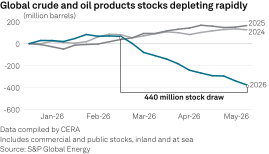
Across the US, inventory losses have been driven by a surge in oil exports, which have risen 3 million b/d higher since the war began, according to CERA analysis. Gasoline stocks have dropped for 15 weeks straight, while diesel stocks have languished near "critical levels" ahead of summer driving season, Currie said.
OECD countries, which typically hold about half the world's oil inventories, had just 28 days' worth of demand cover in state reserves at the end of the first quarter and 63 days in commercial stocks, according to the latest IEA report.
In April, the IEA warned that Europe's total jet fuel reserves could fall below 23 days by August if it can only replace 75% of its lost Middle Eastern supply, or earlier if substitute volumes drop. At those levels, airports face the prospect of physical shortages. Non-OECD Asian countries, excluding China, face stock-outs earlier, having only held about 22 days' worth of cover in crude inventories.
Globally, gasoline stocks fell below their 2021-2025 range in May, while middle distillate supplies have hovered close to 2022 levels. In the fuel oil market, supplies have dropped even more dramatically, with European stocks now at historic lows.
Future trajectory
With little clarity over when Persian Gulf shipping can resume, political appetite for further destocking looks increasingly uncertain.
The IEA is halfway through releasing 400 million barrels of oil into the market between its 32 member states, Toril Bosoni, its head of oil research, said earlier in June.
The historic stock release amounted to about a fifth of the supplies at the organization's disposal and further action is under constant discussion, according to its Executive Director Fatih Birol.
Nevertheless, the market is approaching the "red zone" for inventories in the next one-two months, Birol has warned, and market watchers have said that future releases could prove challenging to approve.
"Another release would not help the market -- it would be viewed as a sign of desperation," said former IEA executive Paul Simons.
China, the world's second-largest oil consumer, has eased the supply crunch by cutting its crude imports, but it remains unclear the extent to which it has drawn on its estimated 1.3 billion barrels of crude stockpiles, according to the IEA.
War risks and geopolitical considerations will complicate decision-making around additional releases.
"One wonders if any country, particularly the biggest contributor of oil stock relief, the United States, will be willing to denude themselves of further reserves," said a recent note from CERA analysts.
With a diminishing stock buffer, consumption will be forced to shrink. CERA analysts now see global oil demand falling at least 2.4 million b/d annually in 2026, seeing the Brent crude benchmark average $110/b over the full year.
