


Refined Products, Diesel-Gasoil, Fuel Oil, Jet Fuel
June 03, 2026
INTERVIEW: Mercuria shipping head says fuel shortages could idle 10% of global fleet

Editor:
HIGHLIGHTS
Refiners sacrificing marine fuel to boost yields
World months from regional fuel shortages
Loss of Middle East exports puts pressure on rates
The shipping sector is fast approaching a fuel crisis that could paralyze a tenth of the global fleet, Larry Johnson, global head of freight at commodities trading house Mercuria, said in an interview.
Since the Middle East war erupted, markets have been preoccupied with potential shortfalls in the diesel and jet fuel traditionally exported in large quantities from the Persian Gulf.
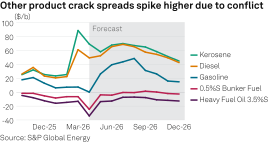
However, as refiners strain to capture soaring clean product cracks, residual fuels have suffered. Increasingly, feedstocks have been held back from the marine fuel market to kept for further processing, leaving the shipping sector at risk of crippling shortages, Johnson said.
"My view on marine fuel oil is there will be regional stock-outs by July and that there are potentially outages in the major hubs by August, September, at the latest," Johnson said.
Unlike other sectors, the shipping industry lacks a buffer of state reserves to manage emergency crises. A steeply backwardated market structure has encouraged suppliers to offer stocks rather than forfeit hefty premiums for prompt supply, triggering steep draws on private inventories.
Singapore, the world's largest bunker hub, saw residual fuel supplies near one-year lows in April, but has pulled additional stock from Europe and Russia to slow losses. Inventories in Northwest Europe have continued to slide, however, and stocks in the UAE's Fujairah have launguished at record lows.
"For marine fuel oil, there's no buffer. There's nothing. So once you're out, you're out. And then ships will have to try to buy diesel fuel, for example," Johnson said.
The sector would then be forced to compete with other end-markets for limited gasoil supplies, which already command a premium to conventional fuel oil.
The global shipping industry in 2025 consumed roughly 3.3 million b/d of residual fuels, and 870,000 b/d of marine gasoil, equivalent to almost 5% of global oil product consumption, according to analysts at S&P Global Energy CERA.
Prices for 0.5% sulfur fuel oil – the industry's most popular fuel type – almost doubled in the first three weeks of the war, lifting the Platts bunkerworld marine fuel index to a four-year high of $1022/mt. Values have since eased to $830/mt, but remain almost 60% higher than pre-war levels.
After the first price spikes, ships were seen part-loading tanks to minimize fuel costs and bet on future price drops. But as the conflict drags on and shortages become more visible, confidence on future fuel availability is faltering.
Demand pressure
Should trade disruptions last another month, Johnson says mass fuel shortages could trigger trade congestion on the scale of the Covid-19 pandemic – shutting down as much as 10% of marine traffic.
As vessels jostle for limited supply, lower-margin segments like dry bulk are most likely to be caught short, he said, potentially exacerbating challenges for agricultural sectors relying on fertilizers for next year's crops.
At the same time, a broader trade slowdown could have a chilling effect on freight rates.
Platts, part of S&P Global Energy, assessed its Global Dirty Tanker Index, which captures a variety of vessel sizes, at a record of over $221,000/day on March 4, but rates have since almost halved in value.
The start of the war caused a burst of activity among buyers seeking short-term substitutes to lost Middle Eastern supplies. But with some 15 million b/d of oil exports still off the market, and signs of imminent demand destruction, that boost appears to have been short-lived.
"If there's three more months of closure, tanker freight rates are going down. There isn't enough oil elsewhere in the world to replace the lost exports from the Middle East," Johnson said.
The extent of the shock will depend on the evolution of the conflict, which has kept over 400 tankers stuck within the Gulf. In April, Mercuria CEO Marco Dunand said the company had successfully evacuated some of its tankers in the early stages of the war, but declined to provide detail on the number still stranded.
Hormuz transits
After the introduction of Iranian tolling on the waterway, transits have mostly slanted towards Iran-linked tankers, producing structural disadvantages for Western traders conscious of observing sanctions, Johnson said.
"Vessels owned or operated by government entities have had some success in getting ships through," he said. "But they, of course, have different diplomatic channels than we would have, and they would have different government types of resources, including potentially military personnel."
Shifting market dynamics could give a boost to the growing fleet of "shadow tankers" used to circumvent restricting, creating additional challenges in regulating a network of Iranian, Russian and Venezuelan tankers that is already over a thousand strong.
"No matter how many ships you put on the sanctions list, you've reached a point of diminishing returns -- when the sanctioned fleet nears the size of the non-sanctioned fleet, then you're out of bullets, the sanctions start to lose effectiveness," Johnson said.
Crude oil futures have continued to hover below $100/b on hopes of a peace agreement between Israel and Iran, although attacks from both sides have tempered expectations for a diplomatic breakthrough.
Platts assessed the Dated Brent physical crude benchmark at $97/b June 2, down from an all-time high of $144/b in April.
