Maritime & Shipping, Crude Oil, Natural Gas, LNG, Wet Freight
October 28, 2026
INTERVIEW: Equinor expects UK to greenlight Rosebank oil and gas project

By Matt Hoisch
Editor:
HIGHLIGHTS
Any other decision would be 'extraordinary': CFO
Decision will send investors strong signal
Warns of European winter gas vulnerability, volatility
Norway's Equinor expects the UK government to greenlight the Rosebank oil and gas development in the UK section of the North Sea, CFO Torgrim Reitan told Platts, part of S&P Global Energy, in an interview Oct. 28 following the release of the company's third-quarter 2026 results, saying any other decision would be "extraordinary."
"We clearly expect that Rosebank is going to be approved," he said. "Anything else would be extremely extraordinary."
In 2023, Equinor took a final investment decision on the project, which is now operated by Adura, a joint venture between Equinor and Shell PLC. The UK government had previously approved the project, but a 2025 court ruling found that the initial government consent was invalid on emissions-reporting grounds.
The court in 2025 allowed work to continue but required resubmission of the environmental impact assessment and forbade production from starting until the project was reapproved. The UK recently reapproved another previously approved, Adura-operated project that was similarly delayed: the Jackdaw offshore gas development.
Reitan stressed that Rosebank is in the "very, very final phase" and "ready to start production in just a few months."
"We are watching this very, very carefully," he said. "A decision here will send a very, very strong signal to investors about the seriousness of the UK government and how they treat investors in their country."
Equinor CEO Anders Opedal said earlier this month that a decision not to greenlight the start of production at Rosebank risks making the UK "uninvestable" for oil companies.
European gas vulnerability
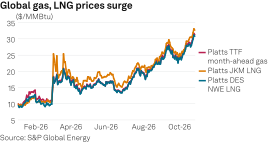
When it comes to the European natural gas market, Reitan warned Oct. 28 that the continent is "vulnerable" heading into winter, with record-low gas storage and elevated prices amid the ongoing conflict in the Middle East.
"It is a vulnerable situation; we need to be prepared for a lot of volatility," he said.
European gas storage levels are trailing those recorded at the same time in recent years. EU-wide storage was 74.9% full as of Oct. 26, according to the latest data from Gas Infrastructure Europe. That was the lowest level for this time of year on record, going back to 2011, GIE data showed.
Lower storage levels typically mean that weather shifts spur larger price movements, Reitan said. "The weather will have a significant impact over the next few months," he said.
While market watchers widely expect this year's global El Niño weather pattern to result in a generally warmer winter, Reitan said that this bearish expectation is already priced into the forward curve.
"People are aware of that effect, and everyone knows that it possibly will have an effect," he said. "Meaning that cold spells ... will typically create a lot of volatility in this situation."
European gas prices have surged to recent highs over the past month. Platts assessed the month-ahead Dutch TTF gas benchmark at €95.83/megawatt-hour on Oct. 27. The index is near its highest level since December 2022.
Reitan subsequently said separately during an Oct. 28 call with analysts that while there is a potential for high prices to stoke demand destruction, Equinor has also seen more interest from market players to buy gas longer-term.
"We see actually an increasing appetite for long-term gas," he said on the call.
The interest comes as Europe faces stiffer competition with buyers in Asia for scarcer spot LNG cargoes due to the wartime disruptions hampering transit through the Strait of Hormuz.
"We see actually fairly solid demand [in Asia] for LNG, even at the current prices," Reitan told analysts.
Even as oil exports from the Middle East have largely rebounded toward pre-war levels, Reitan said Equinor expects LNG flows through Hormuz to remain "very, very limited" until there is a resolution to the conflict.
"There is a significantly different risk related to an LNG ship than a crude tanker," he said.
Other efforts
Reitan also provided updates to Platts on other Equinor oil and gas efforts.
In its home country, Equinor has previously said it aims to maintain oil and gas output from the Norwegian continental shelf at 2020 levels through 2035.
Reitan clarified Oct. 28 that the company is not targeting a specific split between oil and gas output under that goal, but that its current split is "pretty representative for the future."
In 2025, Equinor reported liquids production in Norway totaling about 671,000 barrels of oil equivalent/day, while gas production was slightly higher at 739,000 boe/d, according to the company's annual report.
Regarding Equinor's long-running efforts to develop an LNG export facility in Tanzania, Reitan said there was "nothing new" to share.
The project has faced headwinds amid stalled government discussions over its development.
"We do hope that it will move forward," Reitan said. However, while there has already been a lot of preparatory work, he added that "currently, we are not spending much money at all."
Several other companies are also involved in the push to develop an LNG export facility in Tanzania, including Shell and ExxonMobil.
