Natural Gas
October 21, 2026
UK approves high-profile Jackdaw gas development
By Matt Hoisch and Charlie Mitchell
Editor:
HIGHLIGHTS
Adura says gas supply can start ‘within weeks’
Court had invalidated earlier approval
Potential new approach with Rosebank decision due
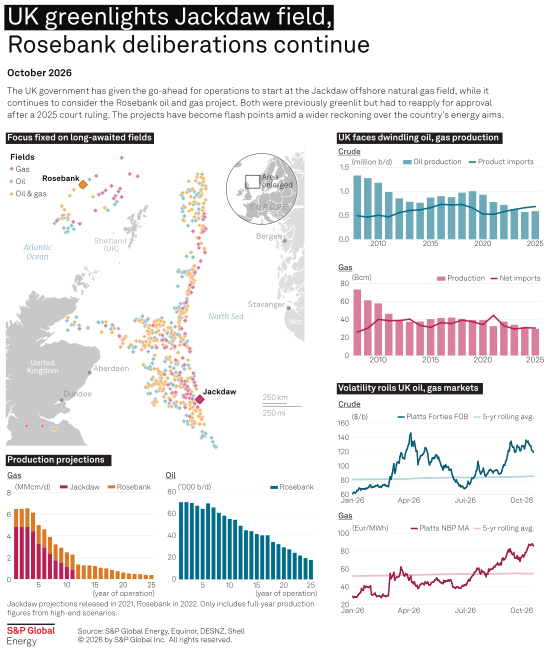
The UK government has approved the Jackdaw offshore natural gas development in the North Sea, it said Oct. 21, allowing one of the country's most contentious energy projects to start up within weeks and signaling a new, more pragmatic approach from Downing Street.
"The OGA [Oil and Gas Authority] granted consent [for Jackdaw] on Oct. 21, 2026. Accordingly, the project may proceed," the government said in a decision document.
The development is operated by Adura, a joint venture between Shell PLC and Norway's Equinor.
"Today's approval clears the way to allow Jackdaw to start supplying gas to British homes, power stations and businesses within weeks," Adura said in a statement Oct. 21.
The operator has said Jackdaw would increase the UK continental shelf's natural gas production by 6% at its peak.
Court challenge
Jackdaw had been approved by the prior Conservative UK government in 2022. However, a court in 2025 found that the initial government consent was invalid because the regulatory approvals process should have taken into account emissions resulting from the consumption of the associated oil and gas.
The 2025 ruling also invalidated the government's consent for another previously approved, Adura-operated project in the UK offshore, the Rosebank oil and gas field, for emissions-calculation reasons. Jackdaw and Rosebank will ultimately provide 10% of UK natural gas supply, according to Adura.
The court in 2025 allowed work to continue on both projects but required resubmission of the environmental impact assessments and forbade starting production until the projects were re-approved.
The UK government is still considering a decision on Rosebank after Adura submitted further information on the development.
The Jackdaw decision was formally taken by new energy secretary Miatta Fahnbulleh, who was given the key job by Prime Minister Andy Burnham after he took office in July.
"This decision will support the country's energy security with homegrown gas this winter and help minimize the UK's use of imported higher emission fuels as we continue our transition to renewables and nuclear," Fahnbulleh said in a statement on the Jackdaw move. "The decision is compatible with our legally binding climate commitments, and we remain resolute in ending new licenses for oil and gas and achieving net zero by 2050."
The previous incumbent, Ed Miliband, who is now foreign minister, was accused by the oil and gas industry of dragging out the decision. Miliband had been the face of the UK's net-zero ambitions.
Even before the Jackdaw approval, Burnham had signaled a more pragmatic approach to the UK North Sea, which is widely regarded as an economic lifeline for the northeast of Scotland.
Conservative leader Kemi Badenoch welcomed the decision, while accusing the government of dithering, while Zack Polanski, leader of the left-wing Green Party, said it amounted to "climate vandalism."
The approval was also cheered by labor union Unite. "Whilst we of course support net zero, we cannot have a jobless transition, abandon our energy security or offshore our carbon responsibilities. That is why we have argued for this decision on Jackdaw," Sharon Graham, its general secretary, said Oct. 21. "We simply cannot let go of one rope until we have hold of another."
The move to greenlight Jackdaw comes as UK gas prices — like those across Europe — have soared to recent highs ahead of winter, amid continued trade disruptions linked to the war in the Middle East.
Platts, part of S&P Global Energy, assessed the month-ahead UK NBP gas price at €85.564/megawatt-hour on Oct. 20. The benchmark is around its highest point since December 2022.
Softer approach
Meanwhile, industry players have been closely watching Jackdaw for signs of a softer approach to oil and gas, after complaining for years about regulatory uncertainty, a challenging tax environment and bans on new exploration. The Energy Profits Levy, which has raised the headline tax rate to 78%, has driven a wave of consolidation and exits from the North Sea by international oil companies.
"Approving Jackdaw is the right decision, but this does not stop the damage being done to the North Sea. And it appears Rosebank remains stuck in political limbo," said an Ineos spokesperson in a statement, calling for the Energy Profits Levy to be amended in the UK chancellor's upcoming budget.
Earlier this month, Equinor CEO Anders Opedal warned that the UK was at risk of becoming uninvestable if Rosebank and Jackdaw were not approved.
"We have applied for consent twice, so now is the second time. We and Adura have done everything we have been asked to do in terms of the approval process, and I think the UK is probably one of the most rigorous approval processes for oil and gas fields in the world," he said. "So our expectation for Rosebank and Jackdaw is that they get approved."
"If not ... I think we and others would then ask, is the UK investable?" he added.
The executive chair of Ithaca, one of the UK's largest domestic players, also told the Financial Times this week that it would likely halt UK investment if Rosebank — in which it has a stake — was not approved.
David Whitehouse, CEO of industry lobby group Offshore Energies UK, said in a statement: "Today's decision on Jackdaw is an important step forward. But securing Britain's energy future means unlocking a wider pipeline of North Sea projects that could deliver £50 billion of investment, strengthen energy security, support jobs and supply chains across the UK, and help meet more of the country's future energy needs from domestic production rather than imports."
