LNG, Crude Oil, Energy Transition, Electric Power, Natural Gas, Renewables
September 17, 2026
GASTECH 2026: LNG participants split over long-term implications of Hormuz shock
By Matt Hoisch and Surabhi Sahu
Editor:
HIGHLIGHTS
Some see recent turmoil limited to near-term concern
Others eye more permanent demand shifts
Broader consensus on growth in long-term contracts, diversification
As the war in the Middle East approaches seven months, LNG market participants at the Gastech conference in Bangkok, Thailand, Sept. 14-17, were split on the long-term implications for demand and growth from an unprecedented supply shock that has persisted far longer than most had expected in the early days of the conflict.
ExxonMobil's vice president of LNG marketing, Andrew Barry, said the major producer still sees global LNG demand more than doubling by 2050.
"What's happening in the Middle East at the moment has not changed our long-term fundamental demand forecast or expectations for LNG," Barry told Platts, part of S&P Global Energy, in an interview on the conference sidelines.
Freeman Shaheen, president of Chevron Global Gas, signaled similar confidence.
"We believe oil and gas have a key role to play in the short, medium, and long-term," he said at the conference. "This [disruption to traffic through the Strait of Hormuz] is a near-term issue, and we're playing the long game."
Two Indian LNG importers told Platts that India has significant potential to absorb additional LNG if prices soften, particularly through higher power-sector consumption and switching from liquid fuels. India's diversified sourcing strategy has been critical to mitigating LNG supply risks since the Middle East conflict unfolded, they explained.
India is the world's fourth-largest LNG consumer and imported more than 25 million metric tons in 2025, according to S&P Global Energy CERA data.
Buyers pivot
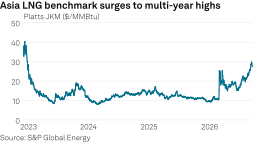
On the buy-side, however, participants hinted at more durable shifts away from LNG as the supply squeeze pushes prices to multiyear highs. Platts, part of S&P Global Energy, assessed the JKM benchmark for LNG delivered into Northeast Asia at $27.394/million British thermal units on Sept. 17, around its highest point since December 2022.
Thailand's Prime Minister Anutin Charnvirakul used part of his Gastech opening address to highlight upcoming government support for households seeking to install rooftop solar panels.
"While we work to diversify supply, strengthen domestic energy security, improve efficiency, and reduce volatility in global markets, a transition that leaves people unable to pay their energy bills will not be sustainable," he said.
Pakistan is also embracing homegrown energy with an eye to significantly expanding renewables and hydropower. The government aims to almost eliminate its reliance on imported fuel for power production by 2036, according to the chairman of the National Grid Company of Pakistan, Fiaz Chaudhry. While Pakistan had already been planning such a shift for years before the late-February outbreak of war in Iran, Chaudhry said that the shock has bolstered its ambition.
"[The war] has not changed our plan," he told Platts in Bangkok. "But it has now forced us to even believe in that plan even more."
Pakistan imported some 6.6 million mt of LNG last year, almost all from Qatar, according to CERA.
Risk of being 'fuel of the wealthier countries'
Even some sellers are skeptical that earlier growth expectations can hold.
"If you're a developing country today and you need safe, secure, reliable baseload power, I am not sure you turn to LNG or to gas in the way that I think you would have done 10 years ago," Richard Holtum, the CEO of trading house Trafigura, said at Gastech.
Holtum pointed to the supply boost from new production expected to hit the market in the coming years; he underscored a risk that LNG becomes the "fuel of the wealthier countries" if industry can't "create [the] demand" to ensure that new output "gets absorbed into the developing markets."
Another industry source who sells LNG also flagged concerns about waning confidence among potential new buyers.
"The risk for the industry is to see a bit of the long-term demand growth, which was underpinning the long development of the supply projects, could be maybe pushed out, maybe reduced, maybe a bit reshuffled," the industry source said. "I can see that. This ... volatility is not helping the long-term stability of the market."
Longer contracts, diversified sourcing
There is, however, a relative consensus among participants that the kinds of LNG deals being done are changing, with buyers eyeing longer contracts and hedging around cargo sources.
"There is a new wave of interest in signing long-term contracts," the industry source said. "Before [Strait of Hormuz disruptions], some [buyers] were holding back because they were waiting for [the expected boost of new supply]. Now we are seeing them actually sourcing because they see that in the end, long-term stability is important."
Liz Westcott, CEO of Australia's Woodside Energy, pithily characterized a shifting interest from "just-in-time LNG" to "just-in-case LNG."
"Increasingly, flexibility is something customers are seeking," she said.
Many Gastech attendees argued that a growing focus on reliability is a boon to portfolio players who can offer volumes pooled from a range of projects. Among them was Rashid al-Mazrouei, chief marketing and origination officer for LNG with the Abu Dhabi National Oil Co. He said the days of buyers sourcing from a single project are "gone."
"The diversification that is happening in the market today is there to stay," Mazrouei said.
At the same, Eni's Chief Operating Officer for Natural Resources, Guido Brusco, warned of a seemingly countervailing, broader trend away from globalization as industry players seek more control over supply chains.
"This world will be less global than before," he said.
As geopolitical uncertainty mounts and energy markets grapple with the pressures of a more fractious world, sightlines on LNG's future growth grow hazier.
