LNG, Natural Gas
September 08, 2026
EU should loosen gas storage requirements after 2027: market watchers

By Matt Hoisch
Editor:
HIGHLIGHTS
Former EU commissioner Simson backs more flexibility
Argues move warranted after Russia trade ends
Existing storage law expires at the end of 2027
The EU should loosen natural gas storage requirements once its existing law on stocking expires at the end of 2027, according to several market watchers.
Those market watchers include the person who was EU Energy Commissioner at the time the bloc implemented its initial gas storage regulation following Russia's full-scale invasion of Ukraine.
"We can allow the storage operators some flexibility," Kadri Simson, who served as EU Energy Commissioner from 2019-2024 and is currently a non-resident fellow at Columbia University's Center on Global Energy Policy, told Platts, part of S&P Global Energy, in a Sept. 2 interview.
Unlike the current regulation, which sets uniform filling targets for all EU countries, Simson supports a more flexible approach after next year that gives member states greater autonomy to set their own stocking targets.
"Member states are in very different positions regarding gas storage," she said. "These flexibilities have to take into account national circumstances."
Simson backs a more flexible approach after next year, partly because the EU is set to end Russian gas imports by fall 2027 under a recent landmark law to sever ties with its once-dominant supplier.
"At that point, we have really removed from our gas market a hostile, unfriendly supplier," she said.
Simson also flagged broader market developments that would support the change: analysts expect the global LNG market to become oversupplied in the coming years, while European gas demand is projected to decline.
"So the massive underground gas storage that we do have will be bigger than needed," the former commissioner said.
Added interest in flexibility
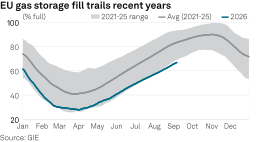
Simson's comments come amid a lagging EU-wide stocking campaign, with the war in the Middle East creating a backwardation in the market's structure through the summer, sapping the financial incentives that would normally spur filling.
Still, others also agree there is room for less stringent and less uniform storage obligations in the years ahead.
"The member states need the flexibility to optimize their advantages and disadvantages," said Olga Khakova, a non-resident senior fellow at the Atlantic Council's Global Energy Center. Factors such as gas storage capacity and domestic gas needs vary from country to country, she said. "Every member state is in such a different place."
In June, industry group Eurogas urged the EU to let its storage law lapse after 2027. It likewise argued a "one-size-fits-all approach through EU-wide storage obligations is ill-suited to Europe's diverse gas landscape."
Other regulatory developments since the start of the decade have also offered further means to hedge against supply risks, according to Ruven Fleming, associate professor of energy law and scientific coordinator at the Groningen Center of Energy Law and Sustainability at the University of Groningen in the Netherlands.
"I would say in the last four years, the relevance of the storage filling as such ... has significantly decreased because we have other tools at hand now that we can use together with these filling obligations," Fleming said.
In addition to the continent's embrace of LNG, Fleming also stressed that European governments have developed "much more sophisticated" national and regional emergency plans in recent years.
"We have much more expressed solidarity mechanisms for what is being delivered from one country to the other in case of a crisis, in case of an early-warning situation, in an alert situation, in an emergency situation," he said. "All these things are much more defined than they used to be a couple of years ago."
The European Commission has likewise signaled an interest in possibly changing its approach to storage.
In May, Ruud Kempener, deputy head of unit for energy security and safety in the EC's Directorate-General for Energy, said the commission was exploring alternative future storage regulation strategies, including whether there needs to be gas filling targets for every member state and whether such targets could be defined differently — for instance, based on gas consumption, rather than as a percentage of storage capacity.
An EC spokesperson declined to comment further on Sept. 7.
EU can't 'regulate itself out' of crises
The EU adopted its initial gas storage regulation in 2022, shortly after Russia's invasion of Ukraine. In the months before the invasion, Russia's Gazprom began limiting gas deliveries to the continent and left its own-operated European storage sites nearly empty.
That law sets filling obligations by Nov. 1 at 80% in 2022 and 90% in subsequent years.
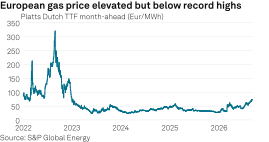
While the regulation spurred stocking, market watchers have also argued that the rigid benchmarks and deadlines helped propel European gas prices to all-time highs during the summer of 2022.
EU lawmakers revised the regulation in 2025, giving member states a wider window to reach targets and allowing for lower fill levels in some cases.
The EC urged member states to take advantage of those added flexibilities this year amid the supply shock from the war in the Middle East by only targeting an 80% fill, rather than 90%; it also pushed to coordinate stocking and avert overlapping demand.
This helped temper price rises, Simson argued.
"Some flexibility has kept TTF [gas] prices significantly under the 2022 levels," she said.
At the same time, Simson stands by the decision to advance the 2022 regulation.
"I do feel that that was the right move, and I do feel that part of the energy crisis [in 2022] was happening due to the low filling rates of our storage before we put this regulation in place," she said.
Even if member states get more latitude to govern their own storage filling, Simson continues to see a role for Brussels to coordinate between them.
"Member states do need cooperation and solidarity in the gas market," she said.
The Atlantic Council's Khakova argued Brussels can still support gas market development, but warned against overregulation in a more geopolitically volatile world with more frequent crises.
"The long-term solution is creating market conditions where Europe, [the] EU, attracts gas," she said. "Where there are reliable market conditions where players know that things are not going to constantly change, that there isn't going to be serious intervention that will then alter their decision-making."
"The EU won't be able to regulate itself out of these upcoming crises," Khakova said.