Electric Power, Natural Gas, Metals & Mining, Non-Ferrous
August 26, 2026
Gas turbine, copper supply seen as near-term data center constraints in PJM

Editor:
HIGHLIGHTS
Consultant develops data center forecast
PJM about 12% of 2025 US turbine orders
A PJM Interconnection consultant expects power demand growth from artificial intelligence and related data centers to increase steadily once AI models are trained, with potential constraints arising from copper and natural gas turbine supply chains.
"Before 2032, much of the rapid [power demand] growth is driven by AI model training and, during this time period, there is much development of capable models that require very large amounts of data," Margarita Patria, project director at Charles River Associates (CRA), said during an Aug. 26 meeting of the PJM Load Analysis Subcommittee.
But that process is not unlimited because there is a finite amount of high-quality public data available for training, and over time, improvements in model design and chip efficiency are expected to enable models to train with lower power, Patria said.
"So, the training component grows rapidly initially and begins to decline while inference moves in the opposite direction," she said.
Once the technology moves from model development to broader adoption by individuals and businesses, inference demand, or actual AI usage, will likely grow and become a more persistent driver of load.
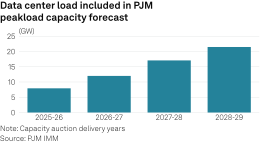
There is very strong training-driven growth in the earlier period, followed by a transition toward steadier adoption and inference growth as AI becomes a normal part of everyday activity, Patria said.
The evolution of internet usage provides an empirical example similar to what is being observed in data centers and AI.
Based on historical data, PJM represents about 35% of the national data center market, but CRA does not project that PJM maintains that share throughout the forecast.
"If PJM becomes more power-constrained relative to other markets, some of the demand that would initially come to PJM can shift somewhere else," she said.
Data center growth constraints
Binding constraints will limit the level of "realizable demand," according to a presentation given during the meeting.
The constraints may or may not bind; if they do not, growth would continue unrestrained, but if they are binding, the level of growth in that year would be lower, Patria said.
Examples of these constraints include semiconductor availability, critical metal availability, power availability to serve new load, power supply build limits, generator interconnection queues, generation retirements, gas infrastructure availability, permitting, and market-design issues.
Although supplies for building data centers are expected to be available over the long term, the primary risk period occurs during the expected peak of global data center build-out from 2027-2030, the consultant said.
"Copper faces the greatest potential supply risk, as availability is ultimately constrained by mining production and the pace at which new supply can be developed," according to the presentation.
Regarding PJM specifically, there is insufficient power supply to meet data center growth as projected in PJM's 2026 load forecast, with 2030-2035 representing the "deepest shortfall."
Gas turbine availability is a near-term constraint to data center growth in PJM.
"Lead-time analysis shows recent gas turbine projects require [about] 36 months from order to operation, with orders translated into future online capacity accordingly," CRA said.
The US share of global gas turbine orders increased to about 42% in 2025, reflecting growing domestic power demand. PJM accounted for about 12% of US turbine orders in 2025, with recent growth supported by accelerating data center development, according to the presentation.
"Under the current load outlook, available unforced capacity does not keep pace with the planning requirement, with the gap beginning in 2027 to 2028 and the largest gap occurring in the early 2030s on the order of 30 gigawatts relative to the reserve requirement," Patria said.
This is largely a physical constraint, "not simply a price equation," because willingness to pay more does not immediately produce additional turbines in the short term. "We know that turbine developers are working to expand their supply chains, but there are real headwinds that are not limited to PJM," she said.
Something has to adjust when demand and available supply do not line up, and that can mean slower load ramps, behind-the-meter supply flexibility, location to areas with more headroom, or waiting for grid service, Patria said.
CRA is developing the data center portion of PJM's large load forecast, with the consultant scheduled to present its independent data center forecast to the Load Analysis Subcommittee in mid-October.
PJM will then present its full large load forecast to the subcommittee in November.
