LNG, Natural Gas
July 24, 2026
Upside risks accumulate across LNG market as Middle East war resurges
By Matt Hoisch and Claudia Carpenter
Editor:
HIGHLIGHTS
Global benchmarks have surged some 50% in recent weeks
Added output has helped temper prices, but further options dwindling
Asian, European demand pose key uncertainties
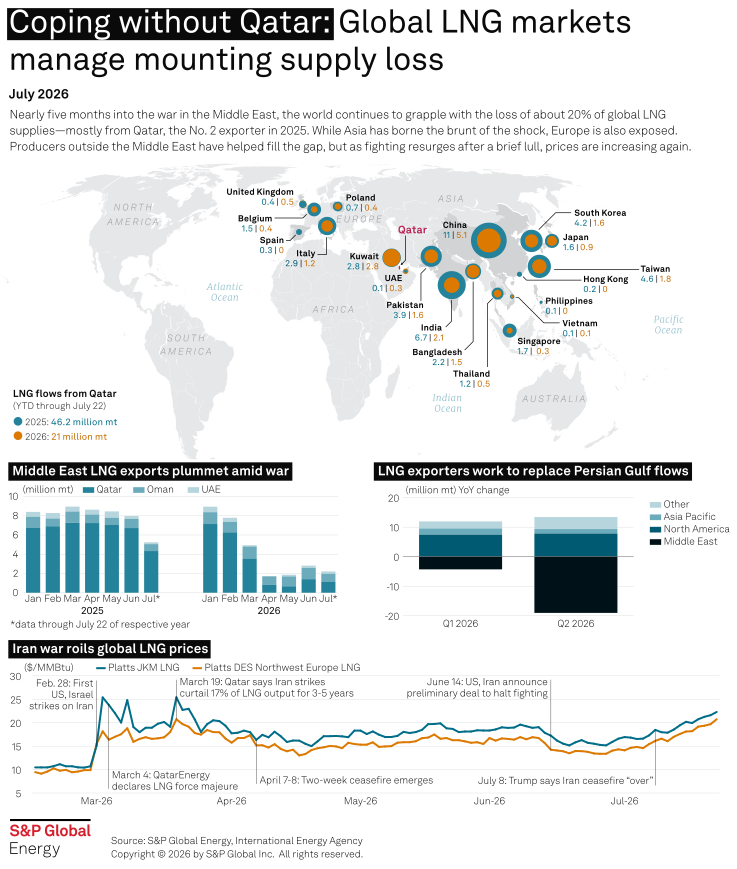
Nearly five months after joint US and Israeli airstrikes set off the war with Iran that has engulfed the region and choked off copious Persian Gulf LNG flows, the world has fewer buffers to cushion further shocks should the wartime disruptions extend much into the future, market watchers have cautioned in recent days.
The warnings come amid a breakdown in the tenuous US-Iran truce, which has led to renewed fighting and a halt to the trickle of exports that had begun to build just weeks before.
Price rises have followed suit. European and Asian benchmarks have surged some 50% in the past several weeks, more than erasing losses from a bearish streak last month that briefly brought the indexes to recent lows.
Qatar, the Middle East's primary producer and the world's second-largest exporter last year, is the key concern.
Attacks early in the war pushed QatarEnergy to halt output of both LNG and associated products. Days later, it declared force majeure to affected buyers. Subsequent Iranian strikes dealt longer-term blows to two of the country's 14 LNG trains, curtailing 17% of its export capacity for three to five years, according to QatarEnergy.
Even with those extended losses, though, the International Energy Agency said in early July that it expected 2026 global LNG supply to hold roughly steady compared to 2025, assuming maritime traffic through the Strait of Hormuz picks up again in the third quarter and the undamaged Persian Gulf sites resume full operations by October. Those assumptions, however, are looking increasingly shaky.
"Our base case is still de-escalation and continued Qatar ramp-up, but risks are rising," analysts with the bank JP Morgan said in a note July 22.
LNG tanker traffic through the Strait of Hormuz has dwindled to zero for 11 consecutive days up to July 23, according to S&P Global Commodities at Sea.
Transits through the vital waterway slumped in the days after an LNG tanker was attacked offshore Oman.
Qatar's foreign ministry said July 7 on X that its Al Rekayyat LNG tanker was attacked by Iran near Hormuz. According to CAS, the Al Rekayyat was chartered by QatarEnergy, which did not respond to a request for comment.
Dwindling ways to cope
Analysts aren't just concerned that further fighting will deprive the world of additional LNG for longer; they also see diminishing options to offset those losses and temper price rises.
So far, global LNG markets have managed the war "much better" than expected, according to Anne-Sophie Corbeau, a research scholar with Columbia University's Center on Global Energy Policy.
Gas-to-coal switching among consumers has balanced things a bit, but the most consequential relief, Corbeau argued, has come from other LNG producers, who have generated more of the super-chilled fuel and offset Persian Gulf losses.
"That has helped tremendously," she said.
New LNG projects are projected to add output equal to some 50 billion cubic meters of natural gas this year (or about 36 million metric tons of LNG), the IEA said earlier this month. The energy watchdog also sees existing sites contributing over 10 Bcm more, thanks to greater feedgas availability.
The added volumes have so far offset around 70% of the LNG losses from the Hormuz disruptions, IEA Executive Director Fatih Birol said this week.
But analysts expect the boost has been skewed toward the first half of the year. So, markets are set to have fewer ways to cope with supply losses that extend into the coming months than they've had for those over the past five.
"Going forward, we continue to see the rise of alternative supply slowing down, as incremental volumes from existing projects reach their limits and the pipeline of new projects in 2026 is drying out," the JP Morgan team said.
Demand in focus
While producer-led shifts have helped temper price rises so far, consumer-led responses are a central uncertainty to track looking forward, Corbeau argued.
In Asia, there's an upside risk of warmer weather over the following months, raising gas use to meet higher cooling needs. On the other hand, market watchers are also monitoring for the point when price-sensitive buyers—particularly in Southeast Asia—shun more expensive cargoes.
"The fact that LNG imports have remained strong across Southeast Asia despite the loss of Gulf LNG has probably surprised many," Corbeau said. "But we have been at around $20 [per million British thermal units]. If it goes higher, this becomes very painful for some countries' finances in Southeast Asia."
European demand is more of a medium-term concern.
The continent has forgone some of its gas storage build since the start of the stocking season. It faces a growing gap between this year and last, with the EU's filling deficit against the same time in 2025 widening from about 6.4 percentage points in early April to 11 percentage points as of late July, according to the most recent data from Gas Infrastructure Europe.
Maintaining modest injections would ease near-term LNG demand but would boost risk further out if Europe enters winter with an even bigger lag in year-over-year stocking.
This week, the IEA's Birol stressed that further delays in resuming Gulf exports "risk keeping markets tighter for longer."
But price reactions to a tighter environment moving forward may not mirror those seen thus far. The pervasive demand and supply-side uncertainties make for a tenuous situation that underscores the potentially compounding challenges markets face the longer they have to manage without Persian Gulf LNG.
