LNG, Natural Gas
July 20, 2026
European market failing to price full 2027 Russian LNG ban: traders
Editor:
HIGHLIGHTS
Argue persistent doubts on phaseout add to backwardation
Say risk of easing restrictions rises if other shocks pile on Hormuz disruptions
EC has stressed commitment to ban, but law leaves leeway to delay
Many players in the European LNG market remain skeptical the EU will go ahead with its full halt to Russian LNG imports from the start of 2027 amid the persistent supply strains from the war in the Middle East and argue that regardless of whether Brussels eases its planned ban, the doubt is already widespread enough that its impact can be seen along the forward curve.
"The market is not pricing in the Russian ban," one LNG trader told Platts, part of S&P Global Energy.
Partial restrictions under the landmark EU law cutting off gas ties with the continent's once-dominant supplier have gone into force across the first half of this year, ending imports under spot and short-term deals. But flows have yet to fall. On the contrary, the EU has actually seen a slight bump in Russian LNG trade compared with 2025, according to data from S&P Global Energy CERA. So far this year, the EU has brought in about 10.5 million metric tons of Russian volumes (equal to some 14.5 billion cubic meters of gas), up from around 9 million mt across the same period of 2025, per CERA figures.
ACER, a European regulatory body, recently said the EU's overall volume of Russian gas imports would probably go unchanged this year, thanks to carve-outs in the law for long-term contracts. LNG imports under such deals are set to stop Jan. 1, 2027.
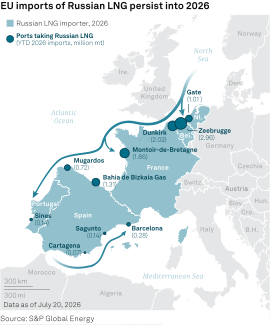
But the market doesn't see that New Year's halt as a sure thing.
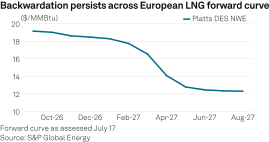
"We are still in backwardation for Q1," an LNG paper trader said. "Prices should be higher for winter [with a full ban on Russian LNG], but you have not had any contango all year basically."
Typically, the forward curve shows a contango structure heading into winter, with prices further out higher than those nearer term, as market participants look to buy and regasify LNG in warmer months to sell for a profit when colder weather pushes up demand.
The current market structure, though, is flipped into backwardation.
Platts assessed the DES Northwest European LNG derivatives contract for Q4 2026 at $18.705/million British thermal units July 17, while the contract for Q1 2027 was assessed at $17.534/MMBtu, placing Q4 2026 at a premium of $1.171/MMBtu to Q1 2027. By contrast, the same time last year, the Q4/Q1 spread was at minus 10.1 cents/MMBtu, implying a weaker Q4 2025 relative to Q1 2026.
Hormuz remains central uncertainty
Traders and analysts stress the fate of Russian flows isn't the only factor shaping prices further along the European LNG curve. The continued loss of exports from the Persian Gulf -- Qatar, in particular -- is the main market contingency.
"Qatari flows are the biggest uncertainty," a third trader underscored. "Everyone is waiting to see when they can actually ramp up."
Nevertheless, sources continue to argue that the market is underpricing the loss of Russian supplies, even after accounting for the Middle East disruptions. Indeed, the months-long drop in maritime traffic through the Strait of Hormuz since the start of the war in the Middle East is the key shift spurring doubts about the EU's resolve to fully stop Russian LNG imports on time.
"The ban was implemented in the first place on the assumption that there would be new LNG coming online," Matteo Ilardo, lead Europe analyst at the geopolitical consultancy RANE, said. "From Qatar, that is not the case anymore."
While new projects have started up since the EU passed its landmark law in January, the loss of most Gulf shipments since the war began in late February has undercut the growth in global supply that analysts had previously anticipated this year. Now, the International Energy Agency expects 2026 global output to hold broadly steady against 2025 levels, assuming Hormuz traffic revives in the third quarter of 2026 and Gulf producers ramp up production over the following months. If that timeline gets delayed, though, the world's LNG supply risks shrinking year-over-year, the energy watchdog stressed in a gas market report earlier this month.
Ilardo sees a growing case for Brussels tempering the Russian restrictions if the Hormuz squeeze persists and other shocks pile on, such as weather that lifts European or Asian demand or an accident that dents US production.
"For now, [easing the Russian LNG ban is] definitely a possibility, but the longer the Hormuz blockage continues, the likelier this becomes," he said. "And then, if we do have more elements building on top of this, it becomes a near certainty to me."
The third trader was similarly doubtful that the EU would push ahead in the face of further market tightening and the continent's already-low gas storage levels.
"If the winter is super cold [and] Asia is buying as well, then the EU might have to delay the timing of the ban," the trader said. "There is no way that Europe can face a ban on this much volume with the ongoing global uncertainty, low storage volumes and competition for cargoes."
A legal opening
EU leaders have repeatedly reaffirmed their commitment to implement the Russian import ban in the months since the outbreak of the Middle East war. Even if there was interest in changing the law, it would require support from a qualified majority of member states and a time-consuming legislative procedure.
But overhauling the regulation would technically be unnecessary for a delay to pan out, because the approved text already leaves an opening. The law's second-to-last article allows the EC to "temporarily suspend" some or all of the import restrictions in the event of "sudden and significant developments which seriously threaten the security of energy supply of one or more Member States."
In response to a request for comment on how the Commission would respond if the loss of Gulf exports continues into the latter part of the year, an EC spokesperson directed Platts to a recent assessment by an EU expert group that "there is no immediate [gas] security of supply concern for winter 2026-2027." The spokesperson declined to comment further.
It remains to be seen whether economic pressures are sufficient for Brussels to allow Russian LNG imports to persist beyond the Jan. 1, 2027 ban. Many still expect the EC not to delay the phaseout. For now, though, even the perception that they could is enough to move markets.
