Natural Gas, Electric Power, LNG
July 17, 2026
Spain emerges as premium gas market on tight LNG availability, heat wave demand
By Eniayo Adeniji and Lena Dias Martins
Editor:
HIGHLIGHTS
PVB DA, MA hit multiyear high premiums to TTF
Spanish stocks draw down as rest of EU continues to inject
LNG imports slump 26% YOY as global supply tightens
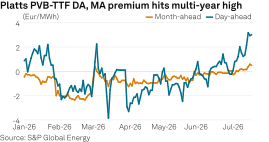
Heat wave conditions across parts of Europe have lifted Spanish gas prices to the highest premiums to their Dutch TTF equivalents in years, with a globally tight LNG market leaving Spain increasingly reliant on stronger pricing to attract cargoes.
"[The] market is globally very tight on the LNG side. So either Spain becomes premium or no cargoes will come here," a Spain-based gas trader said.
Temperatures across Spain have run well above seasonal norms, climbing as much as 5.21 degrees Celsius above the five-year average on June 22, according to CustomWeather data. The heat has driven a sharp reversal in storage behavior: Gas Infrastructure Europe data showed withdrawals from Spanish stocks over 14 consecutive days averaged 35.01 gigawatt-hour/day between July 2-15, bucking the usual summer injection pattern.
As a result, Spanish stocks stood at 72.58% fullness, or 26.01 terawatt-hour, by the end of gas day July 15 -- the only EU market to withdraw on the day. By contrast, the wider EU continued to inject, albeit at a slower pace than in previous seasons. EU gas stocks were 53% full as of July 15, according to the latest data from Gas Infrastructure Europe, more than 10 percentage points below the level recorded on the same day a year earlier.
The tightening balance has widened Spain's premium across the curve. Platts, part of S&P Global Energy, assessed the Spanish PVB day-ahead contract at Eur55.945/megawatt-hour July 15, a Eur3.170/MWh premium to its Dutch TTF counterpart and the highest since October 5, 2023.
Platts assessed the PVB front-month contract at Eur54.980/MWh July 16, a 58.5 euro cent/MWh premium to the TTF equivalent — the widest spread between the two instruments since July 31, 2024.
Gas gains have had a tangible impact on Spanish power prices, with the day-ahead product settling at Eur138.11/MWh for delivery on July 15, marking the strongest price seen since February 2025.
So far this July, gas has accounted for 23% of the Spanish electricity mix, up two percentage points year over year.
In this time, the Platts PVB day-ahead assessment has strengthened by over Eur16/MWh (48%), averaging at just over Eur50/MWh this month so far, which has helped firm Spanish spot power costs by 38% year over year.
On the LNG side, Enagas data showed Spanish LNG in tank inventories at 48% full as of July 16, down 27 percentage points month over month and 16 percentage points year over year. Disruptions to global LNG supply stemming from the ongoing US-Iran conflict have further tightened balances.
Platts assessed the Spanish TVB August instrument at Eur54.615/MWh July 16, at a 13.5 euro cent/MWh discount to the TTF August contract and the highest price since late March.
Import volumes have trended lower since the start of the year. S&P Global Energy CERA data showed Spain imported 1.18 billion cubic meters of gas in June, virtually unchanged month over month but 26% below the 1.58 Bcm recorded a year earlier.
Robust cooling demand has underpinned domestic consumption. Spanish gas for power burn averaged 33.2 million cubic meters/day over July 1-14, up from 31 MMcm/d in the same period last year and well above the 25.7 MMcm/d June average, according to CERA data.
Cross-border flows have also thinned. Spain exported just 1.9 MMcm of gas to France in the first two weeks of July, down sharply from the 31.3 MMcm sent over June 1-14, as domestic demand absorbed available supply.
