Natural Gas, LNG, Electric Power
July 10, 2026
NYMEX gas falls below $3 as summer demand narrative unravels

By J Robinson
Editor:
HIGHLIGHTS
Storage injections outpace consensus again
Freeport outage adds fresh supply pressure
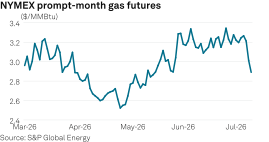
NYMEX prompt-month gas futures tumbled to a six-week low on July 10 following a third consecutively bearish storage report from the US Energy Information Administration and the announcement of a major turnaround maintenance at the Freeport LNG terminal.
In morning trading, the August gas futures contract tumbled to an intraday low at just $2.87/million British thermal units, data from CME Group showed. Prompt-month gas prices below the psychological $3 level appear to signal a shift in market sentiment.
For much of June, NYMEX prompt futures rallied, hitting highs in the $3.40s/MMBtu, as hotter summer temperatures lifted gas-fired power demand and bullish weather forecasts fueled expectations for tighter market balances and a narrowing US gas storage surplus.
Now, that narrative appears to be unraveling.
Disappointing power burn demand and larger-than-expected storage injections have raised doubts recently over the strength of summer gas demand this year. Adding to that, extended maintenance at Freeport LNG and a mild short-term weather forecast in the Southeast both promise to pile on more supply pressure.
"After five weeks of range-bound trading, the August natural gas contract broke through longstanding technical support to open a route to test sub-$3.00/MMBtu yesterday," Eli Rubin, senior energy analyst with EBW Analytics, wrote in a July 10 market note.
"Near term, technical follow-through to the downside is likely to drive a [further] test of support in the low-to-mid $2.90s/MMBtu," he warned prior to the NYMEX market open.
Power burn, storage
Following the first major heat wave of the summer, it looks increasingly likely that hot weather won't be enough to lift gas-fired power demand back to record highs this year.
In June, US power burn demand averaged just 40.2 billion cubic feet/day, it's lowest for the month since 2023. Even sweltering temperatures in early July weren't enough to lift power sector gas burn to 50 Bcf/d – well below the record-highs of summer 2024 when US power demand reached 54-55 Bcf/d, data from S&P Global Energy CERA showed.
Weaker-than-expected power demand could also be a key driver behind market analysts' consecutive EIA storage-report misses. Over the past three weeks, the EIA has surprised analysts with injection estimates that have significantly outpaced the market consensus.
Cumulatively, analysts have underestimated storage injections by roughly 30 Bcf, according to the Platts gas storage survey, a poll of the market expectations for the EIA's weekly storage report.
Combined, both factors appear to be raising concerns over the long-term trajectory for US gas inventories. Assuming the current storage surplus remains sticky at nearly 200 Bcf, US stocks could easily reach 4 trillion cubic feet, or higher, by early November.
Freeport outage, weather
Looking ahead, an extended maintenance at Freeport LNG could now push upward of 2 Bcf/d in feedgas back into the spot market, weighing on the US market balance.
According to the terminal operator, the "major maintenance" is scheduled to last through late August as work is completed at the plant's pre-treatment and liquefaction facilities. On July 10, feedgas deliveries to Freeport LNG were estimated at just over 1 Bcf. It remains unclear whether Freeport plans to keep one or more of its liquefaction trains running during the maintenance. If not, feedgas demand from the terminal could have further to fall.
Mild weather across the US Southeast over the next two weeks is also expected to push more supply into the spot gas markets. According to a short-term forecast from CERA, regional gas-fired power demand is projected to average just 11.9 Bcf/d over the next two weeks – down from the month-to average at over 12.4 Bcf/d.
