LNG, Natural Gas
July 03, 2026
Rising Chinese Arctic LNG 2 imports signal firming global market divide: analysts

By Staff
Editor:
HIGHLIGHTS
June flows hit highest monthly level since August 2025: CAS
Seasonal changes, higher shipping capacity support rise
Analysts see limited impact on broader Russia-China ties
A recent increase in LNG shipments to China's port of Beihai, linked to Novatek's sanctioned Arctic LNG 2 project, holds both practical and symbolic significance for the global LNG market amid growing fragmentation, market observers told Platts, part of S&P Global Energy.
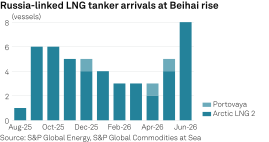
Tankers laden with cargoes from the Russian export facility have been voyaging to the southern Chinese port since August 2025. Although shipments had subsided since last October, they rebounded through the spring and early summer in 2026, reaching a new peak in June, when a record eight vessels called, according to data from S&P Global Commodities at Sea.
Logistical changes, including improved transit conditions along the Northern Sea Route—a shorter maritime corridor that is typically icebound from about December to June—and the expansion of the tanker fleet servicing the project, have supported the rise in LNG shipments to China, according to a market analyst based in China.
"The recent increase in China's imports of Russian gas is related to the Arctic route reopening in summer and Russia's increased shipping capacity," the analyst said. "In addition, the price advantage of Russian LNG should also be another important factor stimulating the increase in imports."
Geopolitical signals, or their absence, are another influencing factor, according to Tatiana Mitrova, a fellow at Columbia University's Center on Global Energy Policy.
Although the US imposed sanctions on Arctic LNG 2 in 2023 under former President Joe Biden, it has yet to crack down on the project's ongoing trade, Mitrova said. This has provided leeway to increase imports from the Novatek facility, according to Mitrova.
"After nearly a year of these operations not being interrupted ... by the US sanctions, I think it is reasonable to make the conclusion that the US is not interested—at least [President Donald] Trump's administration is not interested—in putting more pressure on this project," Mitrova said.
The US Treasury Department did not respond to an email request for comment July 2.
Parallel LNG system
Analysts say that, given China's massive LNG demand of nearly 70 million metric tons in 2025, according to government data, the few dozen cargoes routed through Beihai since August 2025 represent only a modest addition to the country's vast domestic market. They, however, argue that the continued growth in China's imports of the sanctioned supplies points to broader shifts underway in global energy trade.
"Volume-wise, it is not that big," said Filip Rudnik, a research fellow in the Russian Department at the OSW, a think tank based in Poland. "But geopolitically, it has long-term consequences."
Much as a so-called "shadow fleet" of oil tankers has emerged to move sanctioned Russian crude and petroleum products beyond the reach of Western restrictions imposed after Moscow's 2022 invasion of Ukraine, the growing flow of cargoes into Beihai suggests a similar bifurcation is taking hold in the LNG market, which has historically been highly globalized.
"This is an early sign of the formation of two parallel LNG ecosystems," said Irina Mironova, senior research analyst at the New Energy Advancement Hub.
Potential trade expansion
To date, Beihai remains the only Chinese port known to have received these sanctioned Russian LNG cargoes.
Since late 2025, market participants have discussed the possibility of another terminal in northern China handling Arctic LNG 2 imports, but no such operations have been confirmed.
Even as Europe prepares to fully phase out LNG imports from Russia—once its dominant gas supplier—from 2027, market observers see limited implications for a broader deepening of Russia-China energy ties stemming from the ongoing trade in sanctioned LNG.
"The Chinese treat this relationship, these LNG imports, as an opportunity that they can seize with a free hand, while for the Russians, it is more of a lifeline," Rudnik, the OSW fellow, said. "Without the Chinese willingness to import those cargoes, presumably Arctic LNG 2 would not ship any cargoes at all to any kind of client."
Columbia's Mitrova said that, so far, China's relationship with Russia in the LNG sector has been "purely transactional."
While Beijing continues to import energy from its western neighbor, it has largely refrained from making significant investments in Russia's energy industry, unlike its approach in several other regional markets, according to Mitrova.
Russia "is providing China with a certain diversification of supplies," Mitrova said, "but it is not being regarded as a real strategic partner."
That dynamic could shift if Beijing and Moscow move forward with the planned Power of Siberia 2 gas pipeline, which is expected to carry up to 50 billion cubic meters/year between the two countries. However, discussions over the project, which have been years in the making, continue.
"Until Power of Siberia 2 is signed, everyone understands that this relationship is very conditional, very limited," Mitrova said.
Platts assessed the JKM benchmark for LNG delivered to Northeast Asia at $16.523/million British thermal unit July 3, down 1.8% day over day.
