Electric Power, Natural Gas
May 27, 2026
Pipeline operators strike deals as data centers turn to colocated generation
By Tom DiChristopher and Killian Staines
Editor:
HIGHLIGHTS
Gas-fired generation dominates projects at 80%
Colocated facilities to serve 22-32 GW by 2030
Data center development is continuing to create infrastructure investment and fuel supply opportunities for natural gas transporters in 2026, with behind-the-meter project construction poised to ramp up.
Midstream companies and gas utilities announced deals to ship fuel to data centers with colocated gas-fired power generation during quarterly earnings calls in April and May. They also outlined plans to build new pipelines or upsize existing infrastructure expansion projects to meet fuel demand from the energy-hungry facilities.
The announcements added to a growing inventory of behind-the-meter projects to serve data centers as barriers to electric grid interconnection persist. Critically, more than 80% of announced on-site generation would rely on natural gas, according to S&P Global Energy CERA.
Through the first quarter of 2026, CERA has tracked 130 North American data center projects that plan to build on-site generation. Together, those facilities total about 186 gigawatts of data center capacity, though it is unclear whether all of those projects will be built.
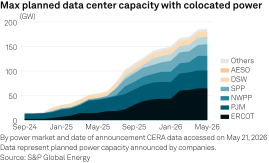
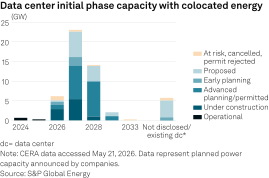
Still, colocated power facilities are expected to support 22-32 GW of data center energy demand through the end of the decade, CERA said. That would represent 26% of new North American capacity forecast through 2030.
If you drill it, they will come
Many of the colocated facilities are slated for construction in gas-producing regions such as the Marcellus Shale, according to CERA.
UGI Corp. on May 6 announced that its midstream and marketing unit, UGI Energy Services, will sell land in Pennsylvania's northern tier to Prime Data Centers. Prime plans to develop a data center with on-site gas-fired generation and expects the facility's fuel demand to exceed 100,000 dekatherms/day within three to five years.
UGI Energy Services could invest more than $100 million in midstream infrastructure to meet Prime's gas demand, the company said. This includes pipeline connections to existing infrastructure and potentially compression enhancements, UGI CFO Sean O'Brien told Platts, part of S&P Global Energy.
National Fuel Gas Supply recently began construction on a lateral to a coal-to-gas power plant conversion in Shippingport, Pennsylvania, which is repowering to serve data centers. The lateral branches off the company's Line N system in western Pennsylvania. On April 29, parent company National Fuel Gas announced a $93 million project to add 94,000 Dth/d of capacity to Line N to serve an undisclosed customer.
National Fuel President and CEO David Bauer said April 30 that he expected additional opportunities to expand Line N, with an immediate focus on supplying behind-the-meter projects and generation to feed PJM Interconnection's 13-state electric transmission system.
Williams completed the first phase of its Aristotle pipeline, which will supply several gas-fired power plants the company is developing to serve data centers in Ohio. The company overbuilt the capacity so Aristotle can serve as an energy artery for future developments along the data center corridor, Williams President and CEO Chad Zamarin said May 5.
Williams also took a final investment decision on the 682-megawatt Neo project in Ohio, the company's fifth project to supply behind-the-meter gas-fired power to data centers and its fourth in Ohio.
Virginia continues to drive deals
Williams also announced plans to upsize its Transco Power Express project due to increasing gas demand to power data centers and market growth in Virginia, the nation's largest data center hub. The addition of a new customer and an increase to an existing commitment will support an expansion of 750 million cubic feet/day, up from the previous plans to expand the Transcontinental Gas Pipe Line system by 689 MMcf/d.
"I think it just demonstrates the value of the Transco system and how we can make minor adjustments to [the] scope of expansion projects and be able to flex to meet the customers' needs," Williams COO Larry Larsen said.
Williams also entered into a 13-year contract to provide 164 MMcf/d of Transco pipeline capacity to a large Northeast data center. The arrangement will allow the customer to displace diesel-generated backup power with cleaner-burning gas. The project will cost about $50 million, and Williams expects to offer the solution to other facilities, Zamarin said.
"There was an assumption that you had to have compressed natural gas or on-site liquefied gas as a storage solution," Larsen said. "I think we're showing that the pipelines -- because of the compressibility of gas -- actually have tremendous storage capacity."
Also in Virginia, Washington Gas Light signed its second data center interconnection agreement to supply gas for backup generation at a 15-MW data center in Virginia. The AltaGas-owned gas utility continues to anticipate serving data centers with electric power capacity of 50 MW or less.
TC Energy announced the $1.5 billion Appalachia Supply project, an 800-MMcf/d expansion of its Columbia Gas Transmission pipeline system to serve new gas-fired generation. The project is backed by a 20-year agreement with a utility, TC Energy CEO François Poirier said May 1.
The expansion could scale up to 2 billion cubic feet/day of gas transportation capacity, "creating line of sight for capital-efficient growth tied to broader economic development, data center demand and ongoing electrification," Poirier added.
Gas transporters go West
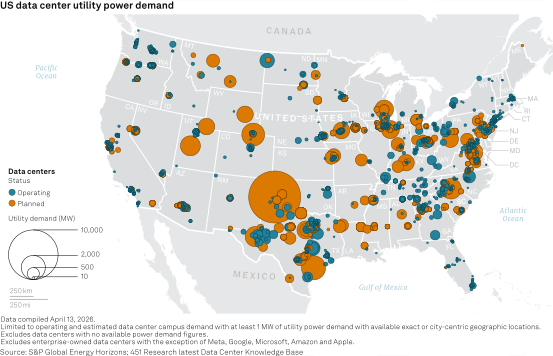
The parallel development of on-site generation and midstream infrastructure has been particularly pronounced in the West, according to CERA. The Switchgrass lateral connecting Colorado and Wyoming on the Rockies Express Pipeline system, and the Green Chili lateral in New Mexico on the Transwestern Pipeline system, are chief examples, it said.
Southwest Gas said May 5 it now expects to expand its Great Basin Transmission system in northern Nevada by 1 Bcf/d by 2028. Additional shipper interest could support another 1.5-Bcf/d expansion through 2035. Demand pulls include data center development at the Tahoe Reno Industrial Center, Southwest Gas Holdings President and CEO Justin Brown said.
"When you think about the state of Nevada and the things that they've done to attract businesses, I think that's also one of the accelerants for what you're seeing here in terms of just how quickly they permit things," Brown told Platts.
Williams is building a pipeline to supply its on-site generation facility at Meta Platforms Inc.'s Eagle Mountain, Utah, data center. Similar to the Aristotle project in Ohio, Zamarin saw the pipeline serving as an artery for future gas demand in Utah.
Energy Transfer has signed agreements to provide firm gas transportation from its Texas intrastate pipeline system to Nexus Hubbard, a behind-the-meter "AI hyperscale campus" under development in Central Texas, co-CEO Thomas Long said May 5. It will supply initial volumes of 150 MMcf/d from the end of 2026, with certain rights by the transporter to increase capacity upon election, Long said.
One Gas announced May 5 a transportation agreement to supply 20 MMcf/d of gas to an Oklahoma data center for primary power generation. The company will use existing capacity in the area to serve the site and make minor on-site infrastructure investments that will also enhance supply within the area, One Gas told Platts.
The capital-light strategy aligns with the company's approach to pairing large-load demand with rate-regulated investments to benefit and protect core customers while facilitating economic development, One Gas CEO Sid McAnnally told investors.
As MDU Resources Group advances its 353-mile Bakken East gas pipeline project in North Dakota, the company is also weighing the potential to serve data centers, MDU President and CEO Nicole Kivisto said May 7. MDU received expressions of interest totaling 1.4 Bcf/d of capacity during a recent open season. Kivisto said a piece of that demand is coming from power generation to serve potential data centers.
"The theme of data center development is certainly a benefit on both sides of our business, whether that be the utility or the pipeline," Kivisto said.
