LNG, Natural Gas
May 27, 2026
German gas grid operators see 'urgent' need for new storage model

Editor:
HIGHLIGHTS
FNB industry group calls for strategic stocks of 24 TWh
Suppliers should also commit to having minimum fill level
New storage model needed to mitigate 'exogenous' shocks
Germany's gas grid operator group FNB Gas said May 27 that the need to implement a two-part strategic gas storage model was "all the more urgent" given recent geopolitical developments.
FNB -- which represents 12 gas grid operators -- published May 27 its latest security of supply report, and called for a new strategy that combines market mechanisms and regulatory protection.
German gas storage sites are currently filled to just 30.3% of capacity -- well down on previous years -- which has led to calls for Berlin to consider a strategic gas reserve.
"Even with growing LNG capacity, gas storage facilities remain the decisive instrument for securing security of supply against exogenous shocks," FNB Gas said.
"FNB Gas is therefore pushing for the implementation of a combination model that combines a storage-based safety reserve with a supplier obligation," it said.
Under the proposal, Germany in the first instance would have 24 terawatt-hours (2.3 billion cubic meters) of gas kept in stock all year round.
"A defined proportion of the working gas volume is permanently withdrawn from the market and held as a strategic reserve for exogenous shocks -- such as the failure of an import infrastructure," it said.
The second part of the model would require the market to ensure a defined minimum fill level by Feb. 1 each year of 63 TWh, creating market incentives for timely storage.
"Against the backdrop of recent geopolitical developments, implementation seems all the more urgent," it said. "Exogenous shocks also require a strategic reserve that cannot be anticipated by the market."
German capacity
Germany holds the biggest gas storage capacity in the EU with a capacity of some 248 TWh, meaning that a 24 TWh strategic reserve would remove around 10% of that capacity from the market.
The country's storage sites were filled to a peak of only 76.7% of capacity in late September 2025 ahead of the past winter.
Stocks were drawn down to a low of just 20.5% of capacity in mid-February this year, and have been slow to rebuild this spring.
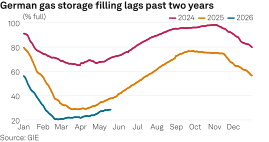
FNB Gas said its proposal would combine a strategic stock with market responsibility.
"With our model, we are sharpening the responsibilities of all market participants for security of supply. The depth of the intervention is limited to the necessary extent," FNB Gas CEO Matthias Jenn said.
FNB Gas said its members believed that the previous storage model based on the summer-winter spread -- buying cheap gas in summer and storing it for use in the expensive winter -- would no longer work "reliably" in the future as an incentive to fill storage.
"They therefore consider a reassessment of the filling process and appropriate precautions to be absolutely necessary," it said.
Winter demand
FNB Gas said storage systems remained "indispensable" as a flexibility tool, with around two-thirds of German gas consumption accounted for during the October-March winter period.
It said some 175 TWh of working gas volume is required for seasonal needs.
"The past winter demand peak was around 6 TWh per day. At the same time, imports to Germany could contribute a maximum of around 3 TWh per day under realistic grid conditions," it said.
The group said that at peak times therefore, more than 50% of Germany's gas supply was covered by gas storage facilities.
"If you want security of supply in the future, there is no way around a new storage system," Jenn said.
The German government has downplayed the risk of low storage on the country's supply security, however.
A spokesperson for the German economy and energy ministry said May 22 that the marketing of gas storage capacity ahead of the next winter had already proven to be "more successful" than last year,
"Significant injections into storage usually take place from June onwards. For many storage facilities, it is even sufficient for injections to begin as late as September," the spokesperson said.
"Gas supply is secure," the spokesperson said, adding that this had been confirmed by the German energy regulator.
Gas availability
The regulator said May 22 that while German gas storage facilities were an important component of the supply chain, they are "by no means" the only relevant factor.
"Germany has sufficient import and storage capacity. Currently, there is enough gas available on the global market, and sufficient import options exist," it said.
"Gas supplies in Germany are stable, security of supply is guaranteed," it said, adding that it assessed the risk of a gas supply shortage as low.
However, it said that given the continued high prices, it remained advisable for residential customers to use gas "sparingly."
European gas prices rose sharply after the US and Israel began their attacks against Iran on Feb. 28.
Platts, part of S&P Global Energy, assessed the TTF front-month price at a recent peak of Eur61.94/MWh on March 19, compared with an assessment of Eur31.40/MWh on Feb. 27. The price was assessed at Eur47.28/MWh May 26.
The regulator said that it was closely monitoring developments in the Middle East, but that LNG from the Persian Gulf did not play a significant role in German supply, as most of its LNG comes from the US.
However, storage industry group INES said May 12 in its latest market report that Germany could face a gas shortfall of about 20 TWh (1.9 Bcm) this winter amid limited storage filling if cold temperatures materialize.
INES said that while it is technically feasible for Germany to fill storage to the current 76% level marketed by Nov. 1, there are "significant uncertainties" looking ahead to the winter.
