Metals & Mining Theme, Non-Ferrous
December 18, 2025
COMMODITIES 2026: CBAM, supply challenges, geopolitics shape EU aluminum outlook
By Sophie Dyas and Tom Bennetts
HIGHLIGHTS
CBAM uproots market norms, prompting tactical buying
Supply challenges from Mozal, Nordural outages tighten market
US/Canada trade flows, arbitrage impact EU premiums
This is part of the COMMODITIES 2026 series where our reporters bring to you key themes that will drive commodities markets in 2026.
The European P1020 aluminum market enters 2026 amid a sense of trepidation, as regulatory changes upend long-standing norms in the market.
Platts, part of S&P Global Energy, assessed the European duty-paid P1020 premium to London Metal Exchange cash at $330/mt IW Rotterdam on Dec.17, reflecting a 9.4% decrease year over year at the midpoint.
The duty-unpaid premium was assessed at $280/mt IW Rotterdam, showing a 10% decrease year over year.
US/Europe arbitrage competition
Uncertainty was the watchword across 2025 as underlying supply and demand fundamentals gave way to a headline-driven market.
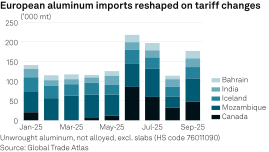
US President Donald Trump's global tariffs on steel and aluminum rerouted major trade flows and saw large volumes of Canadian metal diverted into the European market across the summer period.
Canadian flows bolstered the European market and provided support, given the lean market conditions and low stock levels.
However, with US stocks now at critical levels and the Midwest premium at record highs, the arbitrage opportunity has shifted, and Canadian metal is now flowing back into the US.
Beyond this, multiple sources have noted that the metal currently held in Rotterdam could potentially make its way back west to Canada.
"From an arbitrage position, it makes sense. European premiums are weakening into the first quarter on the CME," one trader said.
"We do not rule out the potential for Canadian flows to continue at a higher-than-usual rate, but perhaps not to the same degree as this year, and we understand that some Canadian metal in Rotterdam could be shipped back to the US," said Karen Norton, associate director for aluminum at S&P Global Energy CERA.
"Our own assumption is that Canada will secure a lower tariff from the US for its exports, and while it is unlikely to be immediate, we would expect more Canadian metal to then be shipped to its close neighbor than this year," Norton added.
As we enter 2026, European sources are closely monitoring US-Canada trade relations and the prospect of any change to current tariffs.
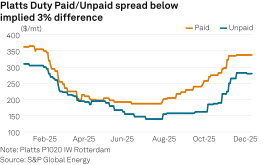
Tight spreads between duty-paid and unpaid metal persisted across 2025, making duty-unpaid metal less attractive in the market.
This has meant that the difference between the two markets is below the theoretical 3% duty difference.
Shifting trade flows, including the possible cessation of Canadian flows into Europe, may reignite the duty-unpaid market as market participants seek alternative supply.
However, demand is expected to remain lackluster into the New Year.
"We do not anticipate a major improvement in European demand next year, but there is considerable optimism in the market at present, more broadly for a boost to consumption from the rapidly growing AI sector," Norton said.
"While we do expect this to have a positive influence on demand, we believe this is being somewhat overplayed and meanwhile some other key end-use sectors in major economies may not perform especially well. We expect this to leave global consumption growing by a respectable, but only slightly stronger 2.1% in 2026," she continued.
CBAM uproots market norms
The EUs Carbon Border Adjustment Mechanism enters its definitive phase in 2026, representing the largest regulatory shift to the aluminum industry in recent years.
Market participants commented on tactical buying behavior across the fourth quarter of 2026, with traders and consumers looking to import metal ahead of CBAM measures coming into effect.
As such, some sources say they expect first-quarter demand to largely be filled by metal already customs cleared.
"I think everybody is sitting on a huge amount of metal, and you can sell without paying CBAM as it's already cleared," a second trader said.
"I expect things to be clearer in March when dynamics consolidate a bit more," he added.
A third trader agreed that he expects a lag in the market reaction to CBAM, and that he only expects the CBAM effect to be realized when market participants seek replacement units.
Supply woes
The P1020 aluminum market is expected to face significant supply challenges heading into 2026, primarily driven by cuts at two major smelters: South32's Mozal Alcantara in Mozambique and Century Aluminum's Norðurál Grundartangi in Iceland.
Mozal will be placed on care and maintenance from March 2026, after South32 failed to secure a new electricity supply agreement with Hidroeléctrica de Cahora Bassa and South African utility Eskom, the mining company said Dec. 16.
The outage comes as a big blow to the European market, with one trader describing Mozal as a "blanket metal" that was attractive to both traders and consumers due to the duty-free status and low-carbon qualities.
In the year-to-date period, Mozambique's aluminum exports stood at 353,030 mt, with the complete volume registered to Mozal, according to S&P Global Commodities at Sea data Dec. 16.
For the year-to-date period, the Netherlands stood as the top export destination with a net volume of 172,058 mt, followed by 55,864 mt going to Spain, 43,507 mt to the US, and 24,244 mt to Greece.
Meanwhile, on Oct. 21, Century Aluminum announced its Norðurál Grundartangi smelter had temporarily halted production on one of two potlines, potentially impacting two-thirds of the plant's 300,000 mt production capacity.
Century Aluminum expects that the outage will last 11-12 months.
"The Norðurál and Mozal stories are putting everyone on edge... [It] does look like supply is going to be a bit tight," one of the traders said.
As two sources of low-carbon metal, the outages have put particular pressure on low-carbon premiums.
Platts assessed both the daily low-carbon aluminum duty-paid premium and the low-carbon duty-unpaid premium at $10/mt Dec. 17, up $5/mt from before the Norðurál outage.
Related content: The potential proliferation of CBAM: a fragmented carbon tariff landscape

Editor: