Metals & Mining Theme, Non-Ferrous
December 15, 2025
INTERVIEW: LME's sustainability focus with green premiums plans, CBAM and LMEpassport
By Sophie Dyas and Shivani Singh
HIGHLIGHTS
LME to launch sustainable premiums across four base metals
Premiums consider carbon emissions, broader sustainability
The London Metal Exchange is looking to launch sustainable premium pricing across four of its base metal offerings, responding to growing demand for transparency and robust environmental assurances, Georgina Hallett, the LME's chief sustainability officer, said in an interview with Platts, part of S&P Global Energy.
The sustainable premiums will shift away from a carbon-only focus, adopting a more holistic approach that also considers factors such as sustainable sourcing.
"The feedback we got from the market was increasingly that consumers are becoming more sophisticated and recognize that sustainability is not just about carbon," Hallett said.
"You have to have the broad range of sustainability assurances as well as the carbon number."
When asked if the LME will introduce sustainability premium contracts on the exchange, Hallett said it depends on the availability of sufficient underlying liquidity for these premiums.
"The proposed hybrid methodology is a potential feeder for exchange-traded contracts, but only if they have the liquidity that would support that", Hallett said.
LME sustainable premiums
The LME has established carbon emissions thresholds on a cradle-to-gate basis across its sustainable premium offerings: aluminum at 10 mt/CO2e, copper at 5 mt/CO2e, nickel at 20 mt/CO2e and zinc at 3.5 mt/CO2e.
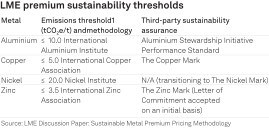
"We want that number to represent sustainable metal, but it cannot be such a gold standard that only a handful of producers can take part, which would mean there isn't enough underlying liquidity," Hallett said.
"We're conscious that 10 mt/C02e [for aluminum] isn't the vanguard of sustainability practice for aluminum, but hopefully it represents the right balance."
Only LME-listed brands are eligible to participate, and all relevant information must be disclosed on LMEpassport, including emissions data and corresponding internal audits. The audits verify data based on the specified emissions methodology for each metal (International Aluminium Institute, International Copper Association and Nickel Institute).
Participants must also comply with a third-party sustainability assurance provider.
The actual sustainability metal premium price will be derived from verified transactions through a partnership with digital platform Metalshub, alongside market data such as bids and offers.
Price data will be reported to Commodity Pricing and Analysis Limited, a new subsidiary of Hong Kong Exchanges and Clearing Limited (HKEX), established in Dubai. Final prices will be published through CPAL on a monthly basis.
The discussion paper was open for feedback until Nov. 28, with responses helping to shape the final methodology that CPAL will implement and maintain.
The exchange may consider expanding this initiative to other metals such as lead and cobalt if there is demand for such premiums, Hallett said. Lead recycling and responsible sourcing for cobalt are important factors to consider, she said.
Hallett emphasized that the premiums are merely a tool for price discovery, not a benchmark for set sustainability premiums.
"It's not our job as the LME to say there should be a sustainability premium or not, but we are the infrastructure provider," Hallett said. "So, it's appropriate that people say to us, you need to provide that route through which the answer can be discovered more scientifically."
It remains unclear how differing regional dynamics will affect overall green premiums.
Platts offers a separate low-carbon aluminum premium (defined as Scope 1-2 up to 4 mt/CO2e) for each of its regional assessments: US low carbon premium, LCAP duty paid in-warehouse Rotterdam and Japan Low Carbon Aluminum Premium.
Each premium varies in response to the distinct supply and demand fundamentals of each market.
Platts assessed the low-carbon premium for the US, European and Asian markets at $0/mt, $10/mt and $58/mt, respectively, Dec. 12, highlighting the huge variance between the regional markets.
It is unclear how the LME will account for this in the overall green premium; however, Hallett acknowledged that it will be a factor to consider in pricing.
CBAM
The Carbon Border Adjustment Mechanism is set to enter its definitive phase in 2026, and the LME has been working to prepare itself and the industry for this significant regulatory change.
The LME has incorporated CBAM requirements into its aluminum LME rules, which involve emissions reporting in LMEpassport.
The LME is following the European Commission's rules on CBAM, which means there is currently no requirement for that data to be audited in 2026. Small changes in Scope 1 data can lead to a large variance in CBAM costs, prompting customers to seek assurance over the accuracy of data.
"Most of the disclosures on [LME] Passport require that a third-party audit is uploaded with it," Hallett said. "There are a couple of self-assessments, but they are clearly marked. As soon as the [CBAM] regulation moves to require auditing, so will our rules."
"LME producers sign a letter of undertaking with us so that if any consumer ever has or indeed if the LME ever has any questions about the underlying metal, we have the right of recourse with the producer to ask questions, and we can do further testing if required."
In its current form, only the LME, the owner of the metal, and the warehouse can see the emissions data on LMEpassport.
There is currently no plan to make that data publicly available, but Hallett hopes that over time, the industry will become more comfortable with transparency in emissions reporting.

Editor: