Metals & Mining Theme, Non-Ferrous
December 11, 2025
Rio Tinto's lithium strategy reflects challenges for broader industry growth

HIGHLIGHTS
Rio Tinto aims for low-cost lithium production
Uncertainty looms amid strong lithium demand growth
The costs outlined in Rio Tinto Group's ambitious strategy highlight some optimistic but sobering realities for the lithium industry, experts said.
Rio Tinto said Dec. 4 that it will streamline its group operations into three business lines: iron ore, copper, and aluminum and lithium. The demand growth for aluminum and lithium requires "rapid supply expansion" to meet demand, Vivek Tulpule, head of economics, told a same-day London briefing.
With its $6.7 billion acquisition of integrated producer Arcadium Lithium, which closed in March, Rio Tinto secured the world's third-largest lithium reserves and resources globally. The company now has "world-class options to grow at the bottom of the cost curve," CEO Simon Trott told the Dec. 4 briefing.
Rio Tinto plans to deliver four "in-flight projects" to increase its lithium production capacity to 200,000 metric tons/year of lithium carbonate equivalent by 2028 from 75,000 mt/y at a 50% EBITDA margin. To do this, it will spend $1 billion annually for the next three years on growth in Canada and Argentina, said new aluminum and lithium CEO Jerome Pecresse.
The four projects include the 32,000 mt/y Becancour hydroxide facility in Quebec. The rest are in Argentina -- the 15,000 mt/y Sal de Vida lithium carbonate project, and two 30,000 mt/y trains of lithium carbonate using direct lithium extraction and the 10,000 mt/y Fenix 1B project at Rincon.
The projects will boost Rio Tinto's lithium production by 2.5 times by 2028, with an average capital intensity of $65/kg, and reduce C1 operating costs to $5-$8/kg across the brine assets. Rio Tinto aims to "get costs down to create the most profitable lithium production cluster in the world" by leveraging infrastructure in Argentina, Pecresse said.
Cost escalation
The capex numbers from Rio Tinto's four existing construction and commissioning stage lithium projects are "quite sobering," Christopher Williams, lithium analyst at Toronto-based Adamas Intelligence, said in a Dec. 10 LinkedIn post.
Williams showed analysis benchmarking Rio Tinto's in-development projects to some peers, which suggested that "at present, the incentive price of the entire industry is going up year by year," the analyst said.
While this assessment is "not at all a swipe at the projects themselves, they are world class," and Williams said Rio Tinto's cost estimates are merely a "high-quality print" of capex budgets on the ground in Argentina and Canada.
Simon Hay, the executive chairman of Leo Lithium Ltd., said Sal de Vida's C1 costs have doubled since it was with Galaxy Resources Ltd., where he was CEO until it merged with Orocobre Ltd. in 2021 to become Allkem Ltd., which then merged with Livent Corp. to form Arcadium in 2023.
This is not Rio Tinto's fault, Hay added, as caustic reagent costs have risen substantially along with energy costs and inflation in Argentina.
Rio Tinto's $660 million capex for Sal de Vida "does just make the returns very difficult, especially when they're talking C1 costs of $6-$7 [/kg of LCE]," Hay said.
"That being said ... Sal de Vida is high grade and chemically very clean brine, and they're going to be there for 40 years, so will extract the value. If you're spending that sort of money on a mediocre asset, I think you're in a bit of trouble," Hay said.
Rincon, however, is "nowhere near the quality of Sal de Vida," so "the DLE just has to work. The DLE at Fenix has worked for 30 years. If they can deploy that elsewhere in their brine assets, I think they'll have a huge advantage over others," Hay said.
Rio Tinto declined to comment for this story.
At Fenix, Rio Tinto also sees DLE reducing overall cycle time from brine to final carbonate to one-two days from two-three months.
"The benefits of reducing overall cycle time of brine to final carbonate from months to a few days has 100s of millions in working cap benefit," Citi analysts said in a Dec. 8 note, after attending a "deep dive" into Rio Tinto's lithium plans in a same day briefing in Argentina.
Uncertainty ahead amid strong demand
Rio Tinto expects a 15% internal rate of return on its brine projects, which Trott said was based on consensus forecasts, though "demand in general ... has tracked in line or probably slightly better than our projections, particularly on grid storage."
Stationary energy storage has already overtaken electric vehicles as the fastest-growing source of lithium demand with "broad-based expansion in all parts of the world," Tulpule said. This has created "an underappreciated source of demand" in supply chain stocks.
"Ongoing industry growth requires very well-stocked inventories throughout the supply chain," Tulpule said, while also warning of "uncertainty around the evolution of market balances over time."
Citi's analysts said that "overall, the market conditions are tough in lithium ... Rio Tinto is developing a sizable footprint at the lower end of the cost curve with the option to quickly develop assets if the market improves."
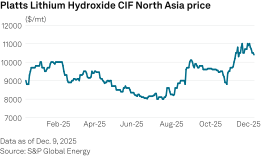
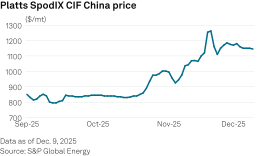
The Platts-assessed Lithium Hydroxide CIF North Asia price was up 4% year-to-date at $10,400/metric ton Dec. 10 and up from $8,800/mt a year prior. Platts, part of S&P Global Energy, assessed SpodIX CIF China at $1,200/mt Dec. 10, up 41.2% from Sept. 1 when it was launched.

Editor: